What does ISO 27001 A.8.26 require for application security?
ISO 27001 A.8.26 addresses security requirements for applications, including software an organization builds and software it buys. Decide what protection the application needs before accepting it. Use those requirements to assess the implementation, retain the test results, and revisit the requirements as its use changes.
A security review describes an application at a particular point in its life. Later releases can add information, users and operations that the review did not cover. The requirements need to follow those changes if acceptance decisions are to remain useful.
Application scope
An application's security requirements cover both the information it handles and the actions it permits. The review includes people using the application and services exchanging data with it. A protection may need to apply across several routes into the same information.
An inventory helps identify those routes. The next question is what each route allows: reading a record, changing it or sending it elsewhere. When an application gains a new operation, the requirements need to account for what that operation can do to the information.
Security decisions
Security requirements reflect what a failure would expose, alter or interrupt. Authentication and permissions address who can act; input handling and integrity protections address what happens to information. The application's business use determines which conditions need to be specified for those protections.
Application and security owners agree those conditions before accepting the implementation. They decide which actions are permitted on the information involved. That gives engineers a basis for design choices and gives reviewers a way to identify a departure that needs an exception decision.
Testable requirements
A security requirement is useful to testers when it gives them a result to check. They need to know which action is allowed, under what circumstances, and what should happen otherwise. An instruction to protect data leaves these decisions open.
The OWASP Application Security Verification Standard offers a reference for selecting checks for web applications and services. Its requirements can inform the technical tests used for acceptance. Keeping the version and identifiers with the tests lets another reviewer find the same reference later.
Purchased applications
Purchased applications need security requirements for the way the organization will use them. Those requirements inform product selection, configuration and acceptance. A supplier's description of an available protection leaves a separate question: whether the selected service and configuration provide it for the intended use.
The acceptance evidence should address that use, including relevant interfaces and account roles. Some conditions can be checked directly; others depend on evidence from the supplier. Where a condition cannot be established, the owner needs a clear decision about the unresolved risk before accepting the application.
Release acceptance
Release acceptance connects each agreed requirement to evidence from the version being delivered. A reviewer should be able to follow the requirement to its design or configuration and then to the result that supports acceptance. A failed test identifies the condition that still needs work.
Record the tested version, relevant conditions and decision alongside the result. If the release proceeds with an exception, retain the reason and approval with it. A later reviewer can then distinguish an accepted exception from a requirement that was missed during delivery.
Requirements after changes
Requirements can become incomplete even when an application continues to pass its existing tests. A release may add an interface or extend an account role without a corresponding security decision. Reviewing the changed behavior against the requirements can reveal the missing condition.
An AI feature introduces the same question about what it may access or do. The OWASP LLM Top 10 guide discusses relevant risks. Owners need an agreed limit on the feature's behavior and acceptance evidence showing how the application enforces that limit.
Missing requirements
A missing requirement calls for a decision about allowed behavior. If two reviewers disagree over whether an action is permitted, running the test again will leave the disagreement unresolved. Application and security owners must settle the rule for the use under review.
Once agreed, the rule can become a requirement with a test and an expected result. Engineers have something specific to implement or correct. Reviewers can compare the result with the decision, including any conditions that limit when the behavior is permitted.
Failed protections
A failed protection needs a correction that can be checked against the agreed requirement. ZeroTB reads the commitment and compares it with the connected system. It drafts a fix for people to approve, then carries out the approved action within scoped permissions.
The result is checked again before closure. A Verified Control Record keeps the requirement, before-and-after state, action, approval and verification together. When the check fails or cannot establish the result, the gap stays open so the team can investigate what remains unresolved.
Continuing checks
The requirement determines which checks can continue automatically and which decisions need review. A repeatable test can detect that an agreed protection has failed. Deciding whether a new data flow needs additional protection requires someone to examine the changed use and its risks.
Assign an owner to unresolved results. A defect can go to engineering; an unclear requirement needs a decision from the application owner. When the check cannot obtain current observations, its state should remain unknown until evidence is available to assess it.
Evidence boundaries
A test establishes what happened under the conditions used to run it. The application version, configuration and date are part of that evidence. When a later release changes the relevant behavior, the earlier result may no longer support an acceptance decision.
The connection to the requirement explains what the result means. Keeping it beside the acceptance decision saves a reviewer from reconstructing the change across separate tickets. The task records the work performed, and the test records whether that work produced the agreed behavior.
Application security evidence
A reviewer can use these records to connect the application requirement, acceptance decision and observed behavior.
| Requirement | What an auditor asks for | Where it comes from |
|---|---|---|
| Defined scope | The uses, interfaces and information included in the review | Approved requirements with the application inventory and data flows |
| Acceptance conditions | The expected result, test conditions and recorded outcome | Dated test results linked to the requirement and design |
| Controlled changes | The behavior changed by a release and the decision to accept it | Release records naming the tested version and affected requirements |
| Accepted exceptions | The reason an unresolved condition was accepted and its review conditions | The exception decision and approval for that application release |
| Verified restoration | The failed condition and evidence of a successful correction | The verification record, including approval and before-and-after observations |
Related controls
| Framework | Control | What it covers |
|---|---|---|
| ISO 27001 | A.8.26 | Defining the security conditions for an application being developed or acquired |
| SOC 2 | CC8.1 | Managing changes to systems and software through controlled review, testing and approval |
| HIPAA | 164.312(c)(1) | Protecting electronic protected health information against improper alteration or destruction |
Example of restoring import validation
In this example, an application release changes an import and allows incomplete records to be stored. The existing requirement says records without an identifier must be rejected. Restoring the check requires a correction, approval and tests of both incomplete and valid input.
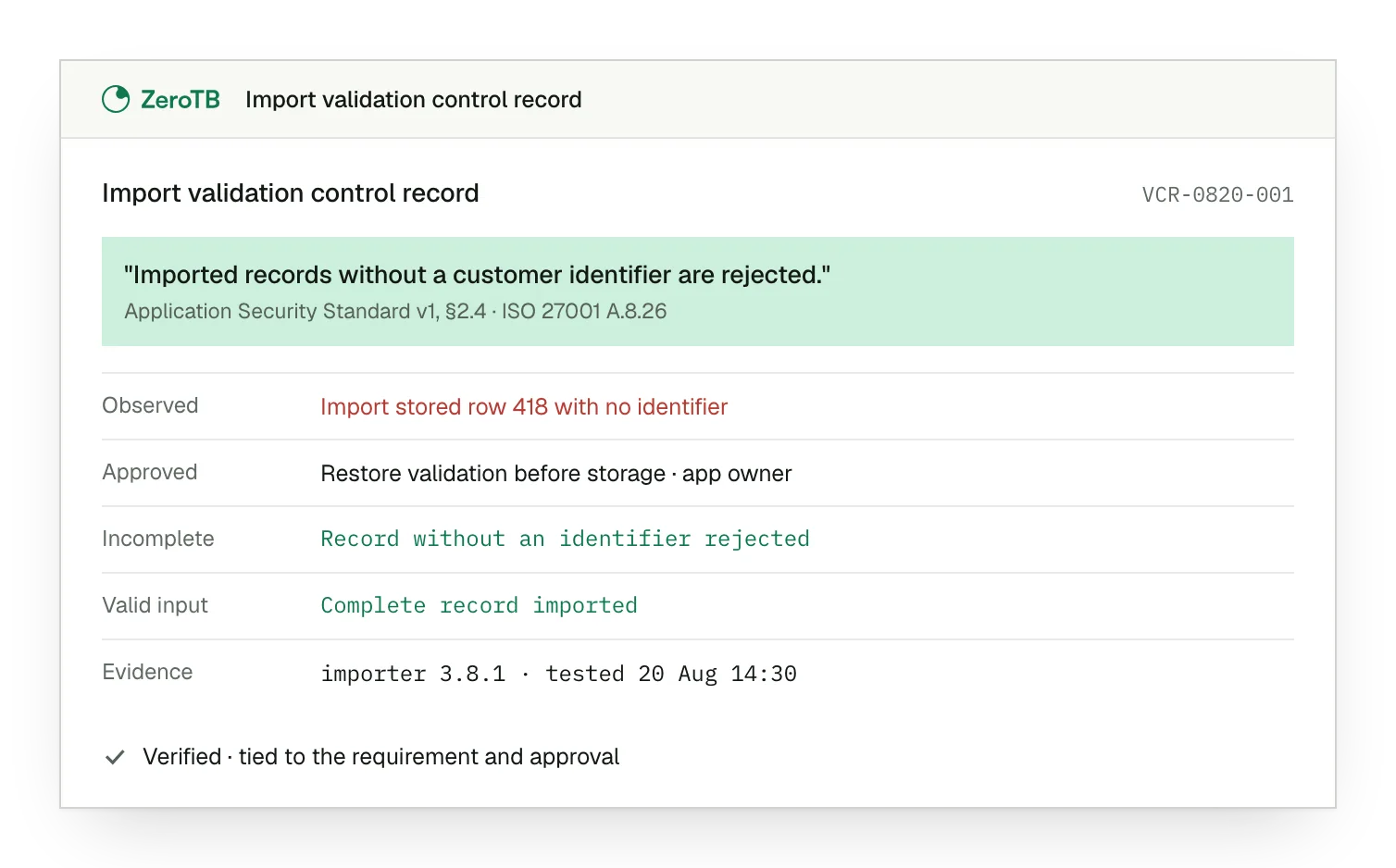
Observed failure. The import accepts a record whose required identifier is missing, contrary to the agreed condition.
Approved correction. The application owner approves restoring the validation that must run before a record is stored.
Verified behavior. Tests confirm rejection of the incomplete record and successful import of a record with valid input.
Recorded result. Dated evidence identifies the tested version alongside the requirement and the approval for the change.
Application requirements checklist
Identify features, interfaces or data flows introduced since the requirements were agreed, and check whether their security conditions are defined.
Select a requirement and inspect whether its test specifies the expected behavior, relevant circumstances and evidence needed for acceptance.
Establish whether the issue needs an owner to decide the requirement or an engineer to correct failed enforcement.
Trace a completed correction to its approval, tested version and results for both rejected behavior and permitted use.
Check who receives failed or unavailable checks and who decides when a changed application needs its requirements reviewed.
Sources
- ISO/IEC, ISO/IEC 27002:2022 overview, 2022.
- OWASP, Application Security Verification Standard, version 5.0.0, 2025.
- AICPA & CIMA, 2017 Trust Services Criteria with revised points of focus, 2022 revision.
- eCFR, 45 CFR 164.312 technical safeguards, accessed November 4, 2026.
Related pages
Technological controls
Read the neighboring control guides for applications, development work and the systems they depend on.
ISO 27001
Find the framework overview and see where application requirements belong in the wider program.
Compliance frameworks
Explore the requirements that different frameworks place on the controls operating across the organization.
Start with the Pilot
Our team can talk through application requirements and recurring gaps with you. The eight-week Pilot maps up to 25 commitments from your report and takes two real control gaps through verified restoration, retaining evidence of the approved work and its result.