What does ISO 27001 A.8.8 require for technical vulnerability management?
ISO 27001 A.8.8 addresses finding technical vulnerabilities, assessing exposure and taking appropriate action. Effective vulnerability management connects each relevant finding to affected systems, an owner and a treatment decision. Verify the deployed result before closing the finding, and retain the evidence that explains what changed and why the treatment was accepted.
A vulnerability can appear in successive scans while its repair waits for a release. The security team sees the finding; engineering sees a ticket. Connecting both to the affected service, an agreed treatment and a closure test gives both teams a defined repair to complete within the ISO 27001 program.
Control scope
A.8.8 connects information about technical vulnerabilities to decisions about the systems the organization uses. The scope needs enough detail to locate affected software and identify who can authorize its treatment. An asset list that omits deployed versions forces the reviewer to find those versions before treatment can begin.
The approved control should explain how findings reach an owner, how treatment decisions are made and what establishes completion. Those decisions give security and engineering a common basis for reviewing progress. They also let a later reviewer compare the organization's stated process with the work performed.
Vulnerability scanning coverage
Vulnerability scanning needs to reach the assets covered by the control. Compare the scan's target list with the current inventory, including systems added since the last review. A result without findings has a different meaning when a service was excluded, unreachable or checked with insufficient access.
Record those coverage gaps alongside the findings so they remain visible during treatment review. The next action may be to restore access for the scanner or inspect an asset through another suitable method. Until that observation exists, the team cannot determine whether the asset needs treatment.
Finding assessment
A reported vulnerability needs an assessment of the affected software and its exposure. Confirm the installed version, the deployment where it runs and the conditions that make the weakness relevant. This connects a scanner's finding to a service the responsible owner can investigate and change.
Keep that assessment with the finding when deciding how to respond. If the reported weakness does not apply, explain the basis for that conclusion and retain the supporting observation. If it does apply, the record should identify affected assets so the eventual correction can be checked against the same scope.
Treatment priorities
Treatment priorities need to reflect the risk of leaving each affected service exposed. A severity rating helps the assessment, but the owner also needs the service's exposure and operational context. That context explains why a finding requires urgent action or can follow an agreed maintenance schedule.
Record the chosen deadline and the person responsible for the decision. When work passes that deadline, the unresolved exposure needs another decision and an escalation route. The review should explain who authorized the delay, what protection remains and when the owner will reconsider the treatment.
Patch management
Patch management has to protect the service while correcting its software. Testing should establish whether the proposed version corrects the weakness and preserves required operation. The owner reviews those results and the recovery plan before authorizing the production change.
NIST includes verification in its patch management guidance. An ISO 27001 patch management record should therefore reach beyond the approval and installation report. It needs a check of the target assets after deployment, with enough detail to establish which systems received the update and which still need attention.
Temporary safeguards
An unavailable patch leaves the owner with a treatment decision to make. Restricting access to the affected service or disabling its vulnerable function may reduce exposure until patching is possible. The choice depends on the weakness and the operation the service must preserve.
A temporary measure needs its own test. If the decision is to restrict access, the check must establish whether that restriction holds. Keep the permanent correction assigned and record when the temporary protection will be reviewed, so the reduced exposure does not obscure the remaining vulnerability.
Treatment exceptions
An exception needs a decision about the remaining risk and a condition for reviewing it. The record should explain why the normal treatment cannot proceed, who accepted that position and which assets it covers. An approval without those details leaves its purpose unclear at the next review.
Keep accepted risk distinguishable from a correction that has been verified. Both can have a documented decision, but they describe different system conditions. Revisit an exception when its stated conditions change, such as the availability of a suitable patch or a change in the service's exposure.
Deployed verification
Verification must establish the result on the affected assets after the change. A merged patch or completed deployment job can leave an instance running the vulnerable version. Compare the resulting state with the treatment's expected outcome, using a rescan or another check suited to the weakness.
Record the assets checked, the time and the result, including any failures or missing observations. Check relevant service behavior as well as the security correction. If part of the deployment remains unresolved, keep that part open so the overall status does not hide an asset that still needs treatment.
Repairs after later changes
An earlier verification describes the deployment that was checked at that time. A later release may reintroduce the vulnerable version, so subsequent checks need to examine the current deployment and reach an owner. Changes made by coding agents belong in that review alongside other software changes.
ZeroTB keeps the commitment, action, approval and before-and-after observations in a Verified Control Record after checking an approved correction. When a finding returns, that history helps establish whether the repair failed or a later change restored the vulnerable state. The next investigation starts from a dated result.
Vulnerability treatment evidence
An auditor can use these records to trace what happened to a finding and inspect the evidence behind its status.
| Requirement | What an auditor asks for | Where it comes from |
|---|---|---|
| Discovery coverage | The checked systems and any gaps in observation | Asset inventory, scanner target lists and dated scan results |
| Finding assessment | The reason for treating the finding and its deadline | Finding records linked to deployed assets and the owner's risk decision |
| Authorized treatment | The owner decision, affected assets and expected result | Change record, approval, test results and deployment logs |
| Controlled exceptions | The decision to accept risk and its review conditions | Approved exception records and checks of any temporary protection |
| Verified outcome | Results for each affected asset, including unresolved observations | Rescans or other suitable observations linked to the original finding |
Related framework requirements
| Framework | Control | What it covers |
|---|---|---|
| ISO 27001 | A.8.8 | Technical weaknesses affecting systems in use, the resulting exposure and the response chosen to address it |
| SOC 2 | CC7.1 | Detection of new vulnerabilities and configuration changes that could leave systems vulnerable |
| HIPAA | 164.308(a)(1) | Security management, including the analysis and management of risks to electronic protected health information |
Example of verifying a deployed patch
This example follows an update across two production instances. One receives the patch; the other continues to run the affected package. The verification records both results, leaving the repair open until the second instance has been updated and checked again.
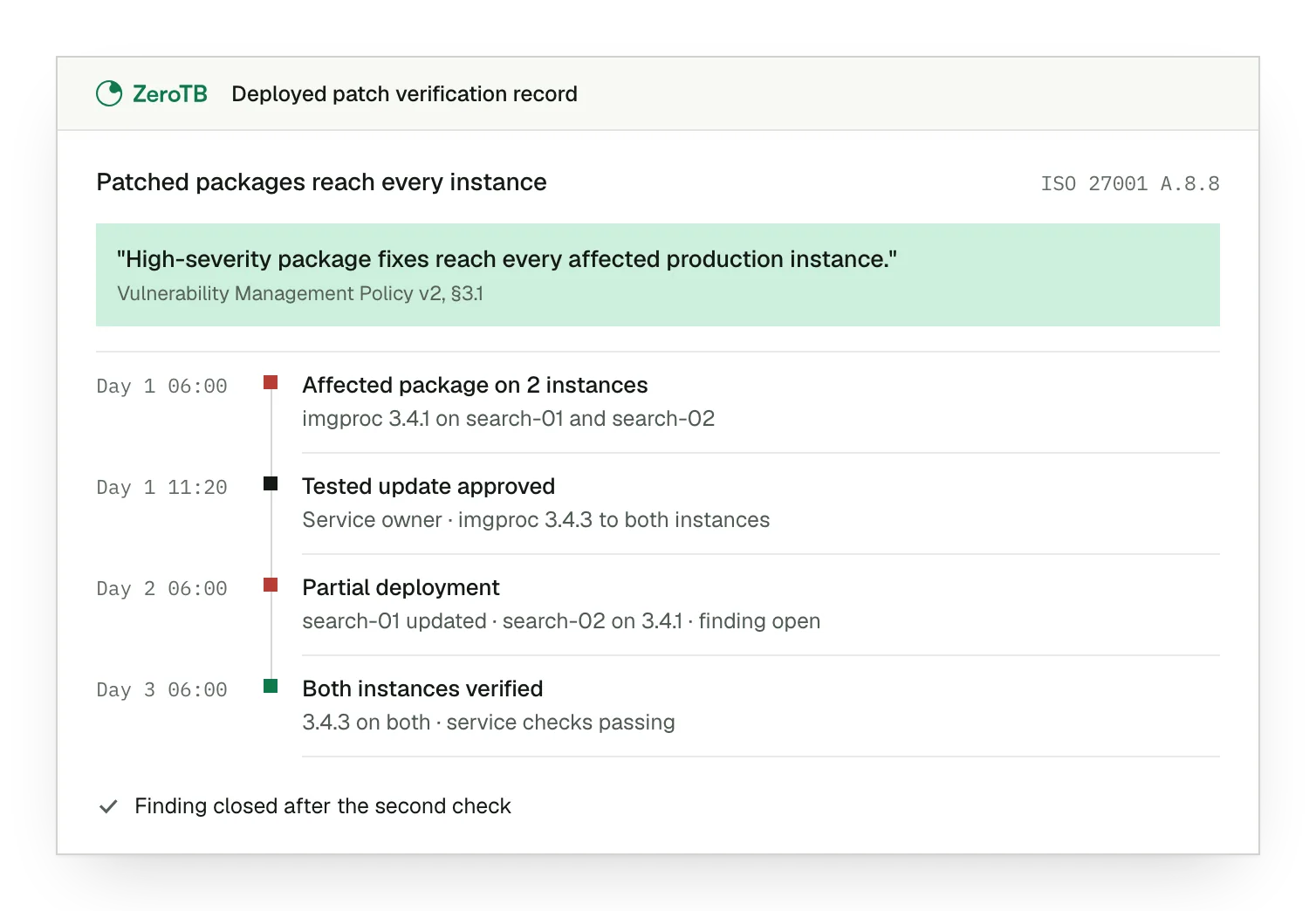
Affected service. The affected package is present on both instances when the service is first checked.
Approved update. Test results support the update, and the owner authorizes its deployment across both instances.
Partial deployment. The deployment updates one instance, leaving the other exposed and the finding open for treatment.
Verified treatment. After the second instance is updated, checks confirm both the correction and required service behavior.
Vulnerability treatment checklist
Compare the inventory with the scan targets and investigate any asset without a current observation.
Read the finding assessment alongside its owner decision, proposed treatment and the deadline for completing that work.
Trace the change approval to the affected assets and the result the owner expects after deployment.
Look for a dated check on every affected asset, keeping failed checks and missing results visible.
Confirm who investigates a repeated finding and when any retained exception is due for review.
Sources
- ISO/IEC, ISO/IEC 27002:2022 overview, 2022.
- NIST, SP 800-40 Rev. 4: Guide to enterprise patch management planning, 2022.
- HHS, Summary of the HIPAA Security Rule, accessed November 4, 2026.
Related pages
Technological controls
Read the other ISO 27001 guides on protecting systems and managing their operation.
ISO 27001
See how individual controls fit within the information security management system and its commitments.
Coding-agent compliance
Explore how controls keep operating as coding agents change software, configurations and development workflows.
Start with the Pilot
The eight-week Pilot maps up to 25 commitments and takes two real control gaps through approved changes and verified restoration. Talk with our team about recurring vulnerability findings and the evidence you need from their treatment.