SOC 2 CC6.7 addresses authorization to move information and protection while it moves, including network transfers and information carried on media. Apply the company’s rules to the people, processes and routes involved. When a route changes, correct the gap and test that permitted transfers work while prohibited ones fail.
A successful export tells you that a file moved. Whether it was allowed to reach that destination is another question. CC6.7 sits within SOC 2 CC6 and covers both the authority to move information and the protections that must remain with it.
Transfer scope
A transfer control needs a defined source, destination and purpose. These details make the policy testable: a reviewer can compare the route in use with the route the company approved. Begin with the information covered by the company's commitments, then identify its movements.
The scope may include a recurring integration, a file export initiated by an employee, or a device carried to another location. Internal movement belongs in the review too. Apply the handling rules for the information to each route, including routes that remain within company systems.
Transfer authorization
Permission to read information does not automatically authorize sending it elsewhere. An employee may need access to customer records while having no approved reason to export them. A service account also needs transfer rights that match the purpose and destination of its assigned job.
Record who can approve a transfer and which people or processes can execute it. Approval for one recipient does not establish approval for another recipient. When the destination changes, the owner needs to assess the new arrangement before existing permissions allow it to continue.
Transmission safeguards
Encryption protects a transfer only along the route where it applies. A service that receives and forwards information creates separate connections to inspect. Review the protection on each connection against the approved rule, including any part of the route beyond the first receiving service.
Destination checks belong with that review. A connection may be protected even when its recipient has no approved reason to receive the file. To establish that the transfer followed the rule, retain observations of where it went and the safeguards applied during its movement.
Devices and removable media
Information can leave an approved system on a device or storage medium. A review limited to network connections can miss that movement. Include these routes when the company permits them, and connect the handling rules to the information and media involved.
The review should establish who may move the media, where it may go and how the information remains protected. Where removable media is prohibited, inspect whether that restriction operates. Where it is permitted, check that the approved safeguards remain in place during the movement.
Changes to transfer routes
A working export can drift from its approved purpose when its destination or permissions change. A new integration may reuse an existing account with broader rights than the new job needs. The export still completes, so a success notification can conceal the control gap.
Compare the configured destination and transfer rights with the approved route after relevant changes. Cloud and infrastructure controls help connect those settings to the systems running the job. The observation should identify the changed transfer so its owner can assess the information at risk.
Approved corrections
A correction should remove the unsafe route while preserving the transfer the business still needs. The data owner decides the permitted purpose and recipient. The system owner can then assess a proposed change against those decisions and the dependencies of the affected job.
A proposed correction should identify the observed gap, the restriction to restore and the expected permitted transfer afterward. Approval belongs with that proposal so the implementer knows which outcome was accepted. If an exception remains necessary, retain its scope, owner and conditions for review.
Verification tests
Verification must show that the approved transfer works and the prohibited transfer fails. Agree on both results before changing the route. A test should use information that is safe to send, since the restriction may still fail when the test first runs.
Then check where the test information arrived and which safeguards protected its movement. Retain the observation time and relevant settings with the result. If the approved transfer fails, the prohibited one succeeds or current observations are unavailable, the gap remains open for further work.
Earlier transfers
Repairing a route leaves a separate question about information already sent through it. The corrected setting shows the present state. Transfer records are needed to investigate the earlier period, including what was sent, which recipient received it and when the route was in use.
Review those findings under the company's data-handling and incident procedures. The information and recipient affect the response, so resolving a configuration gap cannot by itself resolve the history. Record unanswered questions with an owner, and keep that work connected to the correction being verified.
Continuing checks
A restored transfer needs an owner and checks that can detect the next change. The route can change again when a job, account or integration changes. Checking only that the export completes will miss a destination that has moved outside the approved scope.
Define checks against the approved destination, transfer rights and safeguards, with a schedule suited to the commitment. Route failures to someone who can act on the affected system. Missing or stale observations need investigation too, because they leave the team without evidence of the current protection.
Repair records
A useful transfer record connects the rule to the actual route and the result of testing. ZeroTB's Verified Control Record holds the commitment, before-and-after state, action, approval and verification together. From that record, a reviewer can trace the repair and the basis for accepting it.
Transfer evidence
An auditor should be able to follow the transfer from its approved purpose through the settings to the test result.
| Requirement | What an auditor asks for | Where it comes from |
|---|---|---|
| Defined transfer scope | The information, permitted locations and reason for the transfer | Approved policies and records of the routes carrying that information |
| Authorized movement | The accounts or people allowed to send information through the route | Owner decisions, current permissions and any retained exceptions |
| Protected transmission | The protections required for each part of the route | Connection settings checked against those protections, with observation dates |
| Controlled media movement | Allowed media and protections when information moves on it | Handling procedures, approvals and observations of the relevant media or devices |
| Verified correction | The failed condition, owner decision and outcome of each transfer test | The change and dated verification in the Verified Control Record |
Framework coverage
| Framework | Control | What it covers |
|---|---|---|
| SOC 2 | CC6.7 | Permission and protection for information transmitted, moved or removed by people and processes |
| ISO 27001 | A.5.14 | Rules and arrangements for transferring information within the organization and to external parties |
| HIPAA | 164.312(e)(1) | Safeguards against unauthorized access to electronic protected health information during network transmission |
Example of restoring an approved export
An encrypted export can still deliver a file to the wrong destination. Here, a reporting job can reach an external storage location that its owner never approved. Restricting that access must leave the permitted reporting destination available, with protection checked during delivery.
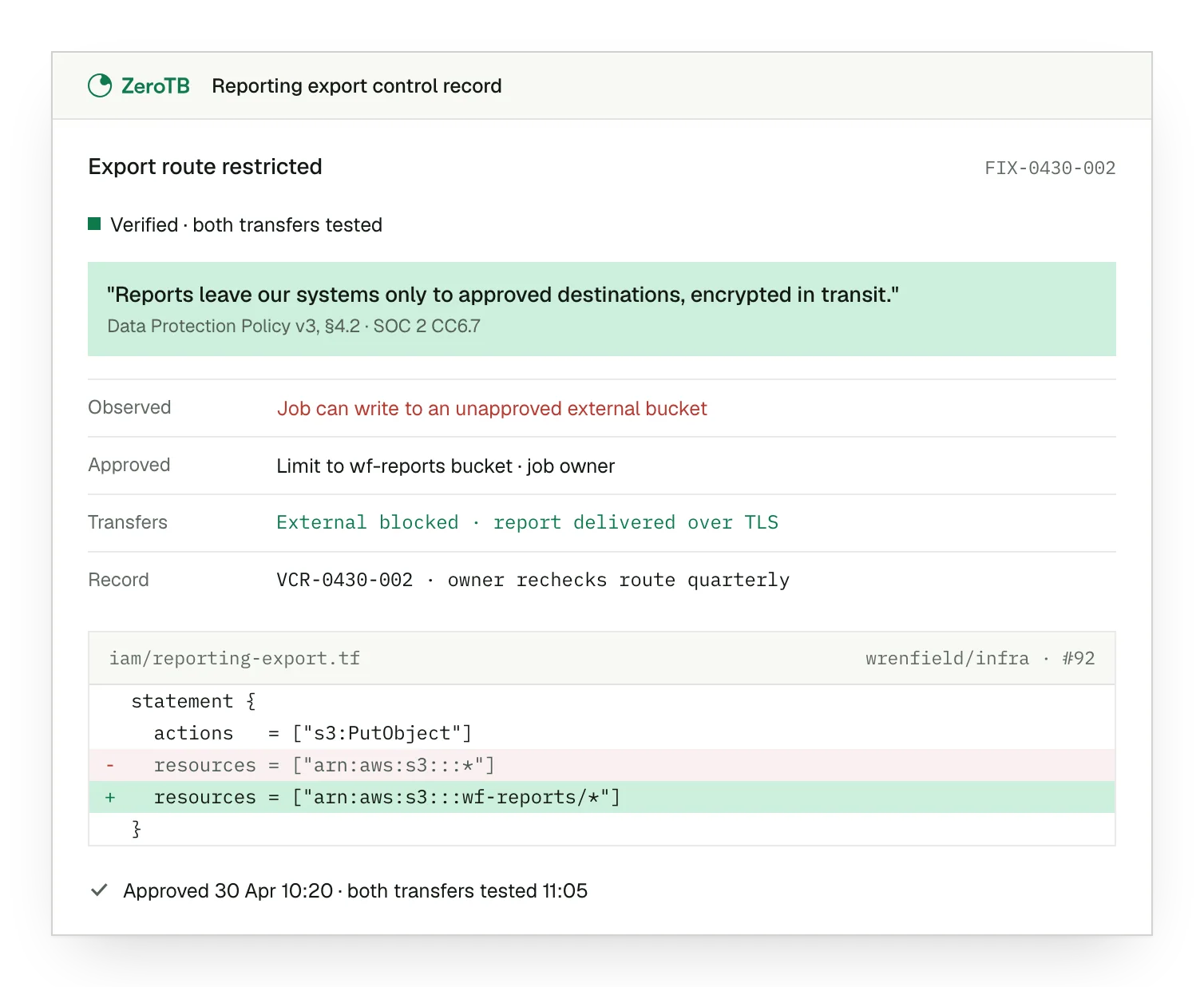
Changed destination. The job can now send reports to an external location beyond its approved destination.
Approved restriction. The owner accepts the proposed restriction after confirming that the original reporting destination remains available.
Transfer tests. Testing blocks the external transfer and confirms protected delivery of a report to the permitted destination.
Recorded result. The record holds dated tests, the approved change and responsibility for checking the route again.
Transfer review checklist
Follow the information from its source to its destination, including services or media along the way.
Establish who may approve the transfer and which people or accounts have permission to execute it.
Check each part of the route against the handling rules that apply to the information.
Test the approved change with safe information, covering both the blocked route and the protected, permitted transfer.
Agree who checks the route after repair and who investigates unresolved questions about earlier transfers.
Sources
- AICPA & CIMA, 2017 Trust Services Criteria with revised points of focus, 2022 revision.
- HHS, HIPAA audit protocol, transmission security, 2018 update.
- ZeroTB, SOC 2 compliance automation with human approval, 2026.
Related pages
SOC 2
See where transfer protections fit among the other criteria covered by a SOC 2 examination.
Frameworks
Browse the control libraries for requirements that apply to the information and systems under review.
Cloud and infrastructure
Read about checking and restoring controls when the configuration of a cloud system changes.
Start with the Pilot
Talk with our team about keeping transfer controls working. In the eight-week Pilot, we map up to 25 commitments and take two real control gaps through approved correction and verified restoration, with a record of the completed work.