SOC 2 CC6.6 addresses system boundary protection against outside threats. Define which connections may enter the system, check that deployed protections enforce those decisions, and correct access that exceeds them. After a correction, test that unwanted connections fail and required connections still work, then retain the results with the approval.
A network exception can remain active long after troubleshooting ends. The incident closes, but the rule still permits connections that the approved boundary should block. This is where CC6 access protections depend on continuing work across security and infrastructure teams.
A useful review follows the connection from the approved requirement to the deployed system. It establishes who can reach the service, why that access exists and what evidence would justify closing a gap.
Boundary scope
CC6.6 concerns protection against threats that originate outside the system boundary. Start with the systems covered by the SOC 2 report and the routes through which outside traffic reaches them. Include public services, remote administration and connections from external networks.
A firewall can support this protection, but its presence alone says little about coverage. The review needs to establish which entry points it governs and which use other protections. Otherwise, a documented rule can remain correct while an overlooked service accepts connections elsewhere.
Permitted connections
A boundary rule is useful when the team can explain which connections it permits and why. The approved purpose should identify the source, destination and service involved. Public access to an application and restricted access to its administration interface serve different purposes.
The system owner decides which of those connections the business needs. That decision gives the reviewer a meaningful comparison with the deployed rules. It also defines the access that must survive a correction, so reducing exposure does not interrupt an approved service.
Effective network rules
A single rule rarely tells the whole story of access to a resource. AWS combines the rules of attached security groups, as its documentation explains. Removing a permission in one group therefore leaves access open if another attached group still allows it.
The review has to cover that combined set of permissions. Follow the source, port and destination through the rules that apply to the affected resource. Then inspect the deployed configuration and test the connection. The edited file alone cannot show whether the unwanted path has closed.
Temporary exceptions
A maintenance task can end while the access opened for it remains in place. The initial approval explains why the rule was added. It does not establish whether the service still needs that access after the work finishes.
An owner and an end condition give the team a way to resolve the exception. When access is still needed, the owner can approve its continued use and safeguards. When its purpose has ended, the rule can be removed through the agreed change process.
Coverage as systems change
Boundary checks need to follow new services and changed connection paths. A check against last month's inventory can miss a newly exposed endpoint. Connecting checks to current cloud and infrastructure scope helps identify services that have no observed protection or assigned owner.
The check also needs a reliable source of current state. An unavailable account or stale configuration export leaves part of the boundary without a current observation. Record which observation is missing and assign an owner to restore coverage before reporting the control as passing.
Approval before restriction
The owner needs to see the effect of a restriction before approving it. Show which connections the proposed rule will block, which it will preserve and which services depend on them. That gives the decision a practical basis beyond removing an alert.
The change record should name the affected environment and the recovery action if necessary access fails. An owner may decide to narrow a source or retain an exception with safeguards. Record that decision with the change so the resulting access can be tested against it.
Tests after the change
Verification must show that unwanted connections fail and required connections still work. Test the deployed system from the relevant source paths, using the expected results agreed for the change. Testing only the permitted route leaves the original exposure unresolved.
Keep the gap open when either result fails or cannot be observed. Save the tested source, destination, service and time beside the resulting configuration. This lets a reviewer understand what the test established and distinguish a successful deployment from an effective boundary restriction.
Review of the exposure period
Closing an exposed route leaves a separate question about what happened while it was open. Establish when the rule changed and inspect available activity records for the affected service. The period of exposure helps security staff decide which events need investigation.
Unexpected activity should enter the organization's security-event review process. Missing logs limit what the review can establish about earlier connections. Keep those limits with the investigation record, while recording the corrected boundary separately, so a successful restriction does not obscure an unresolved security question.
Protection against recurrence
The configuration used by the next deployment needs to contain the approved correction. Otherwise, a manual repair can be overwritten when the environment is rebuilt or updated. This is a particular concern where infrastructure code still contains the permission removed from the running system.
Ownership must continue beyond that repair. An assigned owner can respond when later checks show that access has changed again. Set the check frequency to reflect changes in the system, and retain the results so a new gap has a clear starting point for investigation.
Evidence for boundary controls
Useful evidence connects the approved boundary to the deployed rules, the change decision and the observed result.
| Requirement | What an auditor asks for | Where it comes from |
|---|---|---|
| Defined boundary | Systems in scope, external entry points and the connections approved for each service | System inventory, network diagrams and approved boundary requirements |
| Effective restrictions | The rules protecting each relevant resource and their permitted sources, destinations and services | Dated firewall or cloud rule exports linked to the affected environment |
| Controlled exceptions | The reason for temporary access, its owner and the decision to retain or end it | Exception approvals, incident or maintenance records and review decisions |
| Verified correction | The original exposure, approved change and tests of unwanted and required connections | Change records, deployed configuration and dated connection-test results |
| Continuing operation | Checks after subsequent changes, including failed observations and the response to new gaps | Monitoring history and assigned follow-up work linked to the control |
Framework requirements
| Framework | Control | What it covers |
|---|---|---|
| SOC 2 | CC6.6 | Boundary protections against threats entering the systems covered by the review |
| ISO 27001 | A.8.20 | Security of networks and network devices that carry or provide access to information |
| HIPAA | 164.312(a)(1) | Access to systems holding electronic protected health information by those with authorized rights |
Example of removing an expired exception
An expired troubleshooting exception can leave production administration reachable from the internet. In this example, a TCP port 22 rule remains after maintenance. The correction removes that broad permission while preserving access through the approved administration path, with both outcomes recorded.
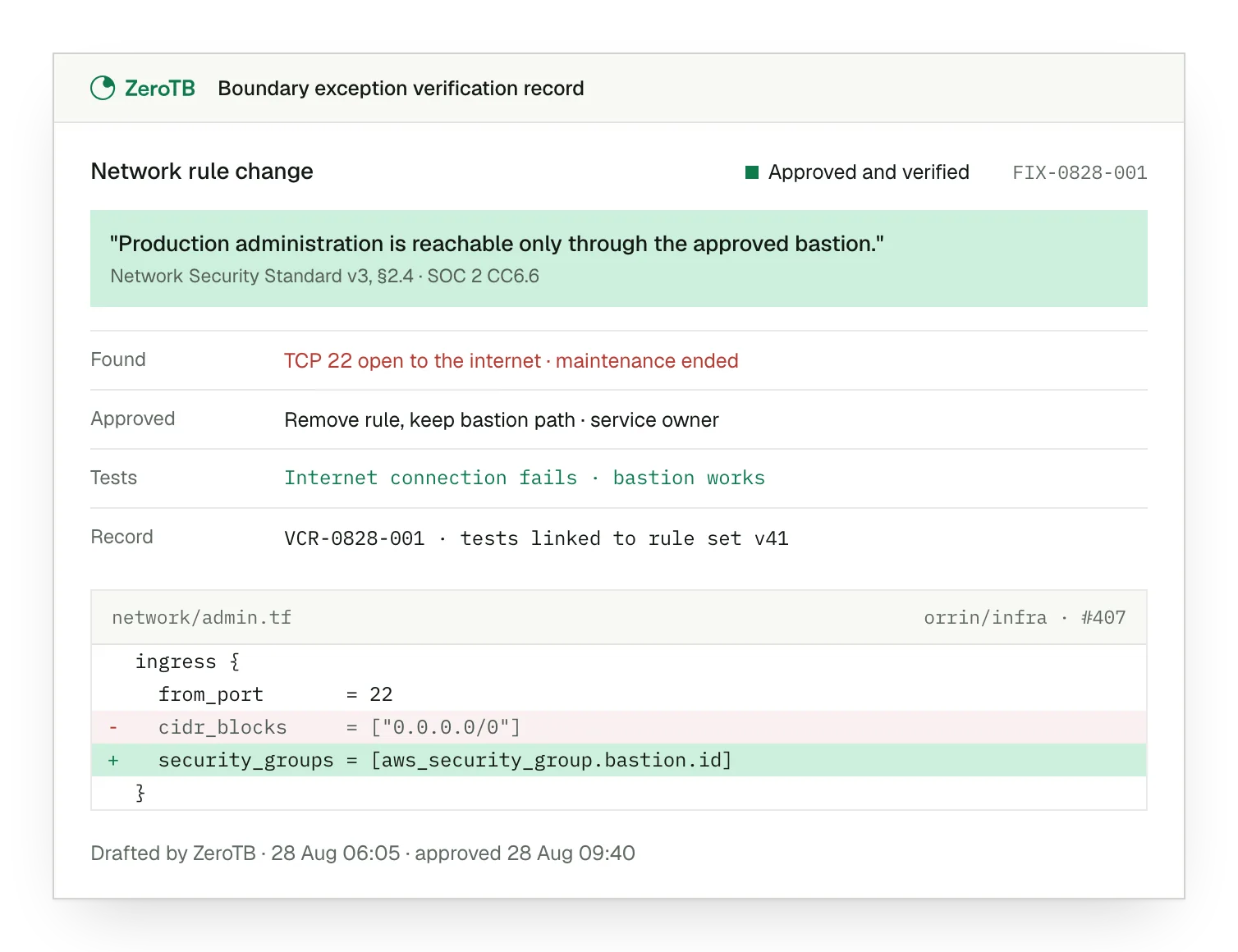
Expired network exception. The maintenance task has ended, but its rule still permits internet connections to TCP port 22.
Approved rule removal. The service owner approves removing the broad rule while retaining the established administration path.
Paired connection tests. A new external connection fails, and a new connection through the approved administration path succeeds.
Recorded verification result. The record links both test results to the deployed rule set and the change approval.
Boundary review checklist
Establish which services the boundary covers and the sources, destinations and connections their approved use requires.
Read the rules together for each resource and identify exceptions or connection paths missing from current checks.
Give the owner the proposed restriction and its effect on required access, then record the decision.
Use tests against the deployed system to establish whether unwanted access stops and required access remains.
Keep the results with the approved change and identify who will respond when later checks find another gap.
Sources
- AICPA & CIMA, 2017 Trust Services Criteria with revised points of focus, 2022 revision.
- AWS, Security group rules, accessed November 4, 2026.
- HHS, HIPAA audit protocol, 2018 update.
- ZeroTB, SOC 2 compliance automation with human approval, 2026.
- ZeroTB, How to stop recurring SOC 2 findings, 2026.
Related pages
SOC 2 criteria
See how boundary protection fits with the other criteria in a SOC 2 program.
Compliance frameworks
Find the framework libraries and follow related requirements for the systems your team operates.
Cloud and infrastructure
Explore how ZeroTB keeps cloud controls aligned with commitments as infrastructure and configurations change.
Start with the Pilot
Talk with our team about boundary gaps and the controls you need to keep working. The eight-week Pilot maps up to 25 commitments and takes two real control gaps through approved correction and verified restoration, with evidence of the results.