What does ISO 27001 A.8.20 require for securing networks?
ISO 27001 A.8.20 concerns securing networks and the equipment that connects systems and carries information. Define which connections each service needs, then check whether the network permits additional access. After a correction, verify that unwanted connections fail and required connections still work before closing the gap.
A service can keep working while its network protection changes. A troubleshooting rule, new route or changed interface can expose it beyond the approved boundary. A.8.20 reviews need to explain both the intended connections and the access the network currently permits.
Permitted connections
The allowed source, destination, protocol and port give a network reviewer something specific to check. These details describe the connection a service needs. A record of its business purpose explains why it exists, while an owner can decide when that purpose changes.
“Restrict administrative access” leaves the reviewer to interpret the restriction. Naming the approved management network and the destination service makes the expected result clearer. A later reviewer can then compare that requirement with current access and ask why any broader permission remains.
Network boundaries
Network security includes the paths between internal systems as well as connections from outside. Administrative interfaces, service connections and links to other environments can each cross a boundary. The review needs to follow those paths to the systems and information they expose.
A network diagram helps explain the intended arrangement, but current settings show whether that arrangement remains in place. Compare both when services move or new routes appear. A diagram that omits a recent connection can leave the reviewer inspecting only part of the network.
Effective access
One restrictive rule does not establish the access a network allows. Another rule may permit the same connection, or another route may reach the destination. Reviewing the relevant path means examining the combination of controls that governs the service's actual exposure.
On AWS, all security groups attached to a resource contribute their permissions. Removing a permission from one group can therefore leave the connection allowed through another. Changes to a shared group also apply to its other resources, so the correction may affect several services. AWS security-group documentation.
Temporary exceptions
Temporary access needs a recorded end condition as well as an approval to open it. Troubleshooting may require a connection outside normal restrictions. Without a removal or review condition, the permission can survive the task that justified it and become part of everyday access.
The record should identify who owns that decision. If the work has finished, the owner can authorize removal and a check of the result. If access must remain, an explanation of the continuing need gives the next reviewer something to assess.
Change ownership
The service owner needs to judge which connections a proposed correction must preserve. A firewall administrator may know how to change a rule without knowing every service dependency. Normal traffic, administration and recovery each need consideration before the owner approves a narrower permission.
Shared rules complicate that decision because several services may use the same permission. The proposal needs to identify those services and the resources that will change. Their owners can assess the impact from the same description and identify connections the proposed change must preserve.
Safe corrections
A correction should remove the unwanted connection and leave necessary access working. The proposal can express that result through the approved source, destination and service. It also needs a way to recover required access if the change has an unexpected effect.
An old rule with no clear owner needs investigation. Deleting it immediately could interrupt a dependency that the finding did not capture. Where access remains necessary, the owner can approve a narrower permission or document an exception with a reason and conditions for review.
Connection tests
Test the approved route as well as the connection that the correction should block. Successful administration through the approved route establishes that required access remains. A failed attempt from the previously permitted source helps establish whether the unwanted access has been removed.
Use new connection attempts, and keep their source, destination, service and time with the results. Existing sessions can behave differently after a rule change because the system tracks them. AWS describes this behavior for security groups. Configuration observations help the reviewer interpret what the tests show.
Missing test results
An unavailable observation leaves a question open about the correction. If a source disconnects or a test cannot run, the reviewer lacks a result needed for closure. The record should identify the missing observation so the next person knows which test remains incomplete.
A failed connection alone can also mislead. The target service might be down, in which case the test says little about its network protection. A successful test through the approved route, together with relevant network observations, helps explain why the unwanted connection failed.
Evidence over time
A network test needs a date and enough context to identify what it tested. Resource identifiers, connection details and configuration observations make the result useful to someone who was absent during the change. They also show which parts of the conclusion later changes could affect.
The Verified Control Record is where ZeroTB connects the commitment to the before-and-after state, action, approval and verification. For network access, that record explains the reason for the correction and the evidence used to close it. Later checks assess whether the same restriction continues to work.
Network security evidence
These records connect the approved network boundary to the access observed before and after a change.
| Requirement | What an auditor asks for | Where it comes from |
|---|---|---|
| Defined network scope | Systems, interfaces and connections covered by the network protection commitment | Network inventory and diagrams linked to the approved policy and service requirements |
| Restricted connections | Current permissions and the business reason for the connections they allow | Firewall, routing and security-group configurations linked to service owners and approved access |
| Managed exceptions | Purpose, owner and review or removal conditions for temporary access | Exception decisions and troubleshooting records linked to the affected network rule |
| Authorized correction | The proposed restriction, affected services and the decision to proceed | Change request and owner approval identifying the resources and permissions that change |
| Verified result | Dated results showing required access working and the identified excess access blocked | Connection tests and network observations retained with the change and its approval |
Related framework controls
| Framework | Control | What it covers |
|---|---|---|
| ISO 27001 | A.8.20 | Protection of networks and network equipment supporting the organization's systems and information |
| SOC 2 | CC6.6 | Protection against external threats at the boundary of the systems within scope |
| HIPAA | 45 CFR 164.312(e)(1) | Safeguards against unauthorized access to electronic protected health information during electronic transmission |
Example of restricting administrative access
In this example, administrative access should come from the approved management network. A troubleshooting rule also allows TCP port 22 from outside that network. Removing the extra permission requires evidence that the approved support connection still works and the unwanted connection is blocked.
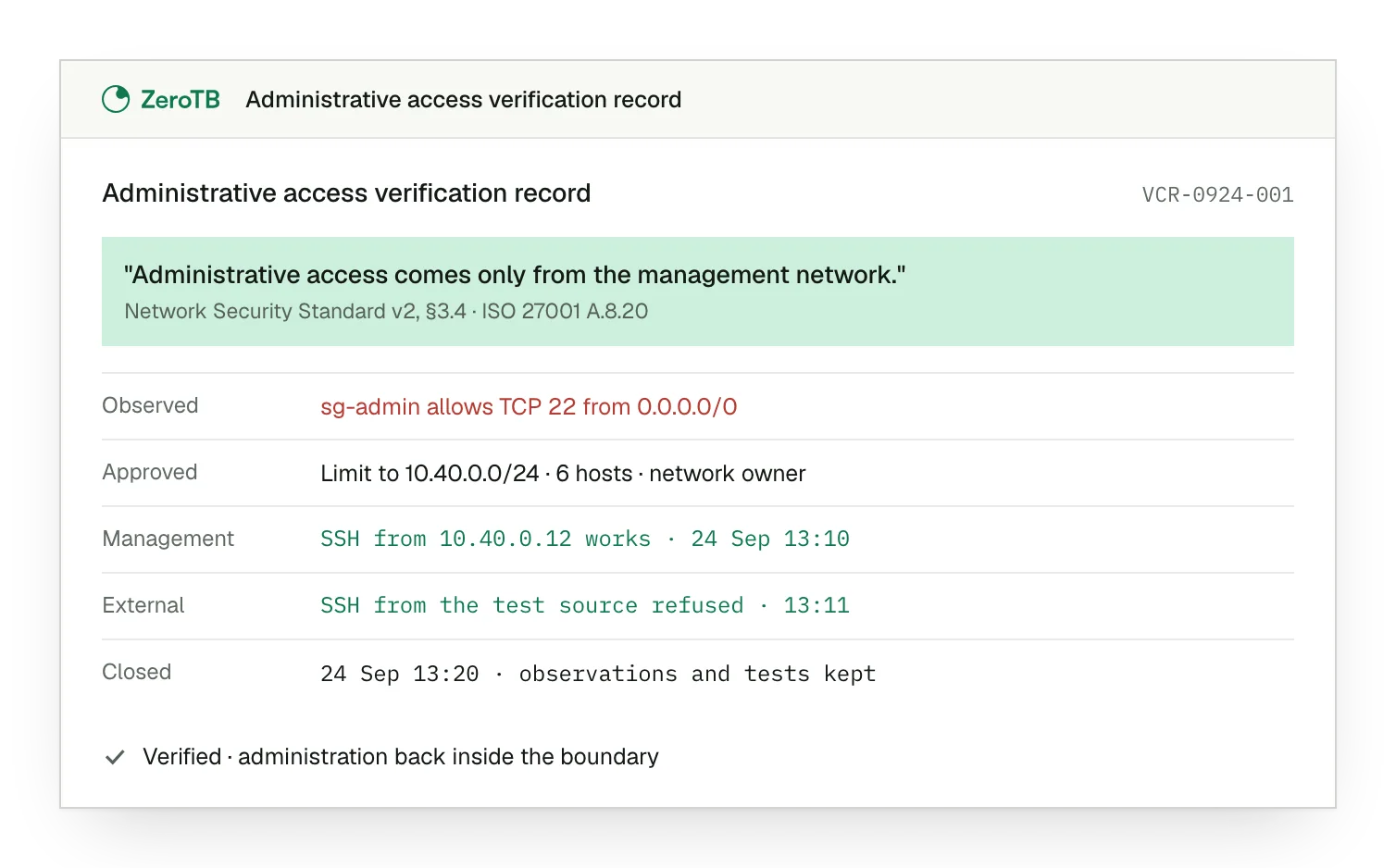
Excess permission. The rule allows a broader source than the management network specified in the commitment.
Approved restriction. The owner reviews the shared rule's affected resources and approves removing the broader permission.
Fresh connection tests. New administration through the management network works; the connection from the external test source fails.
Recorded closure. The record retains dated observations and test results alongside the approval for the change.
Network review checklist
Confirm which source can reach which service, and why the owner considers that connection necessary.
Follow the relevant routes and permissions to check whether another rule still allows the unwanted connection.
Check whether completed troubleshooting tasks left access in place, and whether an owner has approved its continued use.
Give the owner a proposed restriction that identifies affected services and a way to recover required access.
Check the date and source of each connection test, alongside the settings that explain its result.
Sources
- ISO/IEC, ISO/IEC 27002:2022 standard overview, 2022.
- NIST, Guidelines on firewalls and firewall policy, SP 800-41 Rev. 1, 2009.
- AWS, Security group rules, accessed November 4, 2026.
- HHS, Summary of the HIPAA Security Rule, accessed November 4, 2026.
Related pages
Cloud and infrastructure
See how network and configuration changes become control gaps that need approved correction and verification.
ISO 27001
Place network security within the wider program and explore the other controls that support it.
Compliance frameworks
Explore the framework library to find related requirements and the systems where their controls operate.
Start with the Pilot
The eight-week Pilot maps up to 25 commitments and takes two real control gaps through approved correction and verified restoration. Talk with our team about recurring network gaps and the evidence you need to assess their closure.