SOC 2 CC6.5 addresses the information left on equipment and media when they are retired, reused or disposed of. Protection continues until approved removal or destruction has been checked. Before closing a disposal record, establish which media received that treatment and why the result was accepted.
Retiring a laptop changes its inventory status. It can still hold company data while it waits for collection. The disposal work within SOC 2 CC6 follows that equipment through its remaining custody, treatment and release, with evidence of what happened along the way.
Retention and disposal
SOC 2 data retention requirements do not prescribe one retention period for every kind of information. The company establishes periods from its commitments and applicable obligations. CC6.5 addresses protecting information when assets are retired, reused or disposed of, including the treatment that makes release appropriate.
A decision to replace equipment does not establish that its information can be deleted. The disposal decision needs to account for information that must remain available elsewhere. Once that decision is approved, the record should connect it to the specific assets and the authorized treatment.
Assets within scope
The asset list must account for the storage that holds the company's information. A device identifier helps the reviewer find that storage and follow its treatment. If someone removes a drive before releasing the remaining equipment, the disposal record needs to follow the drive too.
Equipment returned for reuse also needs a disposal decision about its existing data. A different employee or department may receive the device next. The procedure should establish what information must be removed before that transfer and which result permits the owner to approve its reuse.
Custody before release
A retired device still needs an identifiable owner while its data awaits removal. It also needs a known location. Without those details, the person reviewing the disposal may find a closed equipment entry and have no way to establish who now holds the device.
Custody records follow each transfer from the releasing party to the recipient. They cover storage and collection as well as the handoff for treatment. If an asset goes missing, the investigation can start with the last recorded holder and work forward from that transfer.
Drift after the audit
A retired status can become a substitute for checking whether disposal is complete. This happens when the inventory and treatment workflows separate. An asset may be ready for collection on one list while its sanitization result is still missing from the record used to approve release.
The useful check is whether a release had the evidence required by the procedure. A review can expose a missing result before collection and allow the owner to hold the asset. After collection, the same finding requires tracing custody and investigating what treatment occurred.
Sanitization methods
The approved sanitization method must suit the media, the information it holds and its intended destination. NIST SP 800-88 Rev. 2 describes clear, purge and destroy methods. Selection should follow the organization's policy and the technical requirements of the media being treated.
Reuse requires a method that leaves the equipment suitable for its approved next use. Destruction removes that option. The owner needs an explicit decision about the intended destination before treatment begins, so the procedure prepares the asset for that destination.
Acceptance of results
Completion and acceptance are separate decisions in sanitization. NIST uses verification for examining the operation's outcome and validation for judging its effectiveness. The reviewer therefore needs to know whether the treatment suited the media as well as whether the operation finished successfully.
An error or an inappropriate method can make the result unacceptable. The NIST guidance describes repeating treatment or selecting a more secure method when validation fails. The disposal record should show the result that was eventually accepted and the decision permitting release.
Records tied to assets
Disposal evidence must identify the media covered by the result. A recycling receipt can establish collection while leaving the treatment of individual devices unclear. Asset identifiers, or a batch record that lists its members, connect that receipt with the equipment and the supporting disposal evidence.
This connection matters when a reviewer selects one retired device. The records should explain its custody, the authorized method, the result and the decision that accepted it. A record for a different batch cannot resolve the selected device merely because the dates or provider are similar.
Vendor handoffs
The company and its disposal vendor need records that refer to the same assets. Collection paperwork identifies what the provider received. Returned treatment records should connect to those identifiers, so a reviewer can trace a device from the company's inventory through the provider's work.
When the lists disagree, the unmatched asset needs investigation. Sometimes an identifier needs clarification; sometimes the treatment evidence is missing. The vendor's response must resolve that specific difference. A completed batch record alone leaves the company unable to explain the asset that was omitted.
Unresolved disposal gaps
A missing disposal record calls for an investigation into both the asset and its treatment. If the equipment remains in custody, the owner can hold its release while the gap is resolved. When it has already left, locating the asset becomes part of the response.
Where recovery is impossible, assess the exposure and follow the relevant incident procedure. Where treatment occurred but evidence was missing, preserve the recovered record and its actual date. Its original timing shows when the gap existed and when it was resolved.
Continuing control checks
Retired assets without accepted disposal evidence need to remain visible between audits. A recurring comparison of inventory, custody and treatment records can identify them. The owner can then see whether an exception concerns an unexplained transfer, missing evidence or treatment that still needs to occur.
The Verified Control Record is where ZeroTB connects the commitment, observed gap, approved correction and checked result. In disposal work, the people handling the media supply the physical treatment evidence. That evidence must identify the asset before the record can explain why its gap was closed.
Disposal evidence
These records connect the approved disposal rule to the assets handled and the decision to close each gap.
| Requirement | What an auditor asks for | Where it comes from |
|---|---|---|
| Defined scope | The data-bearing equipment and media covered by the disposal procedure | Asset inventory, media identifiers and the approved disposal policy |
| Authorized treatment | The selected method and the decision permitting reuse or disposal | Approved disposal request and the procedure applicable to that media |
| Protected custody | The location and responsible party through storage and transfer | Asset handoff records, collection records and the vendor's corresponding asset list |
| Accepted result | The treatment outcome and the decision accepting its effectiveness | Sanitization or destruction records linked to the media and reviewed result |
| Resolved exception | The original gap, approved correction and evidence supporting closure | Investigation records, change approval and dated verification attached to the affected asset |
Related framework controls
| Framework | Control | What it covers |
|---|---|---|
| SOC 2 | CC6.5 | Protection of information as equipment and media leave service or reach disposal |
| ISO 27001 | A.7.14 | Secure disposal or reuse of equipment that holds information |
| HIPAA | 164.310(d)(1) | Device and media safeguards, including disposal and removal of electronic protected health information before reuse |
Example of resolving a disposal gap
In this example, the asset list shows a laptop ready for collection. Its sanitization result is missing. The owner holds collection until the approved treatment has been completed and accepted, then releases the laptop with the decision attached to its disposal record.
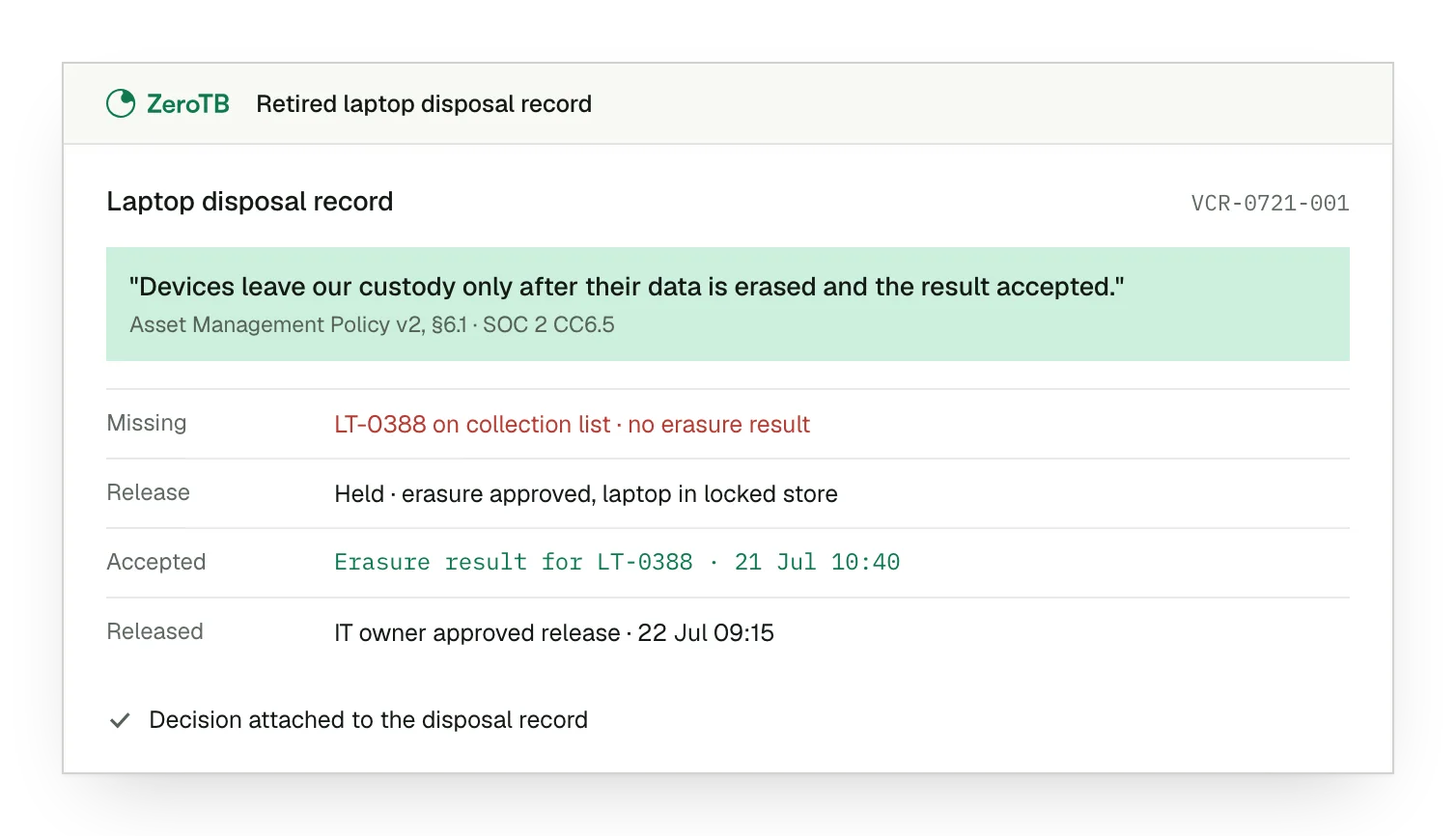
Missing disposal result. The retired laptop appears on the collection list without a sanitization result in its record.
Release on hold. Collection waits while the owner approves treatment and the laptop stays in protected custody.
Accepted treatment result. The reviewer accepts the completed treatment, with its result recorded against the correct laptop identifier.
Recorded release decision. The laptop can leave custody after approval, with the release decision attached to its record.
Disposal review checklist
Establish what treatment the policy requires for the media and whether any information still needs to be retained.
Locate the equipment in the custody records and establish which treatment evidence belongs to that specific asset.
Approve the response appropriate to the finding: missing evidence, unfinished treatment or an asset that cannot be recovered.
Review the outcome for the identified media and decide whether it permits the proposed reuse or disposal.
Keep the original gap and approval with the accepted result, so the release decision can be traced afterward.
Sources
- AICPA & CIMA, 2017 Trust Services Criteria with revised points of focus, 2022 revision.
- NIST, SP 800-88 Rev. 2: Guidelines for media sanitization, 2025.
- HHS, Disposal safeguards for protected health information, accessed November 4, 2026.
- ZeroTB, SOC 2 compliance automation with human approval, 2026.
Related pages
SOC 2 criteria
Place equipment disposal within the wider set of controls that support a SOC 2 program.
Compliance frameworks
Explore related control guidance across the frameworks that apply to the company's systems and information.
How ZeroTB works
Follow the work from an approved commitment through a correction and the evidence of its result.
Start with the Pilot
The eight-week Pilot covers up to 25 commitments and takes two real control gaps through approved correction and verified restoration. Talk with our team about where controls need attention and the records that would help explain the results.