What does HIPAA 164.310(d)(1) require for device and media controls?
HIPAA device and media controls cover the movement of equipment and media containing electronic protected health information. Required procedures cover disposal and data removal before reuse; accountability and backup are addressable safeguards that require assessment. A device's record should show where it went, who handled it and what happened to its information.
Returning a laptop does not remove the patient information stored on it. Someone still needs to decide what to preserve and how to prepare the device for its next use. Those decisions belong in the HIPAA physical safeguards process alongside the return record.
Device and media scope
The standard covers hardware and electronic media containing electronic protected health information, or ePHI. That includes drives inside equipment and separate storage such as backup tapes or memory cards. The inventory needs enough detail to identify the media as well as the computer holding them.
Movement within a facility is part of this scope, alongside receipt and removal. Equipment can change hands without leaving the building. The procedure needs to account for those internal transfers so that the responsible person and the item's location remain known.
Required handling procedures
Section 164.310(d)(2) makes disposal and media re-use required specifications. Disposal procedures address the final disposition of ePHI and the equipment or media storing it. Reuse procedures govern removal of ePHI before the medium becomes available again. Both need an implemented procedure.
An internal reassignment still counts as reuse. Keeping a laptop in the same office does not remove the need to address its stored information. Its next use should therefore be clear while it is awaiting service, before a technician or another employee receives it.
Addressable safeguards
Accountability and data backup and storage require an assessment of what is reasonable and appropriate in the organization's environment. Under HIPAA's general rules, the organization implements each addressable specification when it is reasonable and appropriate. The assessment considers how the safeguard would protect ePHI.
When implementation is unreasonable or inappropriate, the organization documents why and implements an equivalent alternative if that is reasonable and appropriate. A decision record should explain the circumstances behind the choice. It then gives later reviewers a basis for reconsidering the safeguard as circumstances change.
Backup before movement
A backup may be needed before equipment moves. This addressable specification calls for a retrievable, exact copy of ePHI when needed, so the decision depends on the information and the move. The assessment establishes what could become unavailable and whether an appropriate copy exists.
Preparation for reuse raises a related question: is there information on the device that must be preserved before sanitization? The handling plan should identify where that information will remain available. A technician needs that decision before clearing or destroying the storage containing the original.
Custody between handoffs
Custody records should let someone locate a particular device and identify who is responsible for it. An individual identifier separates it from similar equipment. A dated entry showing the sender and recipient then explains how it reached its current location and custodian.
Receipt establishes that the device arrived. It may still be awaiting sanitization, a backup decision or review of the result. Showing that status with the custody entry lets the person arranging reassignment see which handling steps remain open before the device can be released.
Gaps after the audit
Conflicting records can make equipment appear ready for use before its data has received the required treatment. An asset register might show a device as available while its service task awaits a sanitization result. The person arranging the next handoff may see only the register.
A batch ticket creates another problem if it omits the individual media identifiers. Even with a completed status, a reviewer cannot connect every item to the work. Comparing the custody entries with the service evidence reveals which identifiers, results or status differences still need investigation.
Restoration responsibilities
The control owner decides how an affected device should be handled, and a technician or service provider performs the physical work. ZeroTB follows the policy commitment through the observed gap, proposed correction, approval and verified result. That record connects the decision with the completed handling.
The approved task needs to specify the next use, any information to preserve and the handling procedure. With those decisions recorded, the technician knows what work to perform and the reviewer knows what result to expect. Endpoint and process controls support that coordination.
Sanitization checks
Sanitization checks establish whether the selected method completed successfully and whether its result is acceptable for the information involved. NIST SP 800-88 Revision 2 separates verification of the operation from validation of its effectiveness. These checks consider the medium, method, errors and remaining confidentiality risks.
A completed tool operation can still leave an unacceptable result if the method does not suit the medium. The reviewer needs enough detail to accept the result or require further treatment. The chosen procedure determines the checks; a generic completion message leaves that decision unresolved.
Evidence for release
Release evidence needs to identify the particular device or medium it covers. A sanitization record can supply its identifier, the method and tool used, the result and the reviewers. Evidence from a service provider should identify the items received so they can be matched to the inventory.
The Verified Control Record keeps the gap, approved action and checked outcome together. A reviewer examining a released device can follow that record to the evidence supporting its release. If a later review finds a discrepancy, the same links show which work and decision to examine.
Continuing oversight
Changes to offices, providers and return arrangements can leave a device procedure out of date. Equipment may go to a different location, or another team may receive the service evidence. The control owner needs to review these changes so the next transfer remains traceable.
Related frameworks may use some of the same evidence. Before using a sanitization record in another review, the reviewer checks the equipment and information it covers against that framework's requirement. The record can save repeated collection, while the assessment still accounts for differences in scope.
Audit evidence
A review follows the device from the handling rule to the records of what happened.
| Requirement | What an auditor asks for | Where it comes from |
|---|---|---|
| Handling procedures | Which equipment the procedures cover, who handles it and how the organization assessed addressable safeguards | Approved policies and procedures describing the handling work, with the assessment of accountability and backup |
| Movement accountability | Where a particular item went and who was responsible for it at each handoff | Individual asset or media entries, with transfer dates and the people sending and receiving the item |
| Backup before movement | Why a copy was or was not needed, and which copy satisfied that decision | The movement assessment and, where needed, backup records showing the information copied and where to retrieve it |
| Removal before reuse | What treatment the medium received and who accepted the result before it became available | The sanitization record, including the media identifier, method, tool, checks and acceptance of the result |
| Final disposition | What happened to each item sent for disposal and how the provider documented completion | Itemized disposal evidence and the review connecting it to the equipment sent to the provider |
| Verified correction | How the team resolved the handling gap and established that the correction was complete | The control record containing the affected item, approved action, dated result and decision to release it |
Related framework controls
| Framework | Control | What it covers |
|---|---|---|
| HIPAA | 164.310(d)(1) | Procedures for moving hardware and media containing ePHI, including disposal, reuse and assessed accountability and backup |
| SOC 2 | CC6.5 | Safeguards for information on physical assets when the entity disposes of them or otherwise relinquishes control |
| ISO 27001 | A.7.14 | Checks of storage and removal of sensitive information before equipment disposal or reuse, with evidence of the completed handling |
Example of verified device reuse
A missing sanitization result prevents release of the returned laptop in this example. The custody record confirms receipt. The owner resolves the preservation decision and approves the reuse procedure, then a reviewer accepts the technician's evidence before the laptop becomes available again.
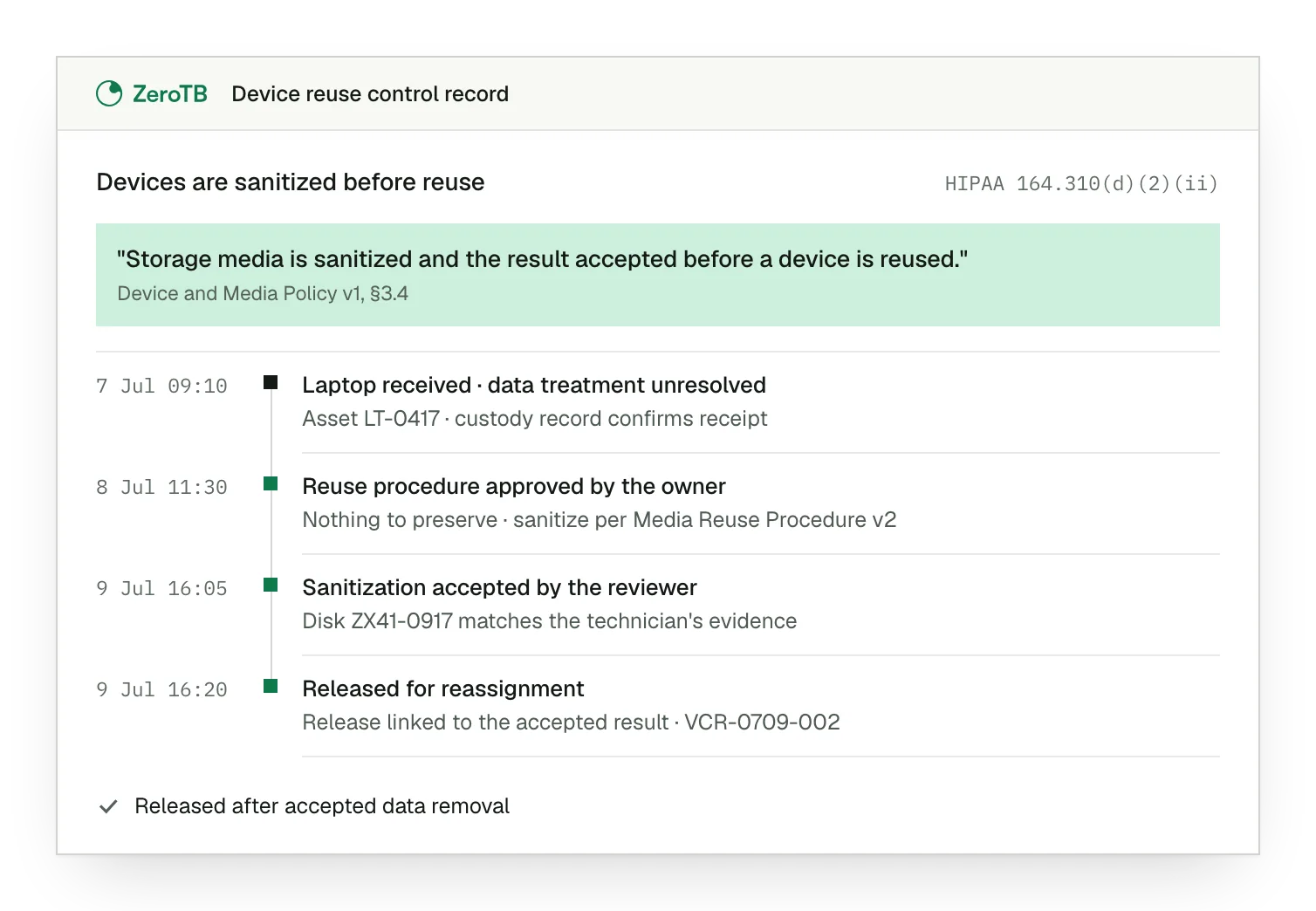
Pending data treatment. The laptop has been received, with its data treatment still marked as unresolved.
Approved handling decision. The owner has decided what to preserve and approved the procedure for reuse.
Accepted sanitization result. The reviewer has matched the technician's evidence to the storage medium and accepted the treatment.
Recorded device release. The laptop becomes available for reassignment, with the accepted result attached to the release decision.
Device handling checklist
Match the asset identifier to the device or medium and confirm its present location and responsible custodian.
Establish whether the item will move, return to service or leave service, including any necessary backup decision.
Confirm the procedure and responsible handler before the equipment moves or its information receives treatment.
Check the completed treatment against the approved procedure and resolve errors or missing evidence before release.
Link the custody history, handling evidence and release decision to the item so a reviewer can follow them.
Sources
- eCFR, 45 CFR 164.310: Physical safeguards, current text consulted November 2026.
- eCFR, 45 CFR 164.306: Security standards, general rules, current text consulted November 2026.
- HHS, Reuse or disposal of computers and electronic media containing ePHI, reviewed August 2026.
- HHS, Security standards: Physical safeguards, revised March 2007.
- NIST, SP 800-88 Revision 2: Guidelines for media sanitization, September 2025.
Start with the Pilot
Talk with our team about device controls in your compliance program. The eight-week Pilot maps up to 25 commitments and takes two real control gaps through verified restoration, with evidence of the approved work and its results.