SOC 2 CC6.3 covers access decisions when duties or systems change. Those decisions include granting rights, changing them and removing rights that no longer have a purpose. Review actual permissions for least privilege and conflicting duties, then check that the approved changes took effect in the affected systems.
Someone who moves from operations into product development may still hold production administrator rights. Their account remains valid, but some permissions belong to a job they have left. The CC6 access controls address this distinction between having an account and needing the access it provides.
Access scope
CC6.3 connects access decisions to the work a person or system is authorized to perform. A useful review identifies the protected data, applications and functions, then establishes who decides access to each. Those decisions need to reflect how the system currently works.
An account list shows which accounts exist in a system. The permission records show what each account can do. Reviewing both helps the owner judge whether an existing approval still applies, especially after changes to a role, an application or the information it contains.
Least privilege
Least privilege asks whether the permissions held are necessary for the work approved. An administrator role may allow much more than the task behind the original request. Looking at the operations that role permits helps the owner decide which rights the current job requires.
Where the system supports it, a narrower role can preserve needed access while removing unnecessary powers. Temporary work needs similar attention when its purpose ends. The employee may stay with the company, but that does not establish a continuing need for the temporary rights.
Separation of duties
Separation of duties requires a view of permissions held together, including those granted through different roles. A person may need to perform a task without holding the right to approve it. An access review should establish whether the system preserves that division of responsibility.
The company defines the incompatible duties and the safeguards around them. Sometimes the owner accepts a documented exception while the conflicting permission remains in place. The record needs to explain the conflict, why it was accepted and what would cause the owner to reconsider that decision.
Role changes
A transfer review compares the access required by the new job with the access already held. New permissions may be necessary, and old permissions may have lost their purpose. Both decisions belong in the review before the resulting access is accepted for the changed role.
A job title can stay the same while project duties change. That is why user access reviews need context about the work itself. An employee still on the payroll may have finished the project that justified privileged access, leaving the permission without its original purpose.
Departure coverage
A departure can leave several access-removal tasks with different system owners. Disabling the main identity addresses one route. Depending on the application, the owner may also need to remove a local account, end a session or revoke a token that still permits access.
The connection between systems determines how much removal happens automatically. Okta's documentation says application deprovisioning depends on the app's settings and lists exceptions. The review therefore needs the outcome in each affected application, including any removal that remains open after the identity task has completed.
Review completeness
An account missing from the review cannot receive a decision about its permissions. Start with the systems in scope and compare their records with the identity provider's assignments. Local permissions need to be visible wherever they can grant rights outside those central assignments.
A permission export also needs a date that makes it useful for the decision. Data from before a transfer will not show the effect of that transfer. Missing or disconnected sources need an owner and a next action, leaving the review open for those observations.
Correction decisions
The correction should specify the access that will remain, as well as the rights being removed. The owner can then assess whether the person will still be able to perform current duties. This decision determines whether to change one assignment or disable the account.
For a transfer, the change may preserve ordinary application access while removing administrator privileges. A departure can require removal across several applications. Any retained exception needs its own reason and review condition, so the decision remains understandable when someone examines the account again later.
Verification after removal
The check after a change must establish what access now works. Its expected result comes from the owner's decision, including any permissions that should remain. After removing an administrator role, check both the obsolete powers and the ordinary access approved for the person's work.
An update reported as successful still needs this check of its effect. Record the resulting permissions and test relevant permitted and blocked operations where appropriate. If the observation is unavailable or the result fails, the owner still has an unresolved gap and a next action.
Evidence over time
Access evidence should explain both the decision and the resulting permissions at the time of the change. A later reviewer needs to connect the person's duties with the approved action. Dated before-and-after records make that connection easier to examine without reconstructing it from messages.
Keep unresolved removals separate from completed corrections, with their owners and next actions visible. This distinction matters when an access review spans several systems. One application may have confirmed removal while another is still waiting for a change or a fresh observation.
Recurring access gaps
Group membership can explain why a removed permission appears again. A review that examines only the individual assignment may miss the source that restores it. Okta's documentation confirms that deactivation leaves group memberships in place, which matters when a former user is later reactivated.
Someone needs to own further checks and act on access that returns without an approved purpose. ZeroTB carries that work from the commitment to a verified correction. Its Verified Control Record retains the observed states, action, approval and verification so the result can be reviewed later.
Access review evidence
The evidence should let an auditor trace the permission, the decision about it and the result of any change.
| Requirement | What an auditor asks for | Where it comes from |
|---|---|---|
| Access by role | Rights held and the duties that justify them | Role descriptions, permission records and the owner's access decisions |
| Least privilege | Rights approved for retention and rights selected for removal | Application exports with review decisions tied to current work |
| Separation of duties | Conflicting rights found during the review and how they were resolved | Responsibility definitions, combined permission records and approved exceptions |
| Changed or removed access | The change authorized and the access observed afterward | Transfer or departure records, change history and verification results |
| Unresolved access | Removals still pending and responsibility for completing them | Open review items with owners, next actions and failed or missing checks |
Related framework requirements
| Framework | Control | What it covers |
|---|---|---|
| SOC 2 | CC6.3 | Granting and adjusting permissions to suit responsibilities, with attention to least privilege and conflicting duties |
| ISO 27001 | A.5.18 | The grant, review, change and removal of rights in line with the organization's access rules |
| HIPAA | 164.308(a)(4) | Rules and procedures for granting and changing access to electronic protected health information |
Example of removing outdated administrator access
This example follows the removal of a production administrator role after an engineer transfers to product development. Development access must remain available. The record shows the old permission, the decision to remove it and the checks that establish the resulting access.
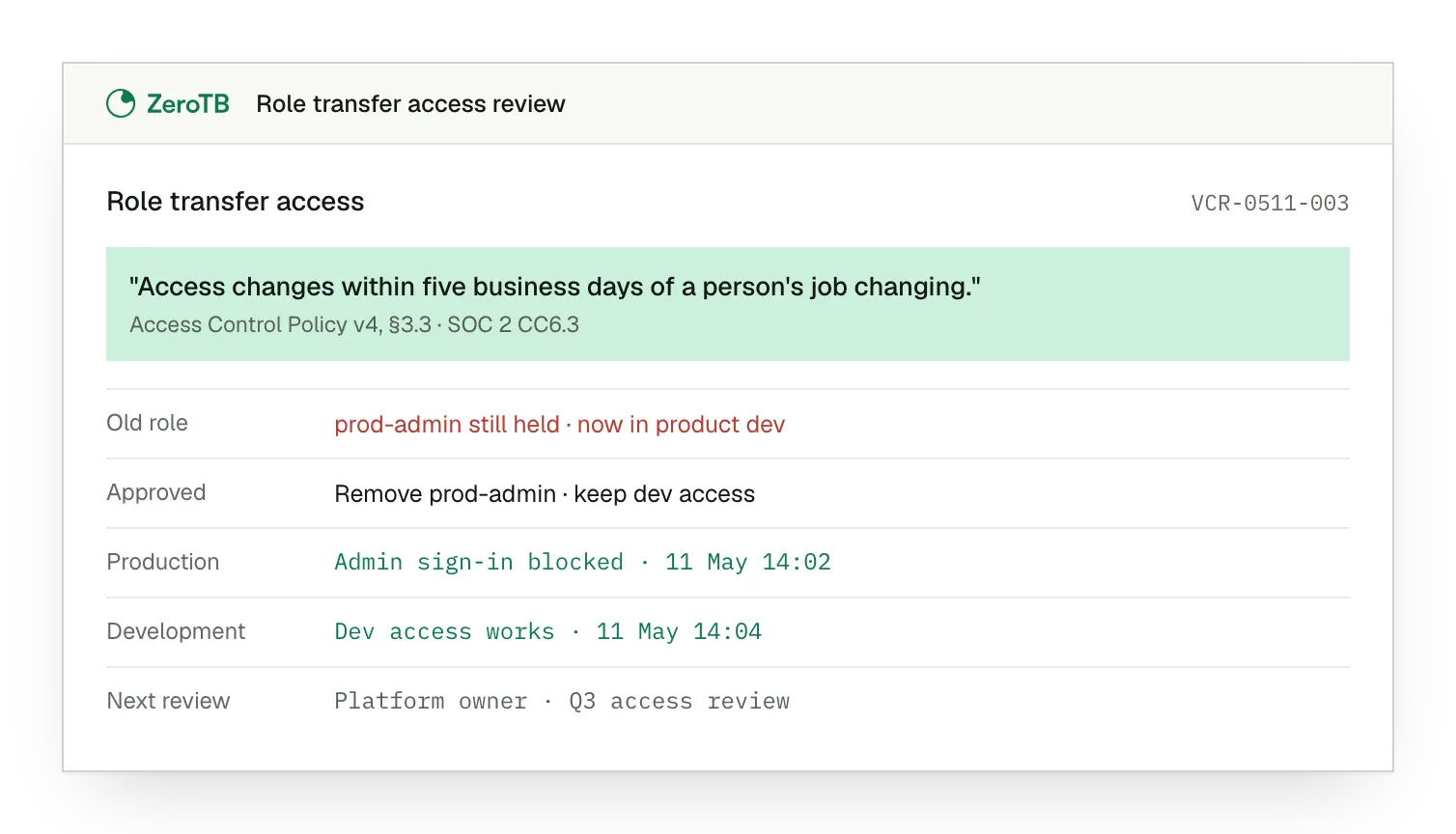
Old assignment. The engineer still has the production administrator role granted for duties in the previous job.
Approved change. The owner authorizes removal of that role and identifies the development access the engineer still needs.
Resulting rights. The check finds production administration blocked and confirms that the approved development access continues to work.
Recorded result. The approval and dated observations stay together, with an owner responsible for the next access review.
Access review checklist
Compare the approved role with current rights across the affected systems, including access granted through groups.
Identify obsolete rights and conflicting duties, then obtain the owner's decision on removals and any retained exceptions.
Confirm that removed permissions no longer work and that access needed for the current role remains available.
Retain the decision and verification results with an owner responsible for unresolved work and future access checks.
Sources
- AICPA & CIMA, 2017 Trust Services Criteria with revised points of focus, 2022 revision.
- Okta, Deactivate and delete user accounts, accessed November 4, 2026.
- HHS, HIPAA audit protocol, updated July 2018.
- ZeroTB, SOC 2 compliance automation with human approval, 2026.
Related pages
Start with the Pilot
The Pilot covers eight weeks, maps up to 25 commitments and takes two real control gaps through approved correction and verified restoration. Talk with our team about permissions that remain after a transfer and how the resulting access could be checked.