SOC 2 CC5.2 concerns the general controls over technology that support business controls. Infrastructure, access, acquisition, development and maintenance all fall within that scope. To apply it, follow a business control through the systems it uses and identify the protections needed to keep its result reliable.
A report can arrive on time even when the job producing it has lost access to a required source. The reader needs to know what the job examined. The supporting technology controls in CC5 control activities help keep that connection between the process and its result reliable.
Technology dependencies
A technology control protects a business control that depends on it. That dependency may involve an application, a service account, a data source and the infrastructure running the check. Each part can affect the result that someone relies on.
The useful starting point is the business control's purpose and scope. From there, trace how information reaches the control, which settings govern its operation and who can change them. This explains why a particular permission, configuration or operating check belongs in the control design.
Access to supporting systems
The process needs access to its inputs, and changes to the process need authorized administrators. These are separate access decisions. An account used to collect evidence may need read permission, while an administrator can alter the settings that govern what the account reads.
A review of permissions needs to account for both decisions. Removing a privilege can be appropriate, yet the same cleanup may remove a required input. The owner can assess the correction more accurately when the request identifies what the dependent process needs to do.
Infrastructure reliability
Supporting infrastructure must let the control process the intended information completely, accurately and when needed. That includes the systems that store inputs, run the application and deliver its output. An available application can still produce an incomplete result if an input is missing.
The operating check should therefore connect system health to the control's purpose. A job history can establish that processing started and finished. Additional observations establish which sources were available, whether processing errors occurred and whether the result covered the expected information for that run.
Technology changes
Technology changes need review against the business controls they support. The same question applies to acquiring an application, developing software or maintaining an existing system: will the resulting system still perform the work required by the control? Its written policy may remain unchanged.
An approved baseline describes the expected configuration. A reviewer can compare it with the revised system and examine tests of the dependent process. ISO’s configuration guidance describes how inventories and controlled changes help maintain systems with the settings they require.
Incomplete control results
Job completion alone cannot establish that a control examined every required source. An evidence job may continue after a permissions cleanup removes access to one input. It processes what remains and records completion, leaving the person reviewing its output unaware of the missing information.
Comparing expected inputs with observed inputs makes that gap visible. An empty result can mean that the source contained nothing relevant. It can also mean that the job could not read the source. The check needs to distinguish these conditions before anyone accepts the result.
Checks between audits
An observation is useful only when its scope and age are clear. The record should identify the system examined, the information available and when the check ran. A satisfactory result from an earlier run leaves open whether later changes affected the control.
Someone must own the response when an input disappears or an observation becomes stale. That person needs a route to the team responsible for the affected system. The commitment and rate of change inform the check schedule; a material system change may need an additional check.
Approved repairs
A repair needs to recover the required function within the approved access boundaries. If a job has lost an input, granting broad permissions could make it run again while creating another problem. The proposal should identify the source and the specific read access needed.
The owner then has a defined change to approve and an expected result to assess. ZeroTB’s control operations connect the commitment, observed gap and proposed fix. People authorize the action; verification after the change establishes whether the control has been restored.
Verification of the business control
Verification must establish that the dependent control produces the intended result after the technical change. A successful permission update establishes that the setting changed. Repeating the affected process with its required inputs establishes whether that change restored the control's operation.
Verification should also test whether the supporting check will reveal the same failure if it returns. If a missing source previously appeared as an empty result, that condition needs a distinct failure state. Keep the gap open when the repeated test fails or its evidence remains incomplete.
Evidence over time
A successful test after repair answers a question about the corrected state. It leaves a separate question about outputs produced while the dependency was failing. The reviewer needs to identify those outputs and decide whether the conclusions drawn from them need another assessment.
The Verified Control Record connects the commitment, before-and-after state, action, approval and verification. Earlier observations give that repair a history. Keeping both allows a reviewer to see when a gap was observed, what changed and which period the available evidence can support.
Evidence for a CC5.2 review
The records below connect each supporting technology control with the business process and the evidence available for review.
| Requirement | What an auditor asks for | Where it comes from |
|---|---|---|
| Defined dependencies | Which business control relies on each system, input and service account | Control descriptions linked to the inventory and the relevant data flows |
| Appropriate access | Who can administer the supporting systems and what the process can read | Permission exports and the decisions approving account access |
| Reliable processing | Whether the process examined its required inputs and detected failures | Run histories, input records, errors and the output of the control |
| Controlled changes | What changed, who approved it and how the dependent process was tested | Configuration versions, approval records and development or maintenance tests |
| Verified restoration | Why the repair was accepted and which observations support that decision | The repair record, observations before and after the change, and dated test results |
Framework control mapping
| Framework | Control | What it covers |
|---|---|---|
| SOC 2 | CC5.2 | Supporting technology controls that help business controls operate reliably |
| ISO 27001 | A.8.9 | Configuration management for systems and the security settings they depend on |
| HIPAA | 164.312(a)(1) | Restricting access to electronic protected health information to authorized people and software |
Example of restoring complete checks
This example follows an evidence job that lost a required input during a permissions cleanup. The approved repair restores read access to the source. A repeated run checks completeness, and a separate test checks that the job detects an unavailable input.
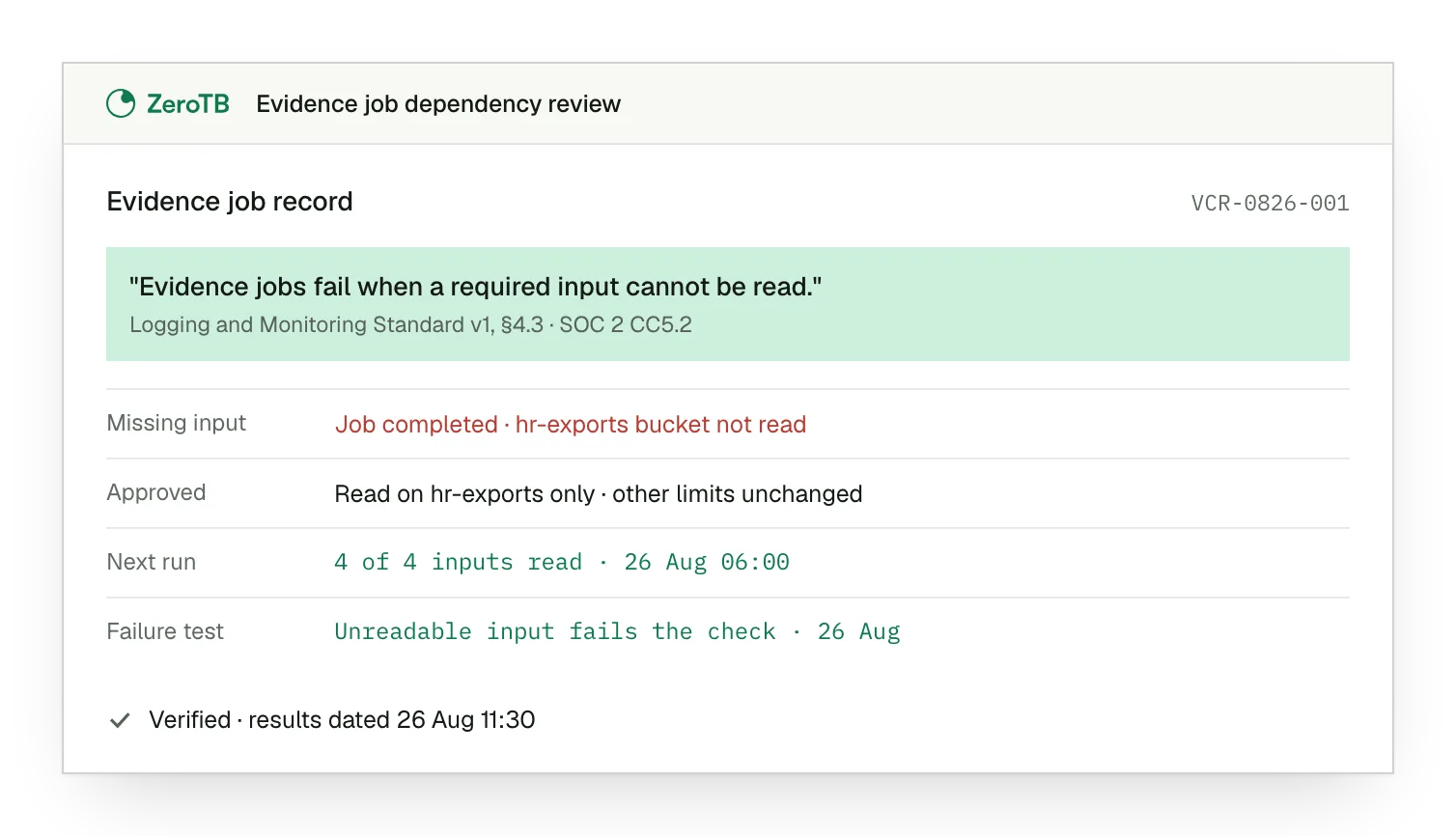
Missing source. A completed run has an input record showing that one required source could not be read.
Bounded correction. The approved change grants read access to the missing source and preserves the account's remaining restrictions.
Complete result. The next run reads all required inputs, allowing the reviewer to inspect the complete output.
Recurrence test. An unavailable source produces a failed check during testing, so the owner can investigate it.
Technology control review checklist
Select a business control and trace the systems, identities and inputs needed to produce its intended result.
Compare the information actually examined with the approved scope, including missing sources and stale observations.
Review a proposed repair against the required dependency and approve permissions or configuration changes within that scope.
Repeat the affected process and confirm that the supporting check detects the same failure if it returns.
Identify earlier outputs that relied on the failed dependency and decide whether they need reassessment.
Sources
- AICPA & CIMA, 2017 Trust Services Criteria with revised points of focus, 2022 revision.
- ISO, Configuration management: Why it is so important for IT security, accessed November 2026.
- HHS, HIPAA audit protocol, July 2018 update.
- ZeroTB, SOC 2 compliance automation with human approval, 2026.
Related pages
SOC 2 criteria
Place technology controls within the wider requirements that shape a SOC 2 program and its evidence.
Compliance frameworks
Explore the control libraries for other frameworks and identify requirements that apply to the same systems.
Compliance controls
See how commitments become checks, approved corrections and records of the results across connected systems.
Start with the Pilot
The eight-week Pilot maps up to 25 commitments and takes two real control gaps through approved correction and verified restoration. Talk with our team about the controls behind recurring gaps and the evidence a completed repair would provide.