What does ISO 27001 A.8.9 require for configuration management?
ISO 27001 A.8.9 concerns the secure configuration of systems, services and networks throughout their use. Configuration management starts with an approved baseline and checks whether deployed settings match it. Differences need an owner decision, and repairs need verification against that decision after the change reaches the running system.
A production setting can change while its approved configuration file stays untouched. The resulting gap belongs in the same review as a change to the file itself. Both can affect whether the system still meets its security requirements.
Baseline scope
A baseline applies to a particular set of systems, with an owner responsible for their configuration. The scope should let a reviewer identify those systems without guessing. It connects each hardware, software, service or network requirement to the resources where someone must check it.
Production and development may use different approved settings. The inventory should show which baseline applies to each resource, so a reviewer can follow those differences. When a new service appears, the same inventory helps reveal whether anyone has assigned it a baseline and taken responsibility for checking it.
Approved security settings
The approved settings give the reviewer something specific to test. A requirement for restricted network access, for instance, needs a list of permitted sources and services. Without those choices, two reviewers could inspect the same rule and reach different conclusions about whether it is acceptable.
The same approach applies to administrative access, enabled services, logging and encryption. Values depend on what the system does and the protection it needs. NIST's configuration guidance explains how security decisions fit within configuration management while allowing the system to perform its business functions.
Deployment sources and live settings
The running system is a separate source of evidence from its configuration file. An engineer can change production through a console and leave the repository untouched. A deployment can also stop before every resource receives the new settings, leaving a partially changed environment.
There are three things to compare: the baseline, the deployment source and the resource as observed. Agreement between the first two cannot establish the third. For changes from coding agents, the review therefore extends beyond the proposed code to the configuration that runs after deployment.
Coverage of configuration checks
Check coverage matters when interpreting a successful result. AWS CloudFormation drift detection, for example, covers supported resources and explicitly specified properties. Its result cannot establish the value of a setting outside that comparison, even when the check completes successfully.
The review needs an observation for every setting on which the control depends. If the chosen tool cannot read a property, a separate check must supply that information. Showing these coverage gaps beside the results helps prevent an unchecked resource from being treated as verified.
Checks between deployments
A deployment check cannot detect changes that happen afterward. Troubleshooting and routine administration can alter a running system without a new release. Newly created resources can also fall outside the last successful check, so observation needs to continue between deployments as well.
The owner decides how often to check, taking account of exposure and how frequently the system changes. Each result needs a time and a team responsible for investigating differences. If the connection stops working, the earlier result remains historical evidence; it cannot describe the unobserved current state.
Exceptions and baseline revisions
A difference needs an owner decision before it becomes either a repair or an accepted exception. A temporary operational need may justify a different setting with additional safeguards. The decision should identify the affected resource, reason, approval and conditions for reviewing the exception.
If the intended protection changes permanently, revise the baseline through the approved change process. Retain the earlier version and the reason for replacing it. Updating the expected value to clear an alert would hide the difference without establishing whether the new configuration is appropriate.
Approval of corrective changes
Approval depends on understanding what a repair will change for the service. Removing a broad network rule may also remove a connection that someone still needs. A useful proposal identifies those dependencies, the access that should remain and how to recover if the change fails.
ZeroTB's cloud and infrastructure work brings the observed gap into a proposed infrastructure-as-code fix. People approve material actions before they proceed. The responsible team can examine the proposed change alongside the commitment it addresses and decide whether the repair is appropriate.
Repairs that survive deployment
A repair must account for the source that will configure the system again. A direct production correction can disappear when an unchanged template deploys. Where the template contains the unsafe value, the approved repair needs to correct that source as well as the running resource.
If the source already contains the approved setting, investigate why production differs before changing the template. Copying the live deviation into code could preserve the problem. A.8.32 change management addresses the controlled change process around these decisions; A.8.9 concerns the configuration that process maintains.
Verification of restored settings
A repair is ready to close when a fresh observation confirms the approved configuration and the service still works as intended. A deployment's completion status does not answer both questions. For a network rule, inspect the permitted sources and test the connections that must remain.
The observation should follow deployment of the corrected source. That order establishes whether the source produces the approved settings, as well as whether the immediate repair worked. A failed observation or a broken required connection leaves the gap open for further investigation and correction.
Evidence across configuration changes
An observation needs the baseline version that was in force when the check ran. Otherwise, a reviewer could judge an earlier configuration against a requirement adopted later. Keeping the version, resource identifier and observation time together makes it possible to reconstruct what the check established.
The Verified Control Record keeps the commitment, before-and-after state, action, approval and verification together. A reviewer can trace the repair from the original difference to the accepted result. Later changes then have their own context, without obscuring the evidence for an earlier decision.
Configuration evidence
These records connect the intended settings to the observed system and the decision to close a gap.
| Requirement | What an auditor asks for | Where it comes from |
|---|---|---|
| Approved baseline | Expected settings, covered resources, version and approval | Baseline documents, configuration templates and approval records |
| Configuration coverage | Which systems and settings were checked, including gaps in coverage | Resource inventory, check definitions and dated observations |
| Explained deviations | The actual difference and the decision to repair it or retain an exception | System observations and approved exception records |
| Controlled repair | The authorized change and the deployment source it affects | Change requests, reviewed pull requests and deployment records |
| Verified result | Settings after the change and the outcome of relevant operating checks | Dated configuration observations and test results linked to the repair |
Related framework requirements
| Framework | Control | What it covers |
|---|---|---|
| ISO 27001 | A.8.9 | Security settings defined for systems, maintained through changes and checked during operation |
| SOC 2 | CC7.1 | Configuration changes that introduce vulnerabilities, and newly discovered vulnerabilities, identified through detection procedures |
| HIPAA | 164.308(a)(1) | Risks to electronic protected health information, with configuration evidence relevant where settings help address those risks |
Example of restoring restricted network access
This example concerns a cloud service whose temporary troubleshooting rule permits access beyond the approved network. Its template still specifies restricted access. Removing the temporary rule restores that restriction; a check after deployment establishes whether the source preserves it and necessary connections still work.
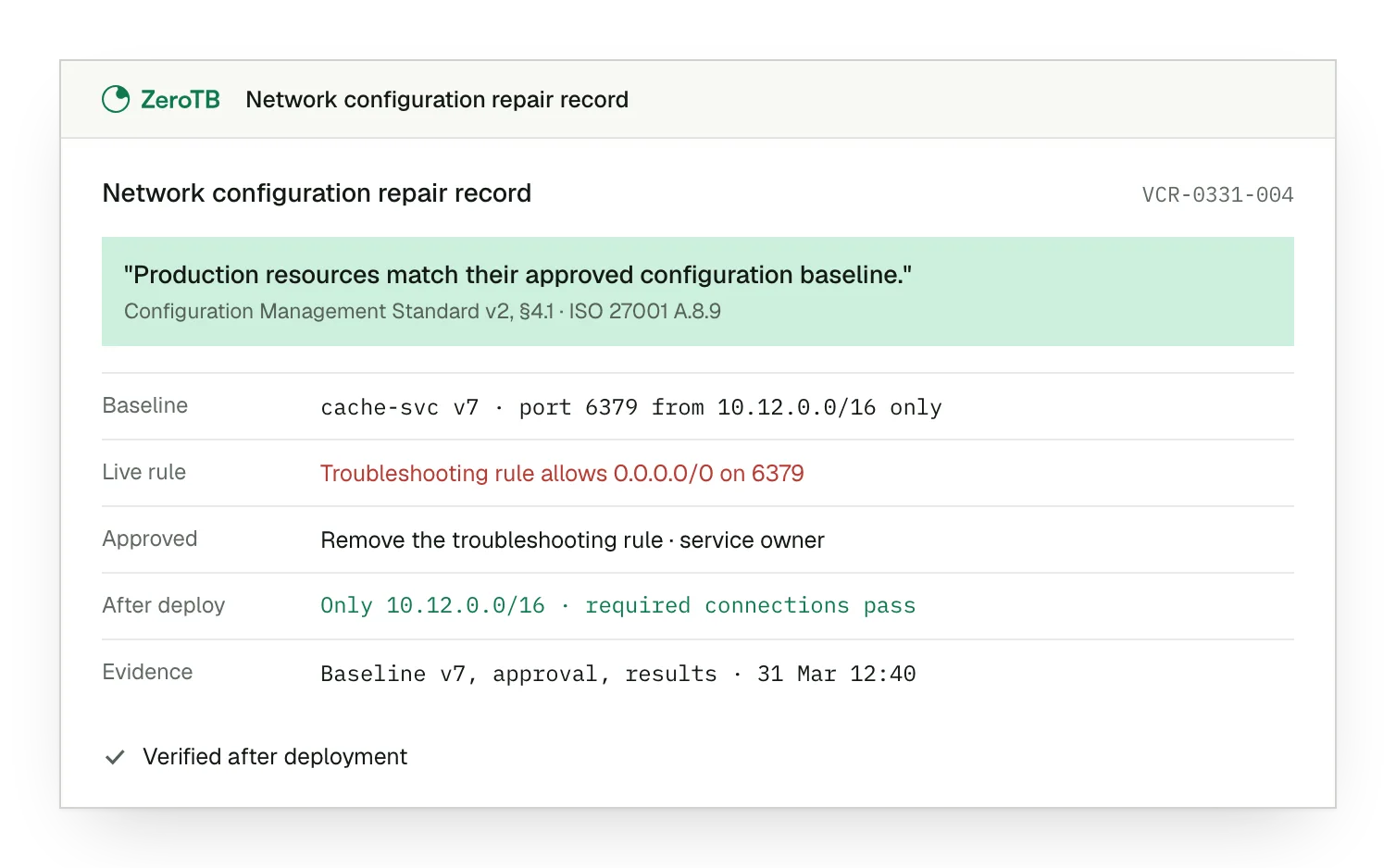
Observed network gap. Production permits a broader range of connections than the baseline recorded beside it.
Approved rule removal. The owner approves removing the troubleshooting rule after checking which connections the service needs.
Deployed result checked. The restricted rule remains after deployment, and tests show that the required connections work.
Repair evidence retained. The resource record includes the baseline version, the owner's approval and the dated results.
Configuration review checklist
Match the approved settings and baseline version to the resources and environments the control covers.
Compare deployed values with the baseline and deployment source, recording any settings the check cannot inspect.
Establish whether the owner approves a repair, a limited exception or a justified change to the baseline.
Confirm the approved settings after deployment and test that required services still work with the correction.
Keep the observation, approved action and verification together, with an owner and schedule for further checks.
Sources
- ISO/IEC, ISO/IEC 27002:2022 overview, 2022.
- NIST, Guide for security-focused configuration management of information systems, updated 2019.
- AWS, CloudFormation drift detection, accessed November 4, 2026.
- HHS, Summary of the HIPAA Security Rule, accessed November 4, 2026.
Start with the Pilot
Talk with our team about the configuration gaps that recur in your systems. In the eight-week Pilot, we map up to 25 commitments, restore two real control gaps and verify the results. The work includes records of the changes, approvals and checks.