Under SOC 2 CC5.1, a company chooses and develops control activities to reduce the risks that could prevent it from meeting its objectives. Begin with the risk and the work it affects. The chosen activity needs to address both, with a design that can change as the business changes.
Finishing a scheduled review says little about the work it missed. A new process may sit outside its scope, even while the old checklist shows every task complete. CC5.1 belongs to SOC 2 CC5 and concerns the selection and design of those activities.
Risk and control purpose
A useful control activity addresses a specific way the company could fail to meet an objective. The risk description explains what could go wrong, where it could happen and why it matters. The activity then interrupts that failure or reveals it early enough for someone to respond.
There is no useful control count without that context. Several activities may address different parts of one risk, while one activity may support several objectives. A review of the control set should explain those relationships and identify risks that still lack an adequate response.
Preventive and detective activities
A preventive activity intervenes before the unsafe action takes place; a detective activity reveals a problem that needs a response. Approval before a change is one preventive measure. Examining completed changes is detective work, which needs an owner able to investigate and act on the findings.
There is a practical question behind that choice: how long could the problem remain before someone must act? Later review can suit errors that are recoverable. Immediate exposure of sensitive information calls for stronger prevention. Detection can then check whether the preventive measure has failed or been bypassed.
Manual and automated work
A repeatable check with known inputs is a useful candidate for automation. Software can compare settings across systems with the same approved rule. Deciding whether an exception has a business purpose takes context, however. That decision belongs with a person who understands the work and its risks.
The reviewer needs to see what the check observed and why it raised a finding. A failed connection also needs attention: no findings may simply mean no data arrived. Showing missing and stale observations helps the reviewer distinguish an incomplete check from a result they can use.
Separation of conflicting duties
Separate duties where one person could both make an unsafe decision and conceal its effects. Follow the actual permissions through the process, from requesting an action to reviewing its result. Two job titles can still leave one person able to perform both tasks through a shared account.
Where a small team cannot fully separate the duties, the risk owner needs to consider other safeguards. An independent review may help if it covers the relevant activity soon enough to act. Record why that arrangement addresses the conflict, including the work and period the review covers.
Scope and operating conditions
A control needs a defined population and a result that someone can check. Its description should identify the systems, transactions or people it covers, along with the expected condition. An owner and an agreed response explain what happens when an observation falls outside that condition.
Frequency belongs in this design decision. A scheduled review needs to cover the activity since the previous review, including any excluded routes or approved exceptions. Its timing should reflect the risk and the rate of change. Copying a cadence from another process can leave substantial work unchecked.
Changes to the working process
Changes in volume, systems or responsibilities can make an established control inadequate. A release review designed around occasional deployments may miss work after teams add pipelines or deploy more often. The scheduled review can still finish on time while its coverage falls behind the process.
Process changes therefore provide a reason to reconsider the design. New systems can expand the population; staff changes can combine previously separate duties. A review of those changes should establish whether the current activity still reaches the affected work and whether its owner can respond at the required pace.
Design gaps and operating failures
The right correction depends on whether the control was poorly designed or stopped operating as intended. A missed review is an operating failure when the agreed review would have covered the risk. A review that excludes a new release route has a design gap even when performed correctly.
The first case may need the missed work completed and its cause addressed. The second needs revised coverage or a different activity. Repeated missed reviews can also expose a design problem: the assigned owner may lack the capacity or access needed to perform the promised work.
Approved control revisions
A revised control needs an explicit decision about the risk it will address and the work it will change. The risk owner judges whether the proposed activity is adequate. The system owner assesses its practical effect, including necessary access, emergency work and any retained exceptions.
Their decisions establish the new expectation and when it takes effect. Recording the reason for the revision helps later reviewers understand the change. An unresolved exception needs an owner and review conditions; changing the document alone does not correct the activity or remove the risk.
Verification after a change
Verification should test the behavior the revised control promises. If a new approval requirement is meant to stop unreviewed releases, test that an unapproved release is blocked and an approved release can proceed. Reading the setting alone leaves its effect on the working process untested.
The result belongs beside the approved change and the observation that prompted it. ZeroTB's Verified Control Record keeps the commitment, before-and-after state, action, approval and verification together. A failed test or unavailable observation leaves the gap open for further work, with its current status visible.
Evidence across the review period
A successful test shows the corrected state at that time; later records show whether the control continues to operate. Dated reviews, approvals and system observations help a reviewer follow that history. Missing periods need an explanation because the latest successful check cannot establish what happened earlier.
Keep each design version connected to the work performed under it. The effective date explains which requirement applied to each activity when a control changes during the period. Records of failures and corrections then show the team's response, alongside evidence from periods when the control operated as expected.
Evidence for control selection
Evidence should connect the risk, the chosen activity and the work performed under that design.
| Requirement | What an auditor asks for | Where it comes from |
|---|---|---|
| Risk rationale | The objective, relevant risk and reason the selected activity can reduce that risk | Risk assessments and approved control descriptions |
| Defined operation | The covered population, expected result, timing and response when the activity finds a problem | Control procedures, system inventories and review instructions |
| Assigned authority | Who performs and reviews the activity, including conflicting duties and approved exceptions | Role assignments, permissions and exception decisions |
| Evidence of operation | Dated records showing what the activity covered and the results during the relevant period | Review records, approval histories and system observations |
| Verified correction | The gap, approved revision, effective date and test showing the resulting behavior | Change records and verification results linked to the applicable control version |
Requirements across frameworks
| Framework | Control | What it covers |
|---|---|---|
| SOC 2 | CC5.1 | Selection and design of activities that reduce risks to the company's objectives |
| ISO 27001 | A.5.3 | Separation of conflicting duties and responsibilities that could permit errors or misuse |
| HIPAA | 164.308(a)(1) | Security management, including analysis and treatment of risks to electronic protected health information |
Example of restoring release review coverage
The monthly review in this example examines releases from the old pipeline. A new pipeline has started deploying changes outside that review. Its owner approves a gate requiring review before release, then tests whether the new rule stops unreviewed work and permits approved changes.
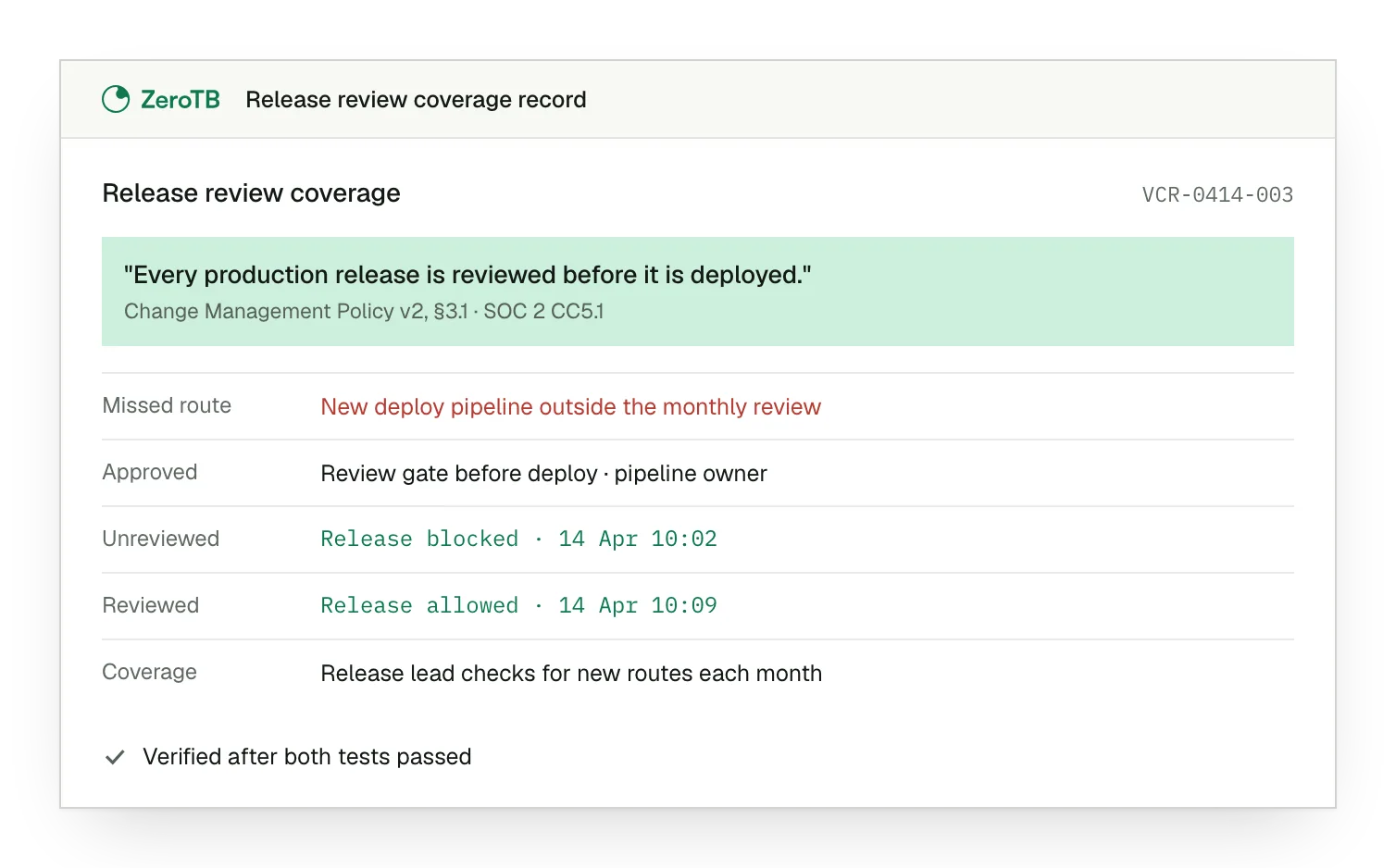
Missed release route. Deployments from the new pipeline are absent from the work examined each month.
Approved design change. The pipeline owner approves adding a gate that requires review before deployment.
Release behavior tested. Testing stops the release without approval and permits the one with the required review.
Continuing coverage checks. An assigned owner checks for further release routes that could escape the revised control.
Control activity review checklist
Check whether the selected activity addresses the current risk and whether its expected effect is clear enough to test.
Compare the control's scope with current systems and work routes, including exceptions and recently changed responsibilities.
Distinguish a missed activity from an inadequate design, then approve a correction that addresses the cause.
Check that the correction prevents or reveals the intended failure while preserving the work the business still needs.
Inspect dated results after the correction and identify missing observations, repeated failures or changes that require another design decision.
Sources
- AICPA & CIMA, 2017 Trust Services Criteria with revised points of focus, 2022 revision.
- ISO, ISO/IEC 27002: Information security controls, 2022.
- HHS, HIPAA audit protocol, security management process, 2018 update.
- ZeroTB, SOC 2 compliance automation with human approval, 2026.
Related pages
SOC 2 criteria
Read the wider SOC 2 criteria alongside the guidance on choosing activities for specific risks.
Compliance frameworks
Find the guides for other frameworks and examine how their requirements relate to the work.
Compliance controls
Follow the work involved in maintaining controls after their design and initial implementation are complete.
Start with the Pilot
Talk with our team about keeping control activities effective as the work changes. The eight-week Pilot maps up to 25 commitments and takes two real gaps through approved correction and verified restoration, with evidence of the completed work.