SOC 2 CC2.3 addresses communication with outside parties about matters that affect internal controls. Customers, suppliers and auditors need relevant information, and the company needs ways to receive and assess their concerns. Keep those communications accurate, assign responsibility for incoming reports and test the routes after changes.
A customer can follow the reporting instructions in a contract and still receive no response. The address may accept messages while the team responsible for them has moved to another system. Within SOC 2 CC2, external communication needs attention to both the information shared and the route back.
External parties and responsibilities
Customers, suppliers and auditors each have a reason to receive information about the service's controls. What they need depends on their relationship with the company. Reporting instructions help customers raise concerns; agreed security duties tell suppliers what they must do for the service.
Auditors need information about the controls under review. For each audience, identify who approves the material and which obligation it explains. The reviewer can use that relationship to check recipients and content, including whether a communication still describes the service its recipient uses.
Approved information
External answers need an approved source that reflects the service being discussed. Contracts, support instructions and security responses can describe different versions of the same commitment. Compare them when the service changes, so customers receive information that applies to their agreement and use.
When sharing a SOC 2 report, keep its scope and period clear and apply the approved access conditions. Retain the version shared and its recipient. Those records help explain what a customer received if a later question refers to an older report or answer.
Incoming reports
A published reporting address is useful only if messages reach someone responsible for assessing them. Check the destination behind each relevant address or form. Delivery to a mailbox, creation of a support ticket and assignment to a reviewer are different events in that route.
The receipt record should identify where the concern arrived and who became responsible for it. An automatic acknowledgement tells the sender that a system accepted the message. The internal record should also show that someone can review it and initiate the appropriate response.
Escalation and decisions
An external concern can require a decision beyond the authority of the person who receives it. Security staff may need to investigate a technical report. The owner of an agreement may need to resolve a question about a customer's obligations before anyone replies.
The communication procedure should identify how to reach those decision makers and return an answer to the sender. Keep the decision beside the original concern. If it leads to corrective work, link that work to the report so its progress remains visible to the reviewer.
Changes after the audit
External instructions can outlast the arrangements they describe. Customers may retain contracts with an old reporting address long after a support migration. If that address leads to an unattended queue, a customer following the agreed instructions can receive no response from the responsible team.
A change review should therefore include material already shared outside the company. Supplier instructions and report-sharing procedures can also require updates when responsibilities or services change. Check the routes and versions still in use, so older communications remain connected to the current operating arrangements.
The scope of a communication gap
A useful investigation starts with the instruction the outside party followed and traces what happened next. Did the information describe the right service? Did the message arrive? Did anyone assess it? The answers identify which part of the communication needs attention and why.
An incorrect answer needs content review, while failed delivery needs a system correction. An unassessed message needs a responsible owner. Keep the observations that distinguish these failures, including the affected period and recipients. Any uncertainty about when the failure began belongs in the investigation record.
Approved corrections
Approval needs to cover both the communication and any system change used to carry it. The owner of an external commitment can judge whether revised instructions meet the agreement. The system owner can assess the proposed destination and how messages will reach its reviewer.
Put the expected result in the proposed correction before either owner approves it. For a reporting address, specify where messages should arrive and who should assess them. These details also define the test: the observed result must match the destination and responsibility the owners approved.
Verification from outside
Verification should follow the route an external party uses. Send a safe test through the published address or form, then confirm receipt and assignment in the intended destination. A configuration screenshot can support the review, but the test establishes whether the route works.
Use test content that contains no sensitive customer information. Record the result and the reviewer who confirms it. If delivery works but assignment fails, the communication gap remains open. The evidence should distinguish the successful step from the part that still needs attention.
Reports received during the gap
Messages sent during the failure need their own review after delivery is restored. Examine the affected queue and available message history for concerns that received no assessment. The responsible owner can decide which need investigation, escalation or a reply to the person who reported them.
The new delivery test cannot answer what happened to these earlier reports. Keep their assessment beside the restoration record, with any resulting work still outstanding. If some history is unavailable, identify the missing period and record the owner's decision about how to investigate it further.
Evidence over time
A reviewer needs to connect the communication in use with the failure and its correction. Retain the approved wording and the observation that exposed the gap. Add the approved action and dated verification so the reviewer can follow what changed and why it was accepted.
Future checks need an owner, including when the service or reporting route changes again. ZeroTB's Verified Control Record keeps the commitment, before-and-after state, action, approval and verification for a completed restoration together. The original communications and received reports provide the context for reviewing that repair under CC2.3.
External communication evidence
The evidence should let a reviewer follow a communication from the agreed responsibility through any concern received and action taken.
| Requirement | What an auditor asks for | Where it comes from |
|---|---|---|
| Defined responsibilities | The duties communicated to each outside party and the owner who approved that information | Agreements and supplier instructions, with the procedure identifying who approves external communications |
| Accurate information | The version of a report or answer sent to a recipient, with its scope | Customer responses, report distribution records and content approvals |
| Working reporting routes | A received message and its assignment, including a test after a route changes | Message records, ticket assignments and dated tests of published routes |
| Assessed concerns | The assessment of an outside concern and the decision about investigation or response | Review records linked to the original concern and any corrective work |
| Verified correction | The approved repair and its test result, plus decisions about reports missed during the failure | Change approvals, delivery results and review of the affected message history |
Related framework requirements
| Framework | Control | What it covers |
|---|---|---|
| SOC 2 | CC2.3 | Communication with external parties about matters that affect internal controls |
| ISO 27001 | A.5.20 | Security requirements agreed with suppliers; relevant to the supplier communication part of this work |
| HIPAA | 164.308(b)(1) | Assurances that business associates safeguard electronic protected health information, within the applicable HIPAA relationship |
Example of restoring a reporting route
This example follows a reporting address that still delivers messages to an unattended queue after a support migration. The approved change forwards them to the security queue. An external test confirms receipt and assignment there, and the owner separately assesses the earlier reports.
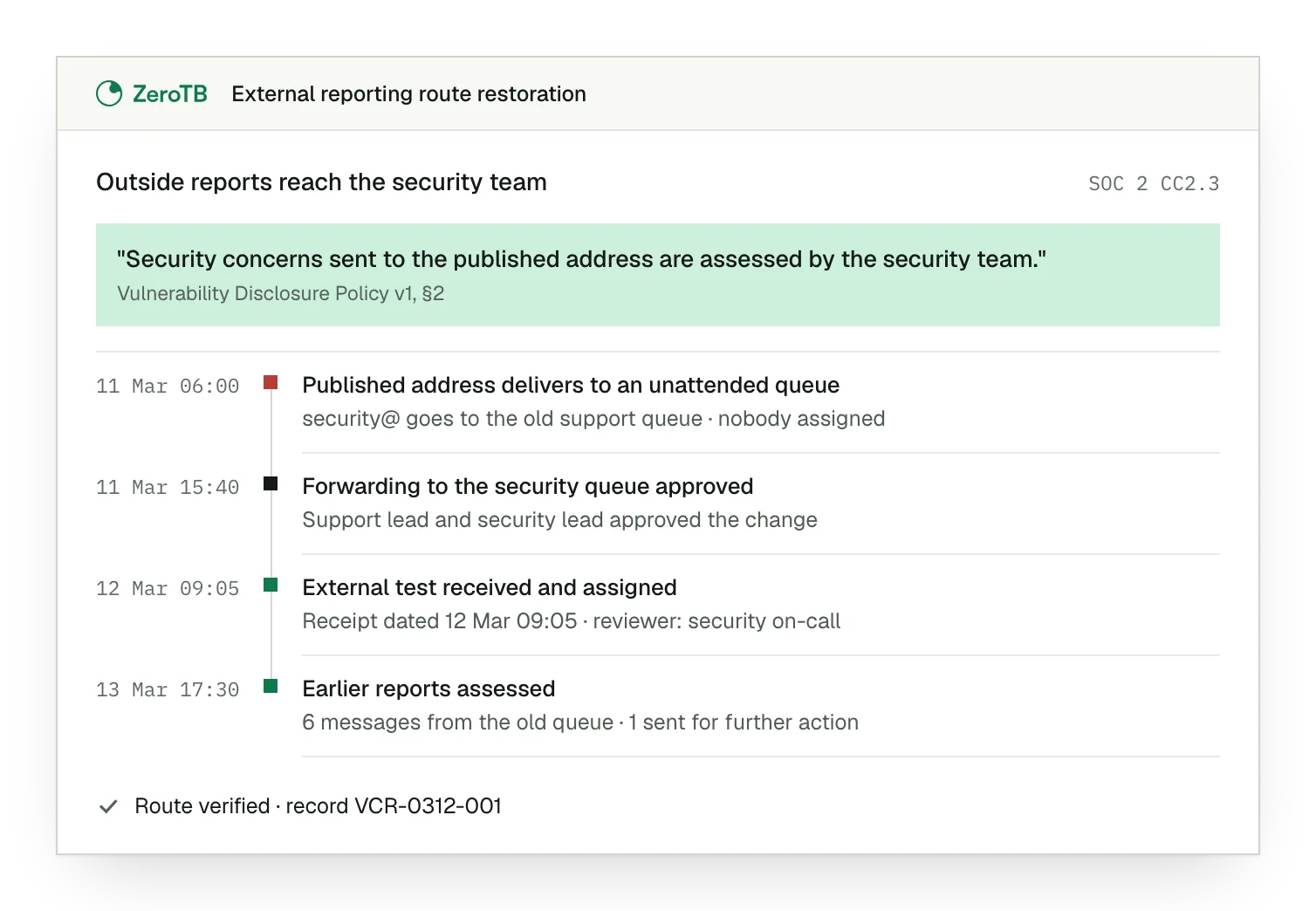
Unattended destination. The reporting address delivers to the old queue, where nobody is assigned to assess incoming concerns.
Approved route change. The record identifies the security queue and the owners who approved forwarding messages to it.
Confirmed message receipt. A test message appears in the security queue, with a dated receipt and an assigned reviewer.
Earlier reports assessed. Reports from the old queue appear with the assessment and decisions about any further action.
External communication review checklist
Identify an approved external instruction or commitment, the parties using it and the owner responsible for its accuracy.
Follow the published address or form through receipt and assignment to establish where an outside concern reaches a reviewer.
Identify the content or system change needed and obtain approval from the owners responsible for its effect.
Test the corrected route from outside and retain the dated result showing receipt and assignment to the intended reviewer.
Review the affected period for unassessed concerns, record the decisions and assign responsibility for further checks.
Sources
- AICPA & CIMA, 2017 Trust Services Criteria with revised points of focus, 2022 revision.
- HHS, Business associates FAQs, accessed November 4, 2026.
- ZeroTB, SOC 2 compliance automation with human approval, 2026.
Related pages
SOC 2 criteria
Place external communication within the wider set of criteria used to evaluate a SOC 2 program.
Compliance frameworks
Explore related requirements across the frameworks that apply to the services and information your company handles.
SOC 2 reports
Understand the report customers receive and the scope they need to consider when reviewing it.
Start with the Pilot
Talk with our team about keeping external communication controls working between audits. The eight-week Pilot maps up to 25 commitments and takes two real control gaps through approved correction and verified restoration, with a record of each completed fix.