SOC 2 CC1.5 requires accountability for control duties: people need to know what work they own, and managers need to assess their performance. When a duty is missed, examine the cause, including workload and incentives. The response should address the overdue work and make the next occurrence achievable.
An assigned owner may still be waiting for an approval when a review deadline passes. Elsewhere, one person may have more reviews than they can complete. SOC 2's control environment includes the management decisions needed when those duties cannot be performed as expected.
Control expectations
CC1.5 makes managers responsible for how people perform their control duties. The company needs to explain the expected work, when it is due and what demonstrates completion. An owner can then understand the duty and the standard against which management will assess it.
The expectation should describe the activity closely enough to distinguish complete work from a partial response. A review may require decisions on exceptions as well as an inspection. The approved procedure gives the owner and manager a common basis for judging whether that review happened.
Authority to act
The person accountable for a control needs authority to obtain decisions and resolve obstacles. Some duties depend on another team supplying information or approving a change. The assignment should make those dependencies visible, including who can decide when the work cannot proceed.
Shared work still needs someone responsible for its overall completion. The people performing individual tasks may differ from the person approving the result. Clear responsibilities help a manager identify where work stopped and direct the response to someone who can act.
Performance assessment
Managers need to assess whether control duties were performed to the agreed standard. A completion status provides a starting point for that assessment. The supporting record should show what the person reviewed, the decisions reached and any work still outstanding.
Performance discussions can then address the actual duty and the conditions under which it was carried out. Recognize work that meets expectations and examine failures consistently. Where conduct requires a formal response, managers should use the company's established process and retain the relevant decision.
Incentives and rewards
Performance targets should support the control duties assigned to each role. A team measured only on delivery speed may face pressure to skip required approvals. Management needs to consider whether its measures and rewards encourage the behavior that its policies require.
Review those measures when responsibilities or business priorities change. A target that suited a smaller team may discourage necessary review as its workload grows. Managers can adjust the expectation or incentive and explain how the change gives the team room to perform its control duties.
Workload and delivery pressure
Managers need to consider workload when a person repeatedly misses a control duty. An acquisition can increase the number of reviews while the owner and deadline stay the same. The review history may show when that change began to affect performance.
Compare the assigned work with the time and support available. Management can provide another reviewer, redistribute duties or resolve competing priorities. If the response changes a deadline, record the approval and reason. The decision must also account for the review that is already late.
Changes in responsibility
Role changes need an explicit transfer of unfinished and recurring control work. An assignment can remain attached to someone who has moved teams, while the new manager assumes another person owns it. Review the responsibilities whenever the people or reporting relationships change.
The transfer should identify the next duty, any overdue work and the authority needed to complete both. A replacement owner needs access to the relevant decisions and records. Management can then check whether the new arrangement covers the work that depended on the previous owner.
Responses to missed duties
Managers need to understand the reason for a missed duty before deciding how to respond. Delays caused by workload or missing authority call for changes to those conditions. Where conduct is the issue, the response follows the company's established process for that behavior.
Include the outstanding work in the decision. The owner needs to know what action has been approved and how its result will be assessed. Completing the late task resolves that occurrence; the next review shows whether the underlying cause still prevents the work from happening.
Escalation decisions
An escalation is useful when its recipient can resolve the problem delaying the duty. Sometimes an owner needs a decision from another team. Sometimes the immediate manager needs authority to change priorities. The escalation route should identify who can make the outstanding decision.
ZeroTB assigns scheduled process work, escalates late duties and verifies completion against the commitment. Managers use those observations to decide a response and retain responsibility for staffing, performance and acceptable exceptions. The record keeps the status of the duty visible while a decision is pending.
Verification after correction
Verify the completed duty against the expectation that applied when it was due. A review that required decisions on exceptions needs those decisions recorded before it can be considered complete. Check the actual review output alongside the date and status recorded for it.
The next occurrence tests whether the revised arrangement works in practice. Examine whether that activity happened on time and produced the required evidence. Another delay gives management a reason to reconsider the cause. Retain the original deadline so the record shows both the lapse and the later performance.
Evidence over time
Keep the original expectation with the decisions and results that follow a missed duty. A reviewer should be able to trace when the work was due, what prevented completion and what management approved. Dated evidence then shows what happened after that decision.
The Verified Control Record connects a commitment with observed states, action, approval and verification. For a process duty, attach evidence of the completed activity to that history. Make any outstanding review or decision visible so the record accurately describes how much of the work is complete.
Accountability evidence
Use these records to show how expectations, management decisions and completed duties connect.
| Requirement | What an auditor asks for | Where it comes from |
|---|---|---|
| Communicated duties | The assigned work, expected timing and standard used to judge completion | Approved procedures, role responsibilities and records showing that owners received their assignments |
| Performance and incentives | How managers assess control duties and align measures or rewards with them | Performance criteria, review records and approved changes to targets or incentives |
| Workload assessment | The reasons for missed work and management's decisions about capacity or pressure | Overdue-work history, workload reviews and decisions on resources, priorities or revised coverage |
| Corrective response | The action approved for a missed duty, its owner and escalation route | Management decisions, exception records and the work assigned to resolve the gap |
| Verified performance | Evidence of completed duties and results under the revised arrangement | Dated review outputs, verification results and records from the next scheduled activity |
Framework requirements
| Framework | Control | What it covers |
|---|---|---|
| SOC 2 | CC1.5 | Accountability for control duties, including performance expectations and management responses to missed work |
| ISO 27001 | A.5.4 | Management responsibility for personnel applying the organization's information security policies and procedures |
| HIPAA | 164.308(a)(3) | Workforce access to electronic protected health information, including appropriate authorization or supervision |
Example of restoring an overdue review
Sharing the review work addresses the capacity problem in this example. One owner has taken on more responsibilities and missed a monthly deadline. The manager assigns another reviewer to help, then examines the overdue review and the following month's work.
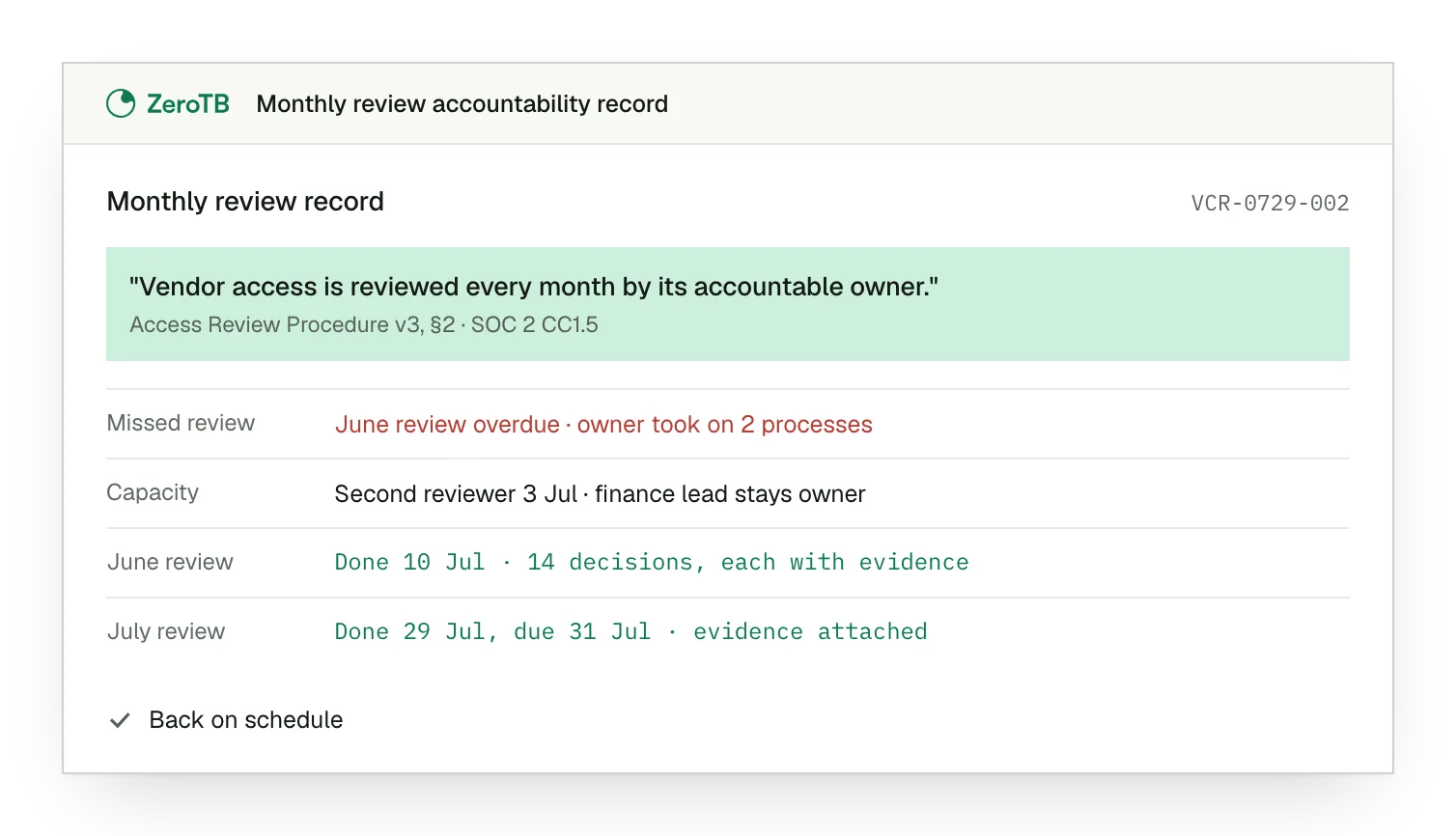
Missed review. The record shows an overdue monthly review and the extra responsibilities assigned to its owner.
Capacity decision. The manager assigns some review tasks to another person and retains the existing accountable owner.
Completed work. The review now contains its required decisions, each linked to evidence of the completed work.
Following month. The next monthly review has the required evidence and a completion date before its deadline.
Accountability review checklist
Identify the assigned activity, its deadline and the evidence that the approved procedure requires for completion.
Examine the missed work with its owner and distinguish workload, authority, conflicting targets and conduct issues.
Decide how to complete outstanding work and address its cause, with an owner and an escalation route.
Compare the following activity with the agreed expectation to see whether the changed arrangement supports timely completion.
Connect the original gap, management's decision and subsequent results so a reviewer can follow what changed.
Sources
- AICPA & CIMA, 2017 Trust Services Criteria with revised points of focus, 2022 revision.
- HHS, HIPAA audit protocol, workforce security, updated July 2018.
- ZeroTB, How to stop recurring SOC 2 findings, 2026.
Related pages
SOC 2 criteria
Explore the wider control environment and the other criteria that support a SOC 2 program.
Compliance frameworks
Find guidance on the requirements that share control work across SOC 2, ISO 27001 and HIPAA.
Governance, risk and compliance
See how control ownership and management decisions connect to the work of operating a compliance program.
Start with the Pilot
Talk with our team about recurring control gaps. The eight-week Pilot maps up to 25 commitments and takes two real gaps through approved correction and verified restoration, with records showing the work and its results.