SOC 2 CC1.4 asks whether the company hires, develops and retains people who can do the work its objectives require. For control owners, that means defining the skills a duty needs and checking that the assigned person has them. Revisit that judgment when the work changes, and keep the assessment with any corrective action.
Training may be complete for a job that has since changed. In the CC1 control environment, the company needs people who can perform the duties they hold today. That includes the unfamiliar work added since their last assessment.
Role requirements
Describe competence in terms of the work someone must do. An access reviewer, for example, needs to understand the permissions they are reviewing. They also need to recognize when they lack enough information to decide and should ask for help.
Use the company's policies and report commitments to establish which duties belong to the role. For each duty, describe the knowledge needed and a way to assess it. Those requirements give the hiring manager and control owner something specific to discuss with the person.
Hiring decisions
Hiring should test the capabilities needed for the assigned control duties. Consider relevant experience, background and technical skills against the role's requirements. A practical discussion or exercise can reveal how a candidate would approach the decisions the job involves.
Keep the selection criteria consistent with the work. Prior experience may support the hiring decision, while local procedures still need explanation during onboarding. Record any development needed before the person takes responsibility for a control without supervision, and who will assess that readiness.
Role-specific development
Development should prepare people for the work they will perform. General security awareness helps staff recognize common risks. A person responsible for reviewing privileges or directing an incident also needs practice with the systems and decisions that duty involves.
Choose learning that addresses the missing skill: instruction, mentoring, supervised work or an exercise. Agree what successful performance would look like before the learning begins. Attendance records show participation; the relevant task or assessment supplies evidence that the person can apply what they learned.
Changes after the audit
System changes can leave an experienced person unprepared for part of their job. Consider a cloud reviewer who knows the existing permissions well. A newly introduced service may use different privileges, and the last assessment may never have tested that knowledge.
When reviewing a system or process change, ask which duties will change with it. The owner can then arrange instruction or supervision before the next control activity. Keep that learning need open even if the person's annual training record shows every course complete.
Retention and continuity
Retaining experienced people preserves knowledge the company uses to operate its controls. A manager's development discussion should include the control work a person performs and the support they need to continue. Relevant expertise and time to learn both matter here.
Pay particular attention to duties that depend on one person's memory. Give others opportunities to learn those procedures and record the reasoning behind important decisions. Experienced staff can then develop into other work without leaving the company dependent on them for every difficult review.
Backup readiness
A designated backup needs practice before the company can rely on them. Their name in a procedure says who should take over. It leaves open whether they can use the current systems, handle an exception and reach the right decision.
Try the handover while the usual owner is available to help. Observe where the replacement gets stuck, then correct the procedure or provide further practice. Repeat the exercise when an important duty changes or a departure leaves someone else responsible for it.
Outsourced duties
An outsourced control duty still needs someone with the skills to perform it. Define the work expected from the provider and the evidence that would demonstrate it was performed. Include changes in assigned personnel when considering whether that capability remains available.
Keep the company's decision authority clear where external specialists support the work. A provider may supply technical expertise while an internal owner approves the resulting action. Agree how a capability gap will be reported and who will arrange qualified coverage while it is resolved.
Correction choices
The correction should address the missing capability and the work at risk while it is being developed. Additional instruction may be enough for a narrow knowledge gap. Unfamiliar or urgent work may need supervision, reassignment or specialist help in the meantime.
Record the affected duty, the proposed support and the owner's decision. Give the corrective work an owner and a completion condition tied to the task. If the problem is an unclear procedure, revise that procedure too; another course may leave the same obstacle in place.
Practical assessment
Close a competence gap when the person can perform the relevant duty to the agreed standard. A qualified assessor can observe a supervised task, review a completed exercise or examine the reasoning behind a control decision. Select an assessment that matches the actual work.
Keep the result specific: what was assessed, when it happened and what the assessor concluded. If support is still needed, record that condition and continue it. A course completion date alone cannot show whether a reviewer understood the permission change that prompted the correction.
Continuing checks
Changes in work should prompt a decision about whether skills need another check. Include transfers and departures as well as new systems. Tell the owner which duty is affected, so they can decide whether the existing assessment still covers the work.
ZeroTB schedules recurring training and exercises from the company's commitments and assigns owners, with escalation when actions become overdue. A person assesses competence. Retain that assessment with the action so the owner can see what was learned and whether any further support is needed.
Evidence boundaries
Keep enough employment evidence to explain the control decision. A reviewer needs the relevant role requirement and assessment, with a date and conclusion. Unrelated personnel information can stay with the people who are authorized to manage those records for the company.
A reference to a supporting record may be sufficient for a particular review. Agree with the auditor which records they need to inspect. Keep the original gap linked to the later assessment so they can follow why the owner accepted the correction.
Audit evidence
Use evidence that connects the role's requirements to the person's readiness and any correction.
| Requirement | What an auditor asks for | Where it comes from |
|---|---|---|
| Defined competence | Duties, required skills and the basis used to judge readiness | Role descriptions and approved control procedures |
| Suitable hiring | Relevant selection criteria and completed checks supporting the hiring decision | Hiring and onboarding records, with access limited to relevant evidence |
| Continued development | Assigned learning, participation and follow-up for identified skill gaps | Development plans, training records and mentoring records |
| Practical readiness | The task assessed, assessment date, result and any remaining support needs | Supervised work, exercises and the assessor's decision |
| Backup coverage | Important duties, designated replacements and evidence of a usable handover | Succession plans, backup assignments and handover exercises |
| Completed correction | The original gap, approved support, resulting assessment and closure decision | The correction record and linked evidence of the completed work |
Related framework requirements
| Framework | Control | What it covers |
|---|---|---|
| SOC 2 | CC1.4 | Hiring, developing and retaining people with the competence needed for their responsibilities |
| ISO 27001 | A.6.3 | Security awareness, education and training suited to people's work, within the information security program |
| HIPAA | 164.308(a)(5) | Workforce security awareness and training, including management, within the HIPAA Security Rule's scope |
Example of restoring reviewer readiness
A supervised cloud review reveals a skill gap in this example: the reviewer cannot explain a new role's permissions. The owner arranges practice with a specialist. Closure depends on what the reviewer demonstrates in a later assessment of the same task.
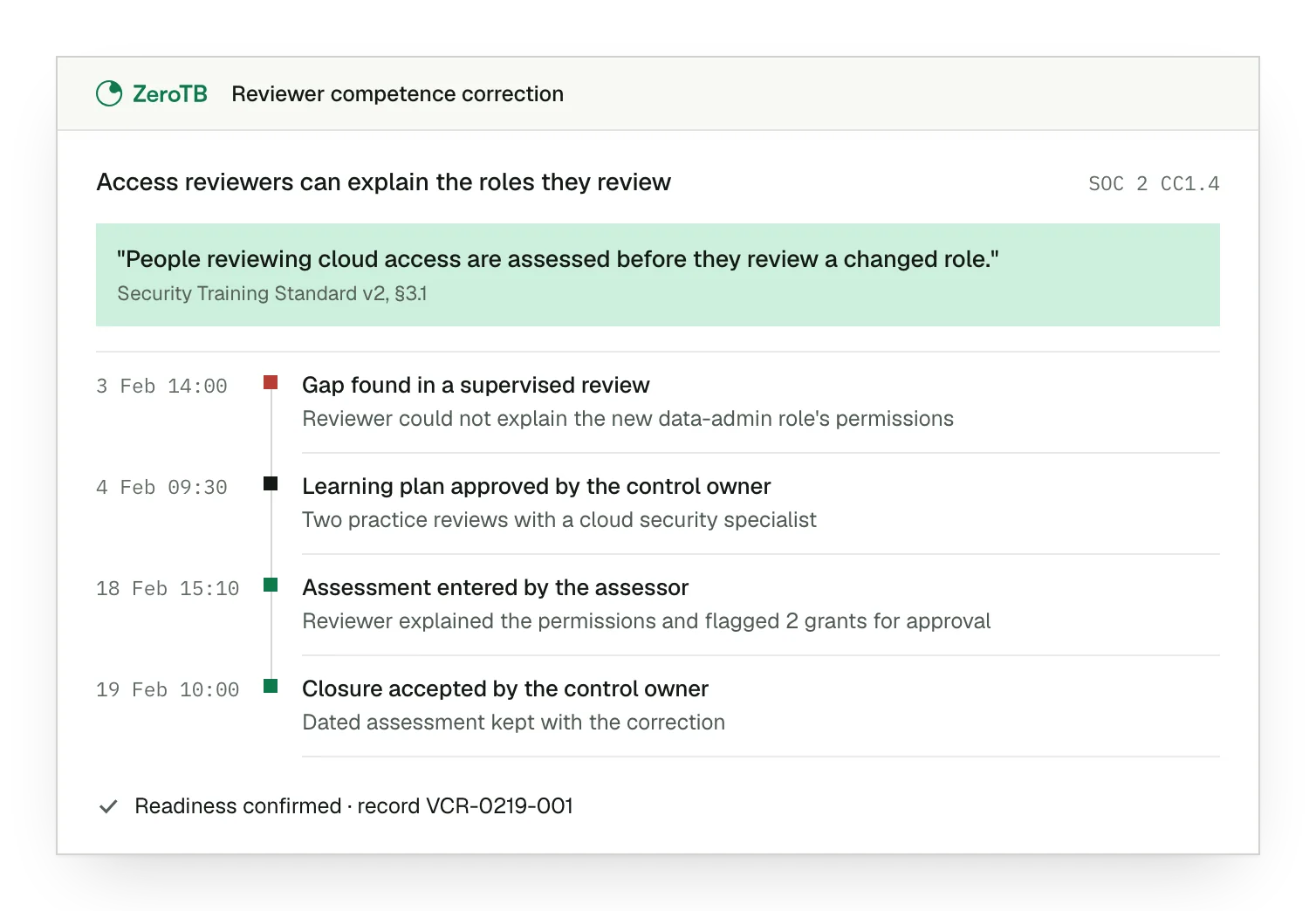
Identified skill gap. The reviewer encounters permissions they cannot explain during the first supervised review.
Approved learning plan. A specialist helps the reviewer practice under an arrangement approved by the control owner.
Assessment result. On the next assessment, the reviewer explains the permissions and identifies access needing approval.
Recorded closure. The owner accepts the assessor's findings and keeps the dated result with the correction.
Competence review checklist
Start with one control responsibility and identify the skills needed to perform its current procedure.
Review the assigned person's demonstrated work against those skills, including any duties added since the last assessment.
Agree who will provide learning or supervision and what result would allow that support to end.
Ask a qualified assessor to observe the relevant task and record where the person still needs help.
Link the assessment to the closure decision and revisit it when the duty or its coverage changes.
Sources
- AICPA & CIMA, 2017 Trust Services Criteria with revised points of focus, 2022 revision.
- AICPA, Trust Services Criteria, CC1.4, March 2020 update, pages 15–16.
- HHS, HIPAA audit protocol, security awareness and training, 2018 update.
- ZeroTB, SOC 2 compliance automation with human approval, 2026.
Related pages
SOC 2 criteria
Explore the wider set of criteria and how people support the controls within it.
Compliance frameworks
Find guidance on related requirements across the frameworks that apply to your company.
Control operations process
See how commitments become checks, approved corrections and records of the resulting control state.
Start with the Pilot
Talk with our team about keeping control duties covered as the company changes. The eight-week Pilot maps up to 25 commitments and takes two real control gaps through approved correction and verified restoration, with evidence of the work.