What does ISO 27001 A.6.3 require for training staff on security?
ISO 27001 A.6.3 covers the awareness, education and training people need to meet their security responsibilities. Training staff on security therefore follows their work: a new role or changed procedure may call for new learning. Review the current population against completed learning, resolve omissions and keep evidence that the required work was done.
An engineer completes the general security course and later becomes an administrator. The new role requires further learning, but no assignment arrives. When the training report is reviewed, the employee still appears among those who completed everything assigned to them.
To find this kind of gap, the reviewer needs information from outside the course report. Compare current responsibilities with the learning on record, then ask which assignments should exist. A missing assignment needs an owner just as an overdue course does.
Training scope
A.6.3 links the learning people receive to the security responsibilities they carry. It sits within the people controls in Annex A. Shared awareness introduces company expectations; further education and training help people apply those expectations in the work assigned to them.
An approved training commitment gives the reviewer something specific to check: who needs learning, which subjects apply and when an update is due. Without that context, a completion date says little about coverage. Read the date alongside the role and the requirement that made the training necessary.
Training population
Training coverage starts with the people who need the learning. A learning platform's completion rate describes the people assigned a course. Anyone missing from that assignment can remain invisible, even when the report shows that every enrolled person has finished the required work.
Compare assignments with current employees and relevant contractors, using their responsibilities to establish which learning applies. Reconcile differences such as a recent starter, a changed role or a person recorded under another account. Preserve the reason for each inclusion or exclusion so the next review uses a consistent population.
Training for each role's security duties
Learning should prepare people for the security decisions their work involves. Common awareness may cover recognizing suspicious requests and reporting concerns. Staff who operate controls also need learning relevant to those duties, such as reviewing access requests or responding to an alert from a production system.
Choose content and exercises around the decision the person needs to make. An administrator might need to explain how an access exception gets approved; a new starter needs to know where to report a concern. The difference in responsibility determines the depth and method of learning appropriate to each person.
Training after role changes
A transfer can create a training gap even when the employee has completed every course previously assigned. Consider an engineer who takes on administrator duties. Their general-awareness record is still valid, but it gives no evidence that they learned the procedures for the new responsibilities.
At the transfer, compare those responsibilities with the learning already recorded. The training owner decides what carries over and what additional learning to assign. Keep the transfer date with the new assignment and completion dates; together, they show whether there was a period of missing coverage.
Current learning material
A procedure change can leave otherwise suitable training out of date. Suppose the company replaces its incident-reporting route after staff complete the course. The old completion records remain available, but they cannot show that staff learned where reports should now go or how to send them.
Link each assignment to a version or dated copy of its material. That lets the owner identify who needs the changed instruction. A small procedural change may need a focused update; a new task may need practice. Choose how to check the update according to what changed.
Overdue training
Resolving overdue learning starts with finding out why the person has not completed it. Access to the course may be broken, the content may be unsuitable, or the learner may need time. Give the issue an owner and keep the original due date alongside any approved revision.
For this human work, ZeroTB schedules tasks from the commitment, assigns them, escalates delays and checks completion. The learner performs the training; people approve material decisions. The control operating process keeps the missed task with an owner until the record shows the work has been completed.
Checks of understanding
A completed course records participation in learning. To check whether the person understood it, use a discussion, exercise or assessment that fits the responsibility. Someone responsible for reviewing access requests, for instance, could explain the decision they would make and the approval they would seek.
Agree what the check must establish, and keep the result with the learning record. If the person needs further learning, leave that work open until the follow-up check succeeds. NIST's learning guidance discusses evaluating programs as needs change, providing a practical reference for reviewing the approach over time.
Repeat assignment failures
Fixing one missed assignment can leave its cause untouched. If transfers never reach the training owner, another employee can miss the same course. Review the transfer process as well as the individual's learning, including how the owner receives new duties and chooses the learning they require.
A subsequent transfer provides a chance to test the process correction: did the expected assignment appear? Keep this check separate from the earlier employee's completed learning. The owner can close the verified individual task while the process correction remains open, awaiting evidence from the next relevant change.
Training evidence
The evidence should let an auditor trace the required learning from its assigned audience through completion and the resolution of missed work.
| Requirement | What an auditor asks for | Where it comes from |
|---|---|---|
| Defined learning | The subjects and roles covered, plus the triggers for new or updated learning | Approved training policy and learning plan |
| Complete coverage | A comparison of eligible staff and contractors with those assigned the required learning | Workforce records, role changes and learning assignments |
| Relevant material | Course content matched to the duties and procedures in force at the time | Dated course material, procedure versions and role requirements |
| Completed learning | Dated completions, with the results of any agreed exercise or assessment | Learning records, exercise outcomes and assessment results |
| Resolved gaps | The missed assignment, owner decision and evidence that the agreed correction was checked | Corrective tasks and supporting evidence in the Verified Control Record |
Related framework requirements
| Framework | Control | What it covers |
|---|---|---|
| ISO 27001 | A.6.3 | Learning that helps people understand security expectations and carry out their responsibilities |
| SOC 2 | CC1.4 | Having and developing the competent people needed to achieve organizational objectives |
| HIPAA | 45 CFR 164.308(a)(5) | A workforce security-awareness and training program, including managers, where the HIPAA Security Rule applies |
Example of closing a training gap
This example follows an engineer who moves into an administrator role without receiving the required learning assignment. The record shows two results: the employee completes the learning, and a later transfer confirms that the corrected process now assigns the expected course.
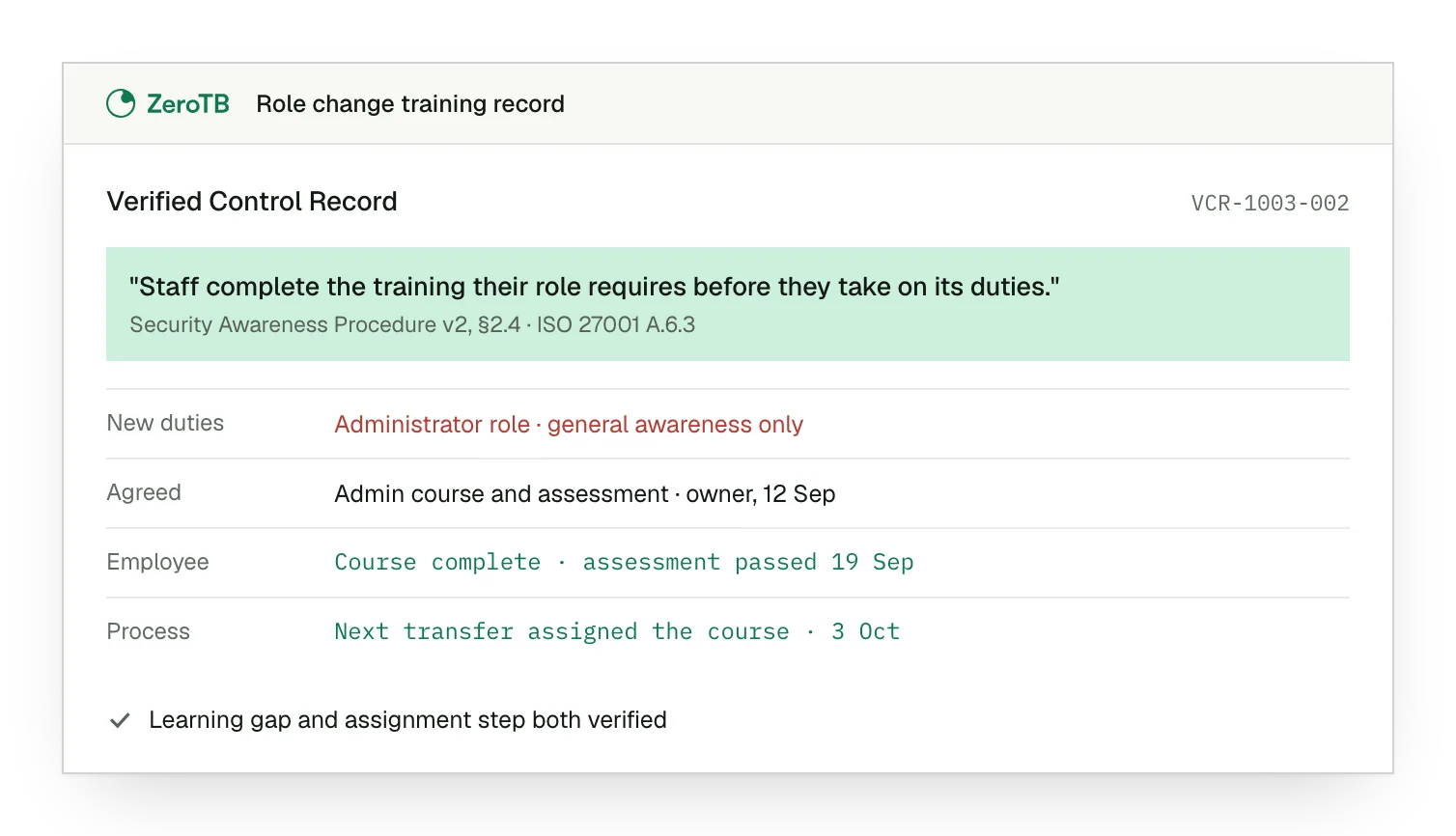
Changed duties. The employee now has administrator duties, but their completed learning covers only general awareness.
Agreed learning. The owner selects the administrator course and assessment required by the new duties.
Verified completion. Course completion and a successful assessment let the owner close the employee’s missing learning task.
Transfer process. A later transfer produces the expected assignment, allowing the owner to verify the process correction.
Training control review checklist
Identify the covered roles, required learning and conditions for updates in the approved training commitment.
Compare current employees and relevant contractors with learning assignments, then investigate people missing from the expected audience.
Inspect recent transfers and procedure changes to establish whether completed learning still covers each person's work.
Check completion and the agreed assessment results before closing a gap, preserving any follow-up work that remains open.
Review the next relevant assignment after a process correction, and retain its outcome with the owner's decision.
Sources
- ISO/IEC, ISO/IEC 27002:2022 standard overview, 2022.
- NIST, SP 800-50 Rev. 1: Building a cybersecurity and privacy learning program, 2024.
- eCFR, 45 CFR 164.308, administrative safeguards, accessed November 4, 2026.
- ZeroTB, Continuous control monitoring, 2026.
Related pages
People controls
Browse the controls for employment, changing responsibilities and other parts of the working relationship.
ISO 27001
Place A.6.3 within the information security management system and its other controls.
Compliance frameworks
Find the framework guidance and control pages for the requirements your company follows.
Start with the Pilot
Talk with our team about the controls you need to keep working. During the eight-week Pilot, we map up to 25 commitments and carry two real control gaps through approved correction and verified restoration, keeping evidence of each result.