Under SOC 2 CC1.2, the board independently oversees management's work on internal controls. Members need to examine both how controls are designed and how they operate. Give unresolved findings a place in board reports, and retain the questions, decisions and follow-up that show members exercised oversight.
If a report says a finding is closed, a board member will usually move to the next issue. Yet the team responsible may still have an overdue action. The difference matters: the board has reviewed an account that leaves out unfinished corrective work.
CC1.2 sits within the CC1 control environment criteria. Its application depends on the company's governance arrangements. Independent members need information they can question and a way to follow management's response after a discussion ends.
Oversight responsibilities
The board's remit should describe its role in reviewing management's internal controls. It gives members a basis for asking about the design of a control or the way it operates. It should also establish what information they can request during that review.
Management operates the controls and responds to weaknesses. The board examines that work against the company's objectives. Both groups need to understand who can decide a matter and when it belongs before the board, so an unresolved issue reaches someone with authority to act.
Independence from management
Independent oversight requires members who can question management's control decisions without reviewing only their own work. Consider who operates the controls, who reports their condition and who can challenge the conclusions. Those responsibilities help explain how independent judgment enters the review.
A meeting described as advisory needs examination of the body's authority and independence before it can support the oversight case. For a small company, discuss the actual governance arrangement with the auditor. The discussion should address who exercises oversight and what that person or body can do.
Access to expertise
Board members need enough relevant expertise to understand the control issues placed before them. That includes access to security knowledge when the review concerns security controls. Members need to understand the significance of a finding before deciding whether management's response is adequate.
The reporting process should let members request explanations and further detail from people with the relevant knowledge. A summary of risk can start the discussion, but members also need to understand the assumptions behind it. Record unresolved questions so the next response addresses the uncertainty.
Complete control reports
A board report must preserve unresolved findings that could change the board's judgment. A summary that marks every finding closed can hide overdue corrective work. Compare the report with the underlying findings and actions before accepting its account of control performance.
Each material conclusion should have a source that a reviewer can examine. Keep the finding, current status and outstanding action connected so the report explains any difference between them. If an action is complete but its result is awaiting a check, the report should preserve that distinction.
Review timing
Set reporting dates around the matters the board is responsible for reviewing. Management can then plan when to present findings and return with responses to earlier questions. The arrangement also needs to identify issues that warrant contacting members before the next scheduled meeting.
An unresolved routine action can remain on the next report. A significant new control failure may need an earlier discussion. In either case, the record needs to show when members considered the issue and what they decided, alongside the information available to them then.
Management's response
A board question needs a recorded response and someone responsible for the resulting action. Minutes should explain the matter examined, the concern raised and the decision reached. This gives the responsible team a clear account of what the board expects management to address.
Follow-up records should show the action owner, expected timing and any unresolved decision that prevents progress. If a correction requires additional resources or a revised approach, that decision needs to return to the appropriate authority. An overdue action should remain visible until management explains how it will proceed.
Evidence of closure
A corrective action is ready to close when the evidence shows that its intended result occurred. For a reporting gap, that means checking the corrected information and the board's review. For an underlying technical gap, it means examining the resulting system state.
ZeroTB's Verified Control Record connects a commitment, before-and-after state, action, approval and verification for a completed restoration. Such a record can inform the board's assessment of management's response. Board members still decide whether the response addresses the concern that prompted their review.
Continuing oversight
The next report should show whether earlier decisions still have unresolved actions. Carry those actions into subsequent reviews with their current owners and supporting evidence. Otherwise, a change of reporting period can remove unfinished work from the board's attention.
The reporting process itself also needs an owner. When staff or tracking systems change, preserve the connection between findings and board decisions. A corrected report establishes what members received on that occasion; checking later reports shows whether the correction continues to work.
Confidential board records
Board reports and minutes can contain confidential business information alongside details of security weaknesses. The company's access restrictions apply to these records and the documents that support them. An authorized reviewer still needs enough detail to understand the matter that came before the board.
Attendance records establish who was there. Minutes explain what members examined, which questions they raised and what they decided. Connect management's later responses to those minutes so the reviewer can follow the matter without having to reconstruct events from separate accounts.
Oversight evidence
These records explain who exercised oversight, what members knew at the time and how management answered their decisions.
| Requirement | What an auditor asks for | Where it comes from |
|---|---|---|
| Defined oversight | The matters assigned to the board and its authority to request information | The remit approved for the oversight body and supporting governance documents |
| Independent, informed judgment | Members' responsibilities, relationships to management and access to expertise | Records of board membership, assigned duties and specialist contributions to reviews |
| Complete reporting | The findings and outstanding work behind a report's conclusions | The report considered by members, checked against the findings and action records |
| Substantive review | Questions raised at the meeting and decisions made in response | Meeting materials and minutes that identify the matters members examined |
| Follow-up and closure | The management response and evidence that supports closing an action | Action records, checks of corrections and the reports considered at later meetings |
Framework requirements
| Framework | Control | What it covers |
|---|---|---|
| SOC 2 | CC1.2 | Independent board oversight of management's design and operation of internal controls |
| ISO 27001 | A.5.35 | Independent review of information security, whose findings can inform oversight decisions |
| HIPAA | 164.308(a)(8) | Technical and nontechnical evaluation of Security Rule safeguards, with a scope distinct from board independence |
Example of restoring complete board reporting
A corrected board report should make overdue work visible and preserve the board's response. In this example, a report omits an unresolved corrective action. The correction connects that action to the revised report, the board's decision and a check of subsequent reporting.
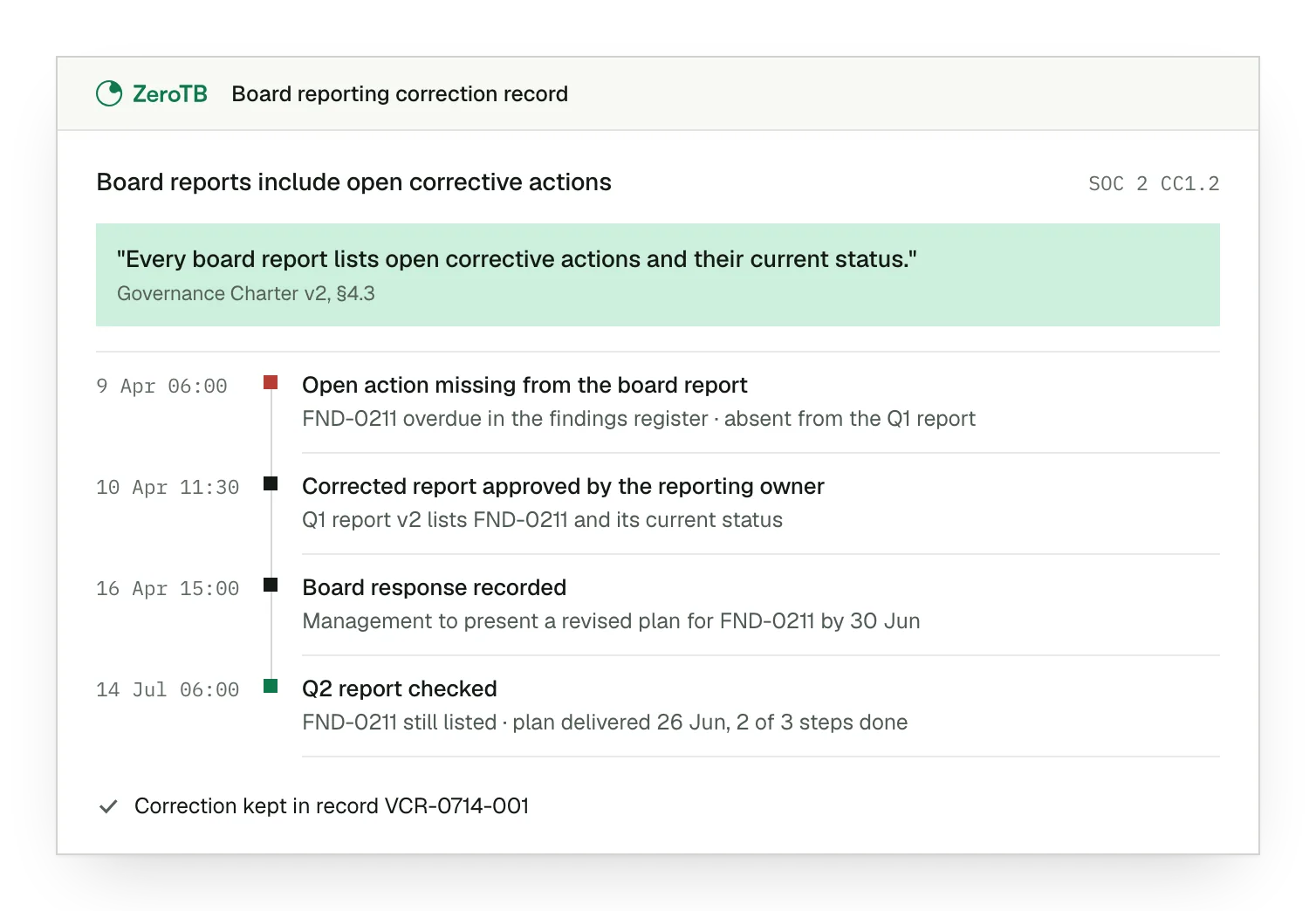
Missing corrective action. An overdue action remains open in the findings register but is absent from the board report.
Approved report correction. The reporting owner approves a revised report that includes the action and its current status.
Recorded board response. Members review the corrected information and record the response they require from management.
Later reporting checked. The next report retains the unresolved action and shows progress against the board's recorded decision.
Board oversight checklist
Establish which body reviews management's controls, what it can decide and how it obtains information and expertise.
Compare reported findings with underlying actions so unresolved work and results awaiting a check reach the people exercising oversight.
Connect each substantive question or decision to management's response, the action owner and the expected completion date.
Check whether the approved correction achieved its intended result before accepting the proposed closure of an oversight action.
Confirm that subsequent reporting retains unresolved actions and explains progress against earlier decisions, including changes in ownership.
Sources
- AICPA & CIMA, 2017 Trust Services Criteria with revised points of focus, 2022 revision.
- HHS, HIPAA audit protocol, 2018 update, evaluation standard.
- ZeroTB, How to stop recurring SOC 2 findings, 2026.
Related pages
SOC 2 criteria
Read how the control environment relates to the other criteria in a SOC 2 program.
Compliance frameworks
Explore related requirements and control guidance across SOC 2, ISO 27001 and HIPAA.
Governance, risk and compliance
Follow how governance decisions connect to the controls and corrective work that teams manage.
Start with the Pilot
Talk with our team about keeping control gaps and their corrections visible. The eight-week Pilot maps up to 25 commitments and takes two real gaps through approved correction and verified restoration, with a record of the work.