SOC 2 CC1.1 asks how the company puts ethics and integrity into practice. Management establishes conduct expectations, makes them known and responds to behavior that falls outside them. A useful review examines whether someone can report a concern, including one about their manager, and whether the company acts on it.
A policy acknowledgment tells you who received the code of conduct. It leaves a further question: what happens if someone is asked to approve work they know is unfinished? Within the SOC 2 control environment, CC1.1 connects the company's expectations with its handling of conduct in daily work.
Leadership conduct
Leadership decisions show whether the conduct standard applies when work comes under pressure. Consider a manager who asks someone to record an unfinished review as complete. The company's response determines whether staff can rely on its written requirement for accurate records.
Review decisions involving senior staff as well as other employees. The record should explain what management decided, why it chose that response and which work needed correction. Later reviewers can then compare cases on their circumstances, without assuming that every departure calls for the same action.
Standards and coverage
The conduct standard needs a defined audience and clear expectations for work performed on the company's behalf. Include employees, managers and relevant contractors in that scope. Explain which expectations apply to each group, including accurate records and the route for raising a concern.
An assigned owner can compare that scope with the people currently doing the work. A new contractor group may receive access to company systems before anyone checks its conduct requirements. Recording the applicable standard and responsible manager makes that omission visible and gives the correction an owner.
Communication and acknowledgment
An acknowledgment should connect a person to the conduct standard they received. The policy version matters, particularly when reporting instructions have changed. Compare the record with the current audience to find people who missed the update or joined after it was distributed.
Then check what people understood. Someone may recall the requirement for accurate records but have no clear answer about challenging a manager's instruction. A discussion of that situation can expose missing guidance. Use the finding to clarify the instructions and the reporting route they describe.
Reporting concerns
People need a reporting route outside their own management line when someone in that line is involved in a concern. Name the recipient and establish who has authority to investigate. The assignment must account for any conflict involving the proposed reviewer.
Test the route as a reporter would use it. Check any access requirements and confirm that the intended recipient receives the message. Use controlled test content for this purpose: the test needs to demonstrate delivery and ownership without putting a real personnel allegation into the compliance queue.
Changes after the audit
Changes in personnel can break arrangements that worked during the audit. A recipient leaves, but the policy keeps their address. A contractor begins work under a different manager, and neither manager checks who is responsible for communicating the conduct standard to that team.
Check the affected arrangement when those changes occur. Record any difference from the approved commitment, along with the person responsible for resolving it. Further checks need an agreed schedule and a route for overdue work, so the next staff change does not leave the action without an owner.
Response to misconduct
The response needs to address both the conduct involved and any records or decisions it affected. Assign someone with the authority and independence to assess the concern. That person determines the appropriate response under the company's process and records the reasons for the decision.
If an incomplete review was recorded as finished, correcting that record is part of the work. Check whether the same pressure affected other reviews, then address the cause with the responsible people. Keep the personnel decision and the operational correction connected, with an owner for each outstanding action.
Verification after correction
Define a correction's test around the failure that prompted it. If concerns were going to an unassigned mailbox, establish what must happen after the address changes. The intended reviewer needs to receive the message, access it and accept responsibility for concerns sent there.
Keep that test result with the owner's approval and the date of the check. It supports closing the mailbox problem. Any investigation or corrective work arising from an actual concern needs its own status, so successful delivery does not close work that remains unfinished.
Confidential evidence
The evidence record needs to explain a correction without circulating the entire personnel case. Include the issue category, owner, decision, action and verified result. Keep the detailed account in a restricted file and reference it where authorized reviewers can find the supporting information.
Access depends on the review being performed. To check a repaired reporting route, a reviewer may need its approval and test result. To assess the response to misconduct, another reviewer may need the underlying case. Share the evidence each needs while retaining those access boundaries.
Automation and judgment
Automated checks suit the parts of this work with observable results: a received acknowledgment, an assigned owner or a completed action. A judgment about misconduct also requires someone to consider the circumstances. That person needs the authority to decide the response.
ZeroTB carries recurring control work through checks, assigned gaps and evidence of verified corrections. Its checks follow the conditions approved for the process. People remain responsible for investigating concerns and deciding personnel actions, while the control record preserves the connection between their decisions and completed operational work.
Evidence for CC1.1
The evidence should let a reviewer follow what the company expected, what happened and how it responded.
| Requirement | What an auditor asks for | Where it comes from |
|---|---|---|
| Established conduct expectations | Which standard management approved and how its decisions applied that standard to relevant work | The policy and approval, alongside records explaining management's decisions about departures from expected conduct |
| Communicated standards | Who received the policy, which version they received and how reporting instructions were communicated | Acknowledgments, distribution records and training records matched to the people covered by the standard |
| Usable reporting routes | Where a concern goes, who receives it and how concerns about a manager reach another reviewer | The reporting procedure, current recipient assignments and tests showing that the intended route works |
| Response to departures | What the authorized reviewer decided and which actions followed from the reported conduct | The protected case file and linked action records showing ownership, decisions and outstanding work |
| Verified operational correction | What changed, how the correction was tested and why the owner accepted the result | The approved change and dated verification result, retained with the decision to close that gap |
Framework control mapping
| Framework | Control | What it covers |
|---|---|---|
| SOC 2 | CC1.1 | The company's ethical expectations and how management communicates, applies and responds to departures from them |
| ISO 27001 | A.5.4 | Management's responsibility for personnel following the information security policies and procedures that govern their work |
| HIPAA | 164.308(a)(1) | Security management, including appropriate sanctions for workforce members who breach security policies and procedures |
Example of restoring a reporting route
A reporting route needs an assigned recipient who can act on a concern. Here, the policy still lists a departed manager's mailbox. This example follows the owner's approved change to the recipient and the test used to decide whether the repaired route works.
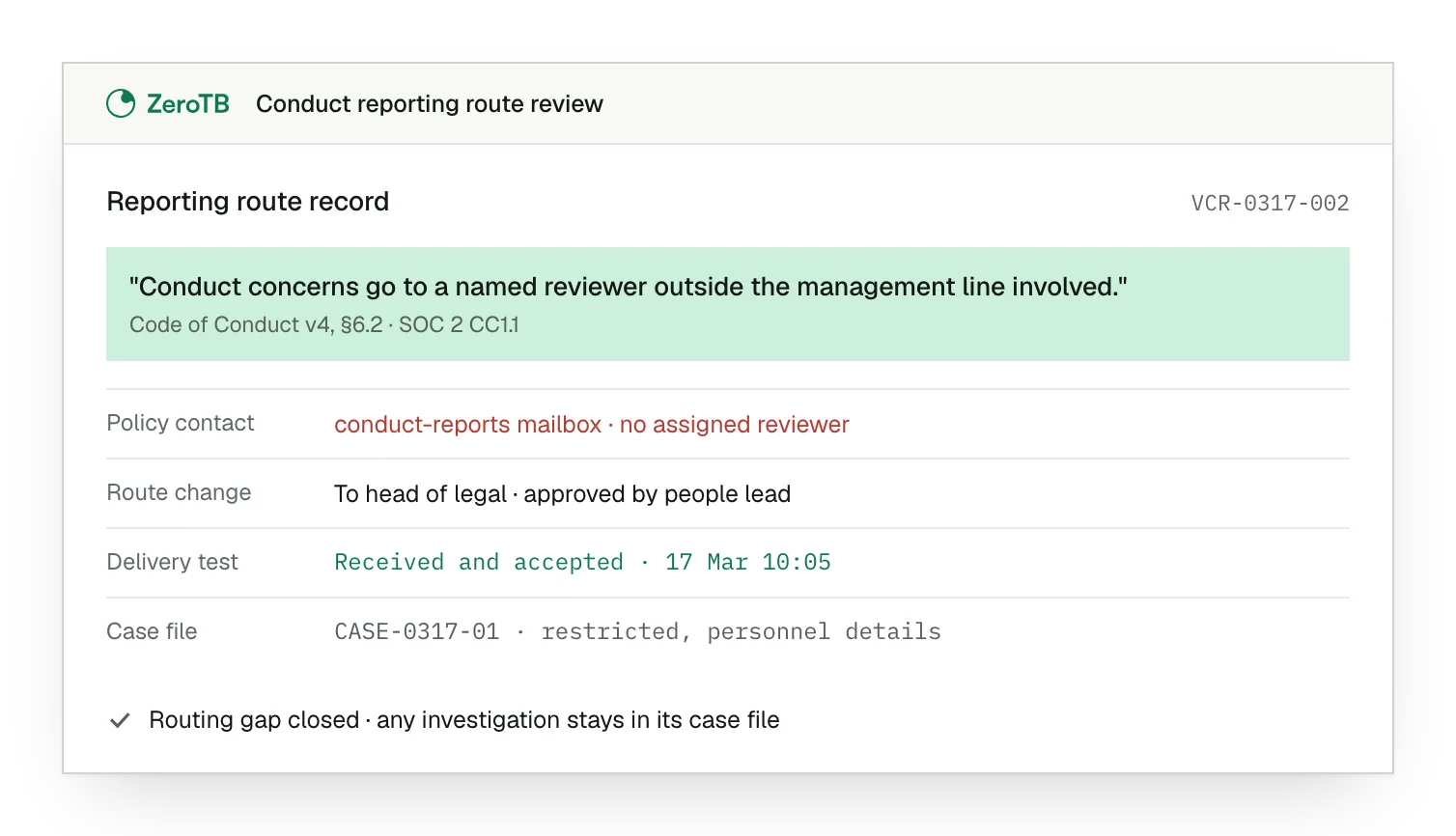
Stale reporting contact. A check finds that the mailbox listed in the policy has no assigned reviewer.
Approved route change. The owner approves a new recipient with authority outside the management line involved.
Successful delivery test. The new reviewer receives the test message and accepts responsibility for concerns arriving there.
Restricted case reference. The record links the test and approval to a protected file holding any personnel details.
Conduct control review checklist
Compare the approved standard's audience with employees, managers and contractors currently working within its scope.
Check the recipient, access and alternate route when a concern involves someone in the reporter's management line.
Follow a recorded departure through the decision, affected work and assigned actions, with access appropriate to the case.
Define what the correction must achieve, then retain a dated observation showing whether that specific condition now holds.
Keep the decision and verification traceable while limiting detailed case information to the people authorized to review it.
Sources
- AICPA & CIMA, 2017 Trust Services Criteria with revised points of focus, 2022 revision.
- ISO, ISO/IEC 27002:2022, information security controls, 2022.
- HHS, HIPAA audit protocol, security management process and sanction policy, July 2018 update.
- ZeroTB, SOC 2 compliance automation with human approval, 2026.
Start with the Pilot
Talk with our team about the conduct processes covered by your commitments. Over eight weeks, the Pilot maps up to 25 commitments and takes two real control gaps through verified restoration. The records preserve each correction, approval and verification result.