What does ISO 27001 A.8.32 require for change management?
ISO 27001 A.8.32 addresses changes to information systems and supporting facilities. It calls for a process to manage that work, including assessment, authorization, testing and review. The practical question is whether the change that reached production can be traced to those decisions and results, including during emergencies.
A completed ticket records one part of a change. The production settings may have changed again since approval, perhaps during an incident or through a later edit. Reviewing A.8.32 means connecting that history to the system as it now operates.
Change control scope
The scope of change control follows the systems and facilities covered by the organization's information security program. A service can depend on code maintained by one team and infrastructure maintained by another. Changes from either team can affect the protections on that service.
A code review will miss a setting changed directly in an administration console. Both routes need a place in the process. The change and development surface connects this work across development and operations, where reviewers need to understand what reached the running systems.
Change management policy
An ISO 27001 change management policy gives people a basis for deciding who can approve a change and what approval requires. It assigns responsibility for assessment, testing, deployment and review, so a request has somewhere to go at each decision.
Procedures explain the details: what information the approver receives, who needs notice and what happens during urgent work. Existing tools can hold the records. A reviewer should be able to follow the request through approval to implementation without searching messages for the missing decision.
Review depth and risk
The depth of review should reflect the change's possible effect on information and services. A familiar maintenance task and a change to production access can need different scrutiny. The approval route should reflect those differences while preserving an identifiable decision for each change.
Repeated work can follow an agreed procedure when its scope, conditions and tests remain understood. A change outside those boundaries needs a fresh assessment. This keeps routine work manageable while giving the owner a reason to reconsider work whose effects have changed.
Security impact assessment
A useful impact assessment identifies the protections a proposed change could weaken. Consider the affected information, permissions, connections and dependent services. A change that preserves application behavior can still alter access, disable logging or expose data through a new route.
The assessment should explain which risks the owner is accepting and which protections testing must confirm. Dependencies matter because a local change can affect another service's assumptions. Give that service's owner enough detail to judge the effect before the change proceeds.
Approval and release identity
Approval needs to identify the version or configuration that will reach production. A reviewer may approve a proposed change before later edits expand its scope. The release record should make that difference visible so the owner can decide whether another review is needed.
For code changes, link the reviewed revision to its test results and deployment record. For configuration changes, identify the resource and proposed settings. GitHub integration supports the repository side of this work; changes made through other routes still need their own traceable decisions.
Testing and recovery
Tests need to address both service behavior and the protections affected by a change. A working application may still allow unwanted access or stop recording activity. The security impact assessment gives testers specific risks to check alongside the functional results.
Recovery also needs an agreed destination: which state can the team restore, and who decides when to restore it? The plan should explain how to check that result. Reverting a software version may leave changed data behind, so the recovery decision must account for both.
Deployment and acceptance
A successful deployment still needs a check of the resulting production state. Compare what was deployed with what received approval, then inspect the protections the change could affect. A passed test in another environment does not establish the production result by itself.
Record whether the owner accepted the result, required further work or used the recovery plan. Update operating instructions and recovery documentation where the change affects them. Those records help the next operator understand the system that exists now and the decisions that produced it.
Emergency changes
Emergency changes need a defined route for urgent decisions and a subsequent review of what happened. Specify who can authorize urgent work and what the team must capture during the incident. The route should preserve accountability while allowing the response the situation requires.
Afterward, review the security effect, tests and any temporary settings that remain. Preserve the actual timing of the action and approval. Record later approval as a later decision, with its own date. NIST's configuration management guidance addresses controlled handling and subsequent review of unscheduled changes.
Changes outside the process
Review a change from the production end as well as from its ticket. A list of completed tickets cannot show work that never entered the process. Deployment history and system activity records can reveal where someone used a different route.
An unmatched change needs investigation: who acted, what did they affect, and does the owner accept the state they left? Gaps in the observations leave those questions unresolved. The history should show whether this was an approved exception or a change that escaped review.
Control restoration
Correcting an unsafe setting may leave the cause of a control gap unresolved. The owner also needs to decide whether the review process or deployment permissions require a change. The correction should preserve the service while addressing how the gap arose.
ZeroTB compares the approved commitment with the connected system and drafts a fix for a person to authorize. It verifies the state after the approved action. The Verified Control Record connects that result to the original commitment, before-and-after observations, action and approval.
Continuing change oversight
Assign responsibility for checking that the change process still covers the systems in use. New deployment routes, repeated emergency exceptions and changed permissions can leave earlier arrangements incomplete. Recurring checks should identify uncovered routes and send each gap to someone who can resolve it.
Related frameworks can use parts of the same change history when their scope and evidence needs overlap. SOC 2 addresses controlled system changes; HIPAA evaluation concerns safeguards for electronic protected health information. Check those boundaries before using one record to support several requirements.
Change evidence
Use these records to trace a change from its stated purpose to the result accepted by its owner.
| Requirement | What an auditor asks for | Where it comes from |
|---|---|---|
| Defined process | Covered systems, change routes, responsibilities and conditions for using the emergency process | Approved policy and procedures linked to the system inventory |
| Assessed impact | The affected protections, dependencies and risks considered before the owner decided | Change request and security impact assessment |
| Authorized implementation | Who approved the change, when they approved it and which version or settings they accepted | Approval history linked to the release or configuration change |
| Testing and recovery | Results for the relevant functional and security tests, with a usable recovery approach | Test records, deployment plan and recovery procedure |
| Emergency review | The reason for urgent action, actual decision history and disposition of temporary settings | Incident timeline, emergency change record and subsequent review |
| Verified result | The observed production state, accepted outcome and any unresolved gap or recovery action | Dated system observations linked to the change and its verification record |
Related framework requirements
| Framework | Control | What it covers |
|---|---|---|
| ISO 27001 | A.8.32 | Management of changes to information systems and supporting facilities in scope |
| SOC 2 | CC8.1 | System changes and the decisions to authorize, test and implement them |
| HIPAA | 164.308(a)(8) | Safeguard evaluation, including in response to operational or environmental changes affecting electronic protected health information |
Example of correcting an emergency change
This example follows an emergency firewall change that restored service but allowed access from too many sources. The owner approves a narrower range. The correction is complete when testing shows that the required connection succeeds and the unwanted connection fails.
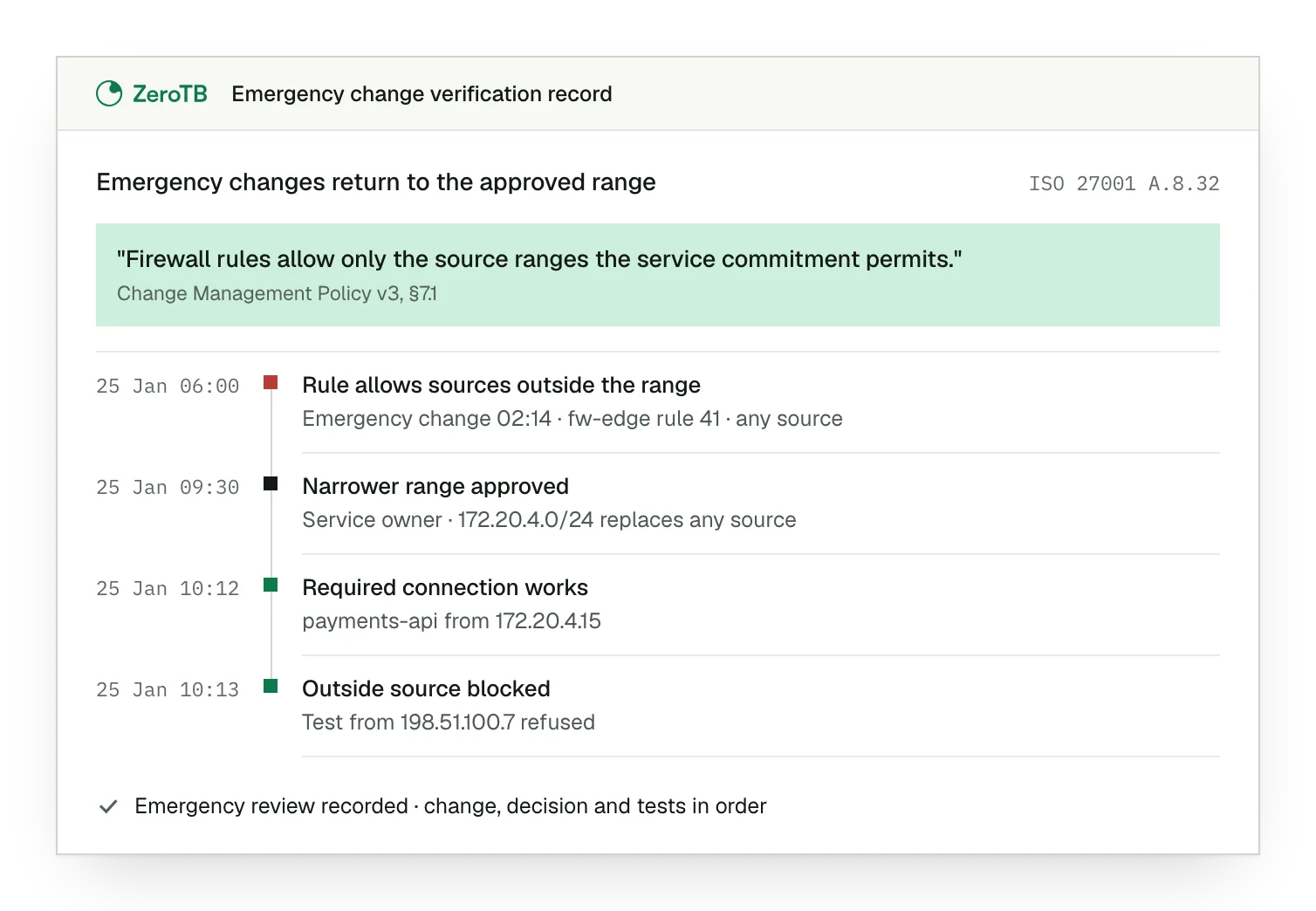
Observed access gap. The temporary firewall rule allows connections from sources outside the range that the commitment permits.
Approved narrower range. The service owner agrees to replace the temporary rule with the approved source range.
Verified connection tests. Tests show the required service connecting successfully and a source outside the permitted range blocked.
Recorded emergency review. The original change, subsequent decision and verification results remain dated in the order they happened.
Change control review checklist
Start with a recent deployment. Follow the links to its request, risk assessment, approval and tested version.
Compare the deployed settings or version with the approval. Include any edits made between review and deployment.
Check when urgent actions and approvals occurred. Find the owner’s decision about temporary settings that remain in use.
Before closing a gap, check the production observations for the expected service behavior and the protections the change affected.
Keep the correction and its approval with the observations and test results that explain why the gap was closed.
Sources
- ISO/IEC, ISO/IEC 27002:2022 overview, 2022.
- NIST, Guide for security-focused configuration management of information systems, 2011, updated 2019; sections 2.3.8–2.3.10 and 3.3.2.
- HHS, HIPAA audit protocol, updated July 2018; evaluation under 164.308(a)(8).
Related pages
Technological controls
Read the other control guides that address technology within the information security program.
ISO 27001
Explore the framework that connects change control with the wider information security program.
Compliance frameworks
Find related guidance for the frameworks that apply to the organization's systems and information.
Start with the Pilot
Talk with our team about the changes that keep creating control gaps. The eight-week Pilot maps up to 25 commitments and takes two real gaps through approved correction and verified restoration, with a record of the results.