What does ISO 27001 A.8.14 require for redundancy?
ISO 27001 A.8.14 calls for redundancy suited to the organization's availability needs. If the primary component fails, an alternative must be able to support the required service. Check what both depend on, test the failure the design addresses, and retain the results of any correction.
An instance marked healthy may be useless as a fallback if it relies on the same failed database as the primary. Redundancy depends on those connections. The review has to establish which parts of the service remain usable when the intended failure occurs.
Availability requirements
The availability requirement determines which failures the service needs to withstand. A component failure, a lost network connection and an unavailable location create different recovery needs. The design needs a clear account of which events it addresses and which services must continue through them.
Define the acceptable interruption and the work that must remain possible during recovery. These decisions establish the conditions for judging the design and its tests. They also explain why a critical transaction service and an internal reporting job may need different levels of redundancy.
Shared failure points
Redundancy depends on whether the alternatives can survive the same event. Two application instances may both lose service when a shared database or network path fails. Follow the connections from each instance through the service; the resources labelled redundant are only part of the review.
A separate location helps with a local outage, at the cost of additional systems and configuration to maintain. AWS describes choosing locations according to workload requirements and dependencies. Operating in another region should follow from the failure the service needs to withstand.
Capacity after failure
The fallback needs to carry the work it receives when the primary component fails. It may accept connections and still run too slowly for the service to be useful. Agree how much performance can fall before users can no longer complete the required work.
Test with a load that represents those users' needs while the component is unavailable. Keep the load, errors and delays with the result, so someone reading it later can understand the conditions. A successful connection alone leaves the question of usable capacity unanswered.
Backups and redundancy
Recovering information and keeping a service operating are different jobs. Backups provide information that can be restored after loss or damage. Redundant resources provide an alternative when a component fails. A design may need both to meet the availability requirement the organization has adopted.
Restoring a backup needs time and a system that can use the recovered information. A redundant copy has a different limit: it may receive an unwanted change from the primary. Review backup controls together with redundancy to account for both problems in the recovery design.
Changes after the audit
Changes to infrastructure can undo the separation established by an earlier test. Both instances might move into one location, or a deployment might connect them to the same dependency. Neither change necessarily stops normal service, so the loss of redundancy can go unnoticed.
The previous test records which assumptions to revisit after a change. Compare deployed settings with those assumptions, looking for removed replicas and altered routes. When an important dependency changes, the owner needs to decide whether the old result still describes the protection the service has.
Failover test conditions
A failover test needs a failure to simulate and a service outcome to measure. Specify which component will be unavailable, how the alternative should take over and what users should still be able to do. Agree when to stop if the exercise causes problems.
Use a controlled environment and approve the scope before testing. Measure the whole interruption, including the time needed to detect failure and respond manually. Microsoft recommends testing complete flows against recovery targets because a component may recover before the services that depend on it do.
Security during failover
Failover has to preserve the service's information protections as traffic moves. The alternative still needs the required access restrictions, encryption and event records. Include them in the test so that the owner can see whether both availability and security held through the transition.
Check for missing updates and conflicting data after recovery. An application can respond successfully while returning information that is incomplete or inconsistent. Agree how the exercise will identify those problems and retain the results with the service checks before accepting the arrangement.
Approved repairs
The repair needs to remove the cause of the failed test. Describe the dependency that failed, the proposed arrangement and how to reverse the change if it causes problems. Those details let the system owner judge the consequences and authorize the correction.
ZeroTB checks systems against approved commitments and drafts fixes for gaps it finds. After an authorized change, it verifies the result and retains the action and approval in the Verified Control Record. A redundancy repair needs evidence that the service worked through the failure the design was meant to withstand.
Return to normal service
Returning to the normal arrangement can introduce another interruption or an inconsistent copy of the data. The recovery plan should account for that return, including the condition of the original system and the point at which it can safely receive traffic again.
Test the return as part of the exercise and record any manual intervention it needs. Confirm that the final arrangement restores the intended redundancy as well as normal service. Otherwise, the service may remain available while depending entirely on the component that carried it through the failure.
Evidence between tests
A successful exercise describes the arrangement tested on that date. Keep its configuration, failure scenario and result together so later changes can be compared with the same assumptions. A diagram or a completed change ticket alone cannot explain how the service behaved during the transition.
Assign responsibility for reviewing changes and arranging further tests when the design or availability requirement changes. Missing or stale observations leave an unanswered question about the current state. Keeping that question visible helps the owner decide whether more evidence is needed before accepting the control as operating.
Redundancy evidence
An auditor can trace the availability requirement through the deployed arrangement, the test and any approved correction.
| Requirement | What an auditor asks for | Where it comes from |
|---|---|---|
| Defined availability | The service, tolerated interruption and failure scenarios covered by the control | Approved availability requirements and recovery plans |
| Independent alternatives | The resources and dependencies that remain usable through each intended failure | Current architecture diagrams and deployed configuration records |
| Usable fallback | Observed service behavior, transferred load and required security protections during the test | Dated failover results, service measurements and security checks |
| Approved correction | The discovered gap, intended repair and decision authorizing the change | Change records linked to the control owner’s approval |
| Verified restoration | The repeated test result and the final arrangement after normal service resumes | Verification results linked to the change and control record |
Related framework requirements
| Framework | Control | What it covers |
|---|---|---|
| ISO 27001 | A.8.14 | Redundancy aligned with the availability needs of information processing |
| SOC 2 | CC9.1 | Managing risks from interrupted business operations, including plans for alternative processing |
| HIPAA | 164.308(a)(7) | Contingency plans for protecting electronic health information, recovering data and continuing critical operations |
Example of restoring an independent fallback
This example shows a fallback that loses service with the primary because both use the same database endpoint. The approved repair supplies another database path. Testing then checks application requests while the primary endpoint is unavailable and checks the final arrangement when normal service resumes.
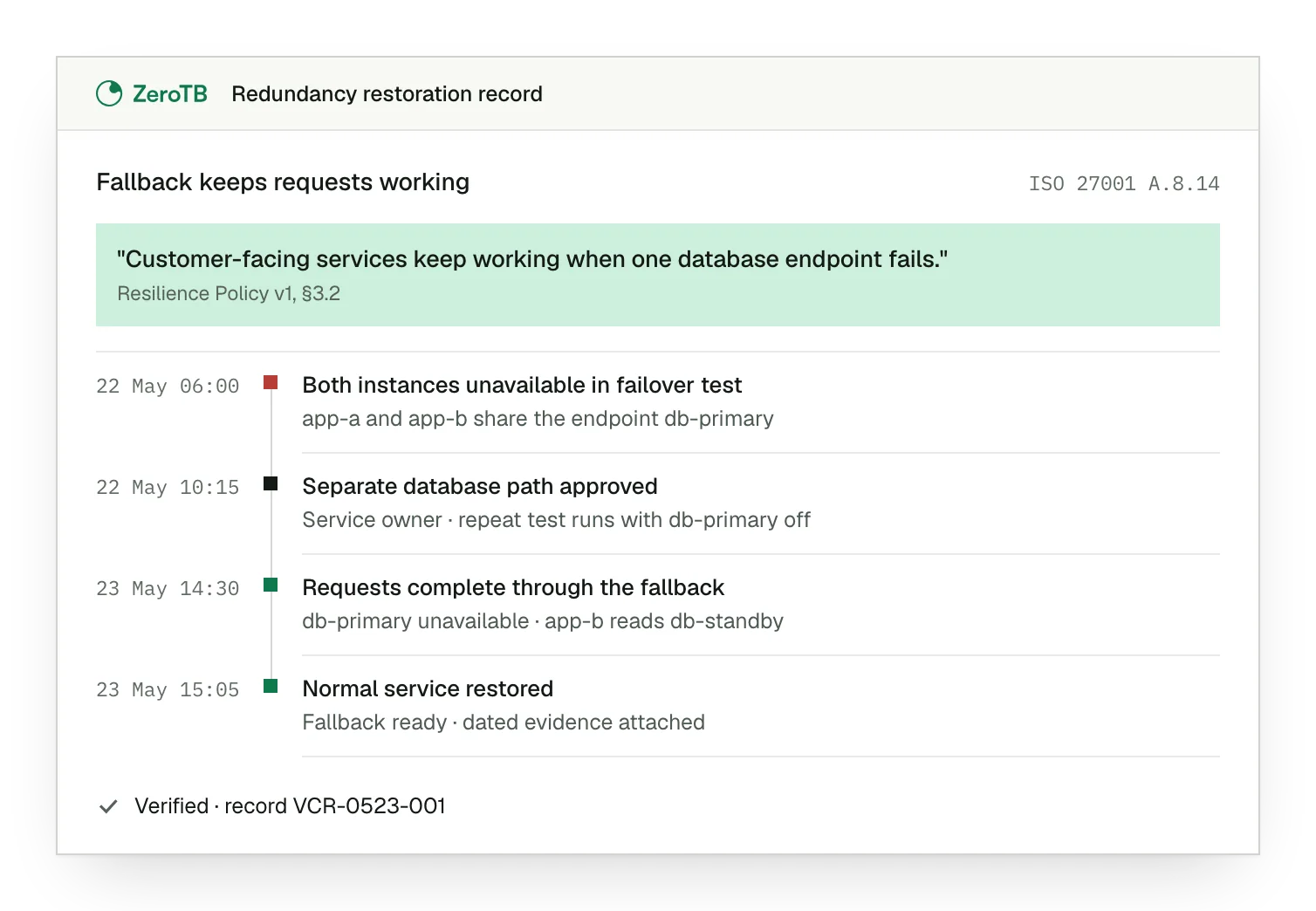
Shared database dependency. The failed endpoint interrupts requests through both instances, including the one intended to provide fallback.
Approved dependency repair. A separate database path is approved by the owner, along with conditions for the repeat test.
Service recovery verified. With the primary endpoint still unavailable, requests complete through the fallback during the test.
Normal service restored. A return test establishes that normal service works and fallback remains ready, with dated evidence attached.
Redundancy review checklist
Identify the work that must continue, the failure it must withstand and the acceptable interruption.
Compare the intended separation with the deployed resources, including the paths both primary and fallback systems use.
Set the failure scenario, expected service behavior, required protections and conditions for stopping the exercise.
Approve the correction, repeat the relevant test and retain the observed result with the change decision.
Confirm the return to normal service restores redundancy, then assign ownership for reviewing subsequent changes.
Sources
- ISO/IEC, ISO/IEC 27002:2022 overview, 2022.
- AWS, REL10-BP01: Deploy the workload to multiple locations, accessed November 2026.
- Microsoft, Reliability testing strategy, accessed November 2026.
- NIST, SP 800-53 Rev. 5, CP-7 and CP-8, 2020, updated control catalog.
- AICPA, Trust Services Criteria, CC9.1, 2017 criteria with revised points of focus.
- HHS, Summary of the HIPAA Security Rule, accessed November 2026.
Related pages
ISO 27001
Place redundancy within the wider set of controls that supports the information security management system.
Compliance frameworks
Explore the related commitments that share evidence across the frameworks relevant to your organization.
Cloud and infrastructure
See how cloud configuration checks connect an observed control gap to an approved correction.
Start with the Pilot
Talk with our team about the availability commitments behind the systems you run. The eight-week Pilot maps up to 25 commitments and takes two real control gaps through approved repairs and verified restoration, with evidence of the results.