What does ISO 27001 A.8.13 require for information backup?
ISO 27001 A.8.13 covers backups of information, software and systems under an agreed policy, together with tests of those copies. Start with the resources the service needs for recovery. Check their backup coverage and use a restore test to establish whether the saved information is usable.
Successful backup jobs can coexist with a database that has never been copied. A.8.13, part of the technological controls, addresses the protection the service needs. Compare the resources now supporting it with the scope of the jobs that report success.
Backup scope
The backup scope should follow the service that needs to be recovered. Copying a database protects its contents, but using those contents may also require software, application settings and information stored elsewhere. Include those dependencies when deciding what the policy covers.
An owner needs to be able to explain why each resource is included or excluded. Linking resources to their services makes that decision easier to revisit. It gives the backup operator a point of contact when a deployment adds something outside the existing arrangements.
Recovery objectives
Acceptable data loss and recovery time are separate decisions. The recovery point objective sets how far back the restored data may go. The recovery time objective sets how long the service may take to return after an interruption has occurred.
Frequent backups may limit the amount of lost data without making restoration fast enough. Test both against the service's needs. NIST's contingency planning guidance uses business impact to establish recovery priorities, giving the owner a basis for deciding whether these limits are appropriate.
Retention choices
Retention sets how far back a team can look for a usable copy. If a problem went unnoticed before the latest backup, that copy may contain it too. The recovery plan needs to allow for the time between damage occurring and someone discovering it.
The available copies show whether retention works as intended. Compare their dates with the policy and investigate missing periods, even when the configured setting is correct. Where services have different retention needs, the approved exception should explain the difference and identify who reviews it.
Protection of backup copies
Copies can be lost alongside working data when they share the same exposure. An account with permission to delete both creates one such risk. Decide how access restrictions and separation should protect the copies against the incidents covered by the recovery plan.
For ransomware, HHS guidance recommends considering backups disconnected from the network. Encryption protects the confidentiality of a copy, but adds a dependency during recovery. The operator needs the keys as well as the data; test access to both under the planned recovery conditions.
Recovery dependencies
Recovery depends on access to the copy and everything needed to use it. The recovery operator may need permissions, encryption keys, compatible software and an available destination. A missing dependency can prevent restoration even when the backup itself is intact.
The procedure should explain where those dependencies come from if the production environment is unavailable. Include them in the test, with the access that the recovery operator would actually use. This exposes missing access or equipment that a routine backup job can leave undetected.
Changes in backup coverage
Backup job history needs to be read alongside the current resource inventory. A successful job says what happened to its assigned resources. It cannot establish coverage for a database that never entered the plan, including one added by a recent deployment.
AWS Backup lets resource types and tags determine which resources a plan includes. A tag change can therefore affect coverage. After deployments or account migrations, inspect the assignment and the copies made for the affected resources. That comparison can reveal an omission before recovery is needed.
Restore tests
A restore test needs to establish what the service can do with the recovered information. Agree which records must be present and which application operation must work. Include the relevant recovery objective in that decision, then use a safe destination for the test.
In AWS Backup restore testing, completion and duration are recorded separately from the optional validation of results. A database restore has the same practical distinction. The database may start successfully while checks of its contents or application use still fail.
Failed recovery checks
A failed restore remains a gap even if the backup job succeeded. The failure record should say where recovery stopped. A missing copy, denied permission and incompatible dependency call for different repairs, so retain enough detail to identify the cause.
Once that cause is corrected, repeat the affected test against the original acceptance criteria. Missing or unusable information keeps the gap open. If the rerun passes, connect its result to the earlier failure so the reviewer can see why the correction is complete.
Approved corrections
Before a backup change proceeds, its owner needs to understand what it will alter. Tie the proposal to the resource, the observed gap and the policy commitment. Explain the consequences for service recovery, permissions and operation so the owner can decide whether to approve it.
ZeroTB reads the commitment, checks connected systems and drafts the fix. People authorize material changes, and ZeroTB checks the state after the approved action. The Verified Control Record connects the action and approval with the observations and verification needed to review the completed work.
Evidence over time
A successful restore proves what was tested at that time and within that scope. Later changes to the service, backup selection or recovery access can invalidate its assumptions. The review schedule should account for those changes alongside the organization's planned testing intervals.
Keep evidence of coverage distinct from evidence of recovery. The first shows which resources have protected copies; the second shows what a test recovered and whether it was usable. Together, dated observations help a reviewer understand both the remaining gaps and the reason for closing a correction.
Backup evidence
An auditor should be able to identify the required protection, see what was tested and follow any repair through to its result.
| Requirement | What an auditor asks for | Where it comes from |
|---|---|---|
| Defined recovery needs | The covered services, their agreed recovery needs and the responsible owner | Backup policy and service recovery plans |
| Current coverage | Recent backup copies for the covered resources, with reasons for exclusions | Current inventory, resource assignments and backup job records |
| Retained history | The dates of usable copies compared with the required retention period | Retention settings and dated records of retained copies |
| Protected copies | The safeguards applied to copies and evidence of authorized recovery access | Storage permissions, encryption settings and recovery access checks |
| Usable recovery | A test result identifying the copy, destination, acceptance checks and recovery time | Restore logs and documented validation results |
| Verified correction | The failed check, the decision to change it and the passing result | Change approval and the linked verification record |
Related framework requirements
| Framework | Control | What it covers |
|---|---|---|
| ISO 27001 | A.8.13 | Keeping and testing copies under an agreed backup policy |
| SOC 2 | CC9.1 | Responses to potential business interruption, including relevant backup arrangements |
| HIPAA | 164.308(a)(7) | Plans to back up electronic protected health information and recover it during an emergency |
Example of restoring backup coverage
An omitted database can receive backups and still need a test before the gap closes. In this example, the database was missed during deployment. The owner approves its addition to the plan, and the recovery result becomes part of the record.
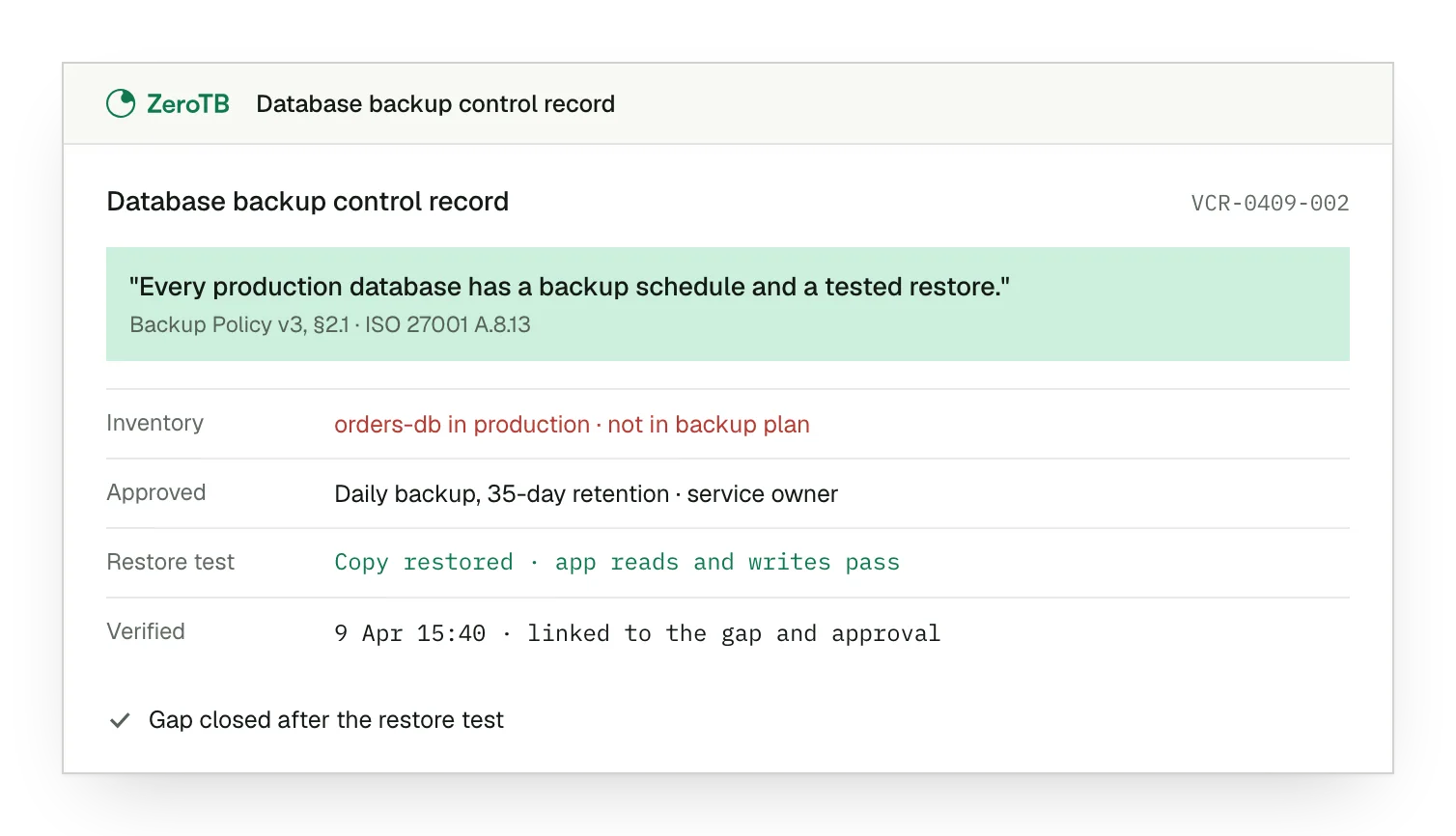
Missing database. A production database appears in the inventory but has no assignment in the backup plan.
Approved coverage change. Approval covers the new assignment and the retention settings agreed for the database's service.
Recovery test passed. Testing restores the new copy and confirms that the required application operations can use it.
Recorded verification. Dated results explain the closure, with links to the observed gap and approval of the change.
Backup review checklist
Establish which service and information need protection, then confirm acceptable data loss, recovery time and retention with the owner.
Match the current resource inventory to backup assignments and recent copies, including resources added or moved since the previous check.
Check whether the recovery operator can reach protected copies, keys and dependencies under the conditions the plan assumes.
Connect the proposed change to the observed gap and agree its effect on the service before proceeding.
Restore the affected information, check its intended use and retain the result with the approved action and original observation.
Sources
- ISO/IEC, ISO/IEC 27002:2022 overview, 2022.
- NIST, SP 800-34 Rev. 1: Contingency planning guide, 2010.
- AWS, Backup resource assignment and restore testing, accessed November 4, 2026.
- HHS, Ransomware and HIPAA and HIPAA audit protocol, accessed November 4, 2026.
Start with the Pilot
Talk with our team about the backup protection your services need. The Pilot lasts eight weeks: we map up to 25 commitments and take two real control gaps through approved correction and verified restoration. The work leaves a verified record.