What does HIPAA 45 CFR 164.310(a)(1) require for facility access controls?
HIPAA facility access controls govern physical entry to facilities and the electronic information systems they contain. Procedures must limit access and allow people with proper authorization to enter. Apply that rule to routine visits, emergency entry and repairs, then test the protections affected by a change.
A badge list may be accurate even when the door it controls will not latch. That leaves an entry point unsecured. HIPAA physical safeguards require attention to both the access decision and the physical conditions that make it effective.
Facility scope
Start with the locations of systems that create, receive, maintain or transmit electronic protected health information (ePHI). An inventory should connect each system to the facility where it is housed. It should also identify the rooms and entry points that protect access to that equipment.
Some locations will belong to a hosting provider; others may be offices with local workstations. The distinction determines who can inspect a site and change its entry arrangements. For each location, establish who manages the physical protection and where evidence of that protection comes from.
Addressable safeguards
The four addressable specifications cover contingency operations, a facility security plan, access control and validation procedures, and maintenance records. Each needs an assessment against the organization's circumstances and risks. The assessment determines how the organization will address the specification in its own environment.
45 CFR 164.306 requires implementation when a specification is reasonable and appropriate. If it is not, document the reason and implement an equivalent alternative when reasonable and appropriate. Keep that decision with the procedures it affects, so a reviewer can understand the choice and its basis.
Access authorization
Entry permissions need an approved purpose that still matches the person's role. A current employee list alone cannot establish whether everyone needs access to a particular room. Compare approved entry rights with the permissions held in the access system or key register.
Role changes, departures and temporary assignments can leave entry rights active after they are needed. The review should identify which doors each credential opens and who approved that access. A decision to retain unusual access needs a clear purpose so the next reviewer can understand why it remains necessary.
Visitor access
A visitor's permission to enter needs limits that the people at the site can apply. The host, permitted areas and supervision arrangements should be clear before entry. A sign-in record helps establish who attended, but the visit also needs to follow those arrangements.
Maintenance contractors may need access to equipment or rooms that ordinary visitors cannot enter. Their authorization should match the job and the time required. Where software testing or revision is involved, the access validation procedure also needs to cover the people authorized for that work.
Emergency entry
Emergency procedures must let authorized responders reach the facilities needed to restore data and support emergency operations. The plan should explain how those people enter when normal entry is unavailable. Their authority and means of entry need to remain usable under the conditions the plan anticipates.
A test can reveal whether an emergency contact is unavailable or an entry method depends on a failed system. Record the test conditions and any corrective action. Changes to the site or response team should prompt a review of the affected arrangements before they are needed.
Changes after the audit
An access review describes the facility at the time of the review. Later changes can leave its conclusions out of date. An office move, for example, may carry an old badge list into a replacement system, including permissions that should already have ended.
Physical work can also change the protection. A door may stop latching after a repair even though its badge reader continues to work. Review the part affected by the change: compare permissions when access lists move, and inspect physical components when building work affects an entry point.
Repair ownership
The person reviewing a facility control may have no authority to repair the building or change its entry system. The gap therefore needs an owner at the site or its provider. That owner approves the correction and arranges the work needed to carry it out.
ZeroTB can track the procedural commitment and assigned follow-up through the control restoration process. Physical work stays with site staff or the relevant provider. Agree the evidence needed from them before the repair, including who will inspect the result and record what happened.
Verification at the facility
Verification needs to test the protection that failed while preserving the access that remains authorized. For a removed badge, check that the credential no longer grants entry. For a faulty door, check the repaired closer and latch under the conditions that exposed the problem.
The test should also confirm that authorized entry remains available, including relevant emergency arrangements. A completed work order establishes that someone reported the job done. Keep the gap open when the required test fails or its result is unavailable, and identify the outstanding test.
Evidence continuity
A reviewer should be able to read the repair record and understand why the gap was closed. The record connects the failed condition with the requirement, approval and action. A dated test result then establishes what was checked after the work and what the check found.
The references matter when several teams contribute records. A contractor may use a door number while the access system uses a room name. Connect those references to the same location before closing the gap, so the next reviewer can match the work order to the inspection.
Evidence for facility access
Access decisions, site checks and repair records need to refer to the facilities and entry points included in the review.
| Requirement | What an auditor asks for | Where it comes from |
|---|---|---|
| Facility security plan | Locations, physical protections and responsibilities for safeguarding systems and equipment | Facility inventory, approved security plan and records of checks at the relevant sites |
| Authorized entry | Approved permissions, reviews of current access and removal of rights no longer needed | Access approvals, badge or key records, entry logs and documented access review decisions |
| Visitor control | Visitor authorization, supervision and records showing that visits followed the agreed procedures | Visitor records, host approvals and the procedures used by staff at the facility |
| Contingency access | Emergency entry arrangements and tests showing that authorized responders can use them | Recovery procedures, emergency contact responsibilities, test results and records of any corrective action |
| Security-related maintenance | Repairs or changes to physical protections, with records of the work and resulting checks | Work orders for affected doors, locks or other components, linked to dated inspection results |
Physical access across frameworks
| Framework | Control | What it covers |
|---|---|---|
| HIPAA | 45 CFR 164.310(a)(1) | Policies and procedures that limit physical entry to electronic information systems and facilities while preserving authorized access |
| SOC 2 | CC6.4 | Restrictions on physical access to the facilities and assets covered by the organization's controls |
| ISO 27001 | A.7.2 | Controls at entry points that allow authorized people into the organization's secure areas |
Example of restoring a secure doorway
A door repair is complete only when the required protection works again. Here, a storage-room door has stopped latching after maintenance. The facilities owner approves the correction, and the site inspection checks both the latch and entry with an authorized badge before closure.
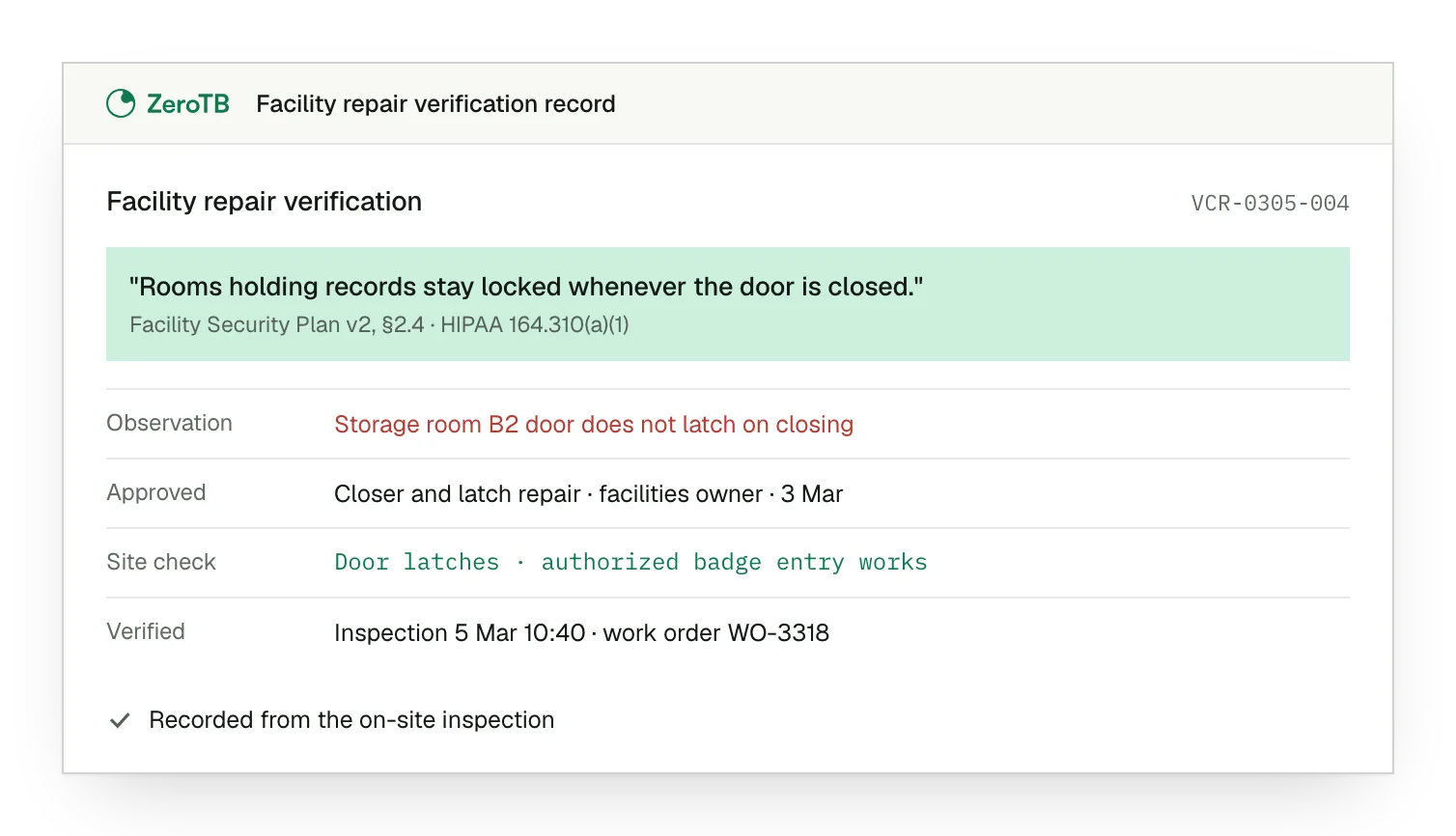
Failed door latch. The observation identifies the affected doorway and shows that the door remains unsecured after closing.
Approved physical repair. The facilities owner approves a contractor's adjustment of the closer and inspection of the latch.
Entry and closure. The site check confirms that the door latches and authorized badge holders can still enter.
Dated verification record. The inspection result joins the repair approval and work order in the Verified Control Record.
Facility access review checklist
Connect each relevant system to its facility, entry points and the person responsible for physical protection.
Compare actual entry rights with approved roles, visitor arrangements and the access needed during an emergency.
Identify who can perform the physical work or access change, and obtain the responsible owner's approval.
Check the condition that failed and confirm that authorized entry remains available after the approved correction.
Keep the requirement, location, repair approval and dated test result together for the next review of that protection.
Sources
- eCFR, 45 CFR 164.310: Physical safeguards, accessed November 4, 2026.
- eCFR, 45 CFR 164.306: Security standards, general rules, accessed November 4, 2026.
- HHS, HIPAA audit protocol, July 2018 update, facility access provisions.
Related pages
Physical safeguards
Read the adjoining HIPAA standards for workstation use, workstation security and the handling of devices and media.
HIPAA
See how physical safeguards fit with administrative and technical safeguards across the wider HIPAA security program.
Compliance frameworks
Find guidance on the other frameworks whose requirements may apply to the facilities and systems under review.
Start with the Pilot
Talk with our team about the gaps in your current program. The eight-week Pilot maps up to 25 commitments and takes two real control gaps through approved correction and verified restoration, with a record of each result.