What does ISO 27001 A.6.6 require for confidentiality agreements?
Under ISO 27001 A.6.6, confidentiality agreements need to cover the information entrusted to the people and organizations receiving it. Document the terms, obtain signatures and review them regularly. When the work changes, check that the accepted agreement still covers the relationship, information and intended use.
The project has expanded since the supplier signed its agreement. Before sharing more information, someone needs to establish whether the existing terms cover the new work. Agreement reviews become useful when they catch that question and carry it through to an authorized decision.
Agreement coverage
A.6.6 connects confidentiality agreements to the information protection your organization needs. The ISO 27001 program establishes the scope of the control. Within that scope, a review should establish which relationships need agreements, locate the documents and identify any work whose confidentiality terms remain unresolved.
An agreement register helps when its entries point to actual relationships. For each entry, a reviewer needs to know what information is covered and who checked the terms. Linking that entry to the project or activity makes the record useful when the work later changes.
Parties and responsibilities
Coverage starts with knowing which people and organizations receive confidential information. Staff records may account for employees, while supplier and project records identify external recipients. Look across those records when establishing coverage. Otherwise, an agreement review can miss a relationship simply because another team manages it.
Responsibility can cross teams too. The business owner knows what the work involves; the contract owner decides whether the terms cover it. The control owner needs both answers to complete the review. Recording those responsibilities also gives unresolved questions a route to the person who can decide.
Information and permitted use
The agreement should identify the information being protected and the purpose for which it may be used. A project name alone can hide changes in either. The review should compare the actual information shared with the description and use authorized by the agreement.
The UK Intellectual Property Office's NDA guidance explains why the permitted purpose and onward disclosures need attention. For an operational review, record the intended recipients and use alongside the information involved. The contract owner can then decide whether the existing terms cover that arrangement.
Agreement selection
An existing contract may already contain the confidentiality terms a relationship needs. The review begins with those clauses and their scope. Where they cover the proposed work, the contract owner can record that conclusion; where coverage is missing, the owner decides how to amend the arrangement.
A separate non-disclosure agreement is one possible route. Another is an amendment to existing terms. Choose through the authorized contract process and retain the reason for that choice. The relevant question for the control review is whether the accepted document covers this relationship and its work.
Review triggers
Review agreements when the work changes, as well as on the schedule your organization has approved. Project owners can identify changes before the next scheduled review arrives. Give them a clear route to the agreement owner when recipients, information or the intended use change.
The related access-agreement control in NIST SP 800-53, PS-6 leaves review frequency to the organization and addresses signatures after updates. Decide the frequency for this control and record it. Include the events that call for an earlier review, with someone responsible for acting when they occur.
Signature checks
A signature check should establish which version the relevant party accepted and when. Approval of a template leaves that question open. The reviewer needs the completed agreement or acceptance record connected to the party and the version that governs the work under review.
The Intellectual Property Office guidance also recommends checking that the signer has authority. Keep that decision within the approved contract process. When an agreement changes, record whether renewed acceptance is needed and retain the resulting evidence beside the updated version, with the responsible owner's decision.
Gaps before disclosure
An unresolved agreement gap needs a decision about what information can be shared while it is corrected. The business and contract owners should agree any interim restrictions. Those restrictions need to reach the people handling the information, including anyone responsible for granting access.
If information has already been shared, establish what was disclosed, to whom and under which terms. A later signature cannot establish how the earlier disclosure was handled. Record that assessment separately from the agreement update, including any further action the responsible owner decides is needed.
Approved corrections
Closing a gap requires an approved agreement and a check that it covers the changed work. Once the contract owner has approved suitable terms and the relevant party has accepted them, the reviewer has a specific document to examine against the gap originally recorded.
ZeroTB coordinates recurring review work by scheduling it from commitments, assigning people, escalating late tasks and checking completion. The terms still require an authorized person's decision. Keep that decision, the accepted document and the completed coverage check together, so the reason for closing the gap is available later.
Duties after the relationship
The end of a project can leave confidentiality duties that still apply. The agreement owner should identify those duties from the accepted terms, including any instructions about information still held. The project closure record can then show who is responsible for completing the required actions.
A change of role also needs attention when it changes what information someone receives. Keep the relevant agreement and any decision about continuing duties available to the responsible owners. This connects responsibilities after employment changes to the terms accepted during the relationship.
Evidence over time
Evidence should show how agreement coverage changed during the period under review. Retain the accepted version, subsequent review decisions and the reason for each update. That history lets a reviewer establish which terms applied to a relationship when information was shared or work changed.
Contract details may need restricted access. The control record can identify the agreement, owner and review status while the full document stays in its approved location. A reviewer should be able to reach the underlying evidence through authorized access and distinguish a missing record from a completed check.
Audit evidence
Use the agreement and its review history to explain who is covered, which terms apply and how gaps were resolved.
| Requirement | What an auditor asks for | Where it comes from |
|---|---|---|
| Agreement scope | The relationships included in the review and the information they receive | Control scope supported by staff, project and supplier records |
| Appropriate terms | The decision that the agreement covers the work in scope | Approved terms and the contract owner's recorded assessment |
| Recorded acceptance | The party, signature date and version accepted for the relationship | The signed document and its associated acceptance record |
| Continuing review | Reviews completed on schedule or following a change in work | Dated review outcomes, project changes and the agreed review schedule |
| Resolved gaps | The correction and the completed check against the original gap | The updated agreement, acceptance and review of the changed scope |
Related framework requirements
| Framework | Control | What it covers |
|---|---|---|
| ISO 27001 | A.6.6 | Agreements covering the confidentiality duties of relevant people and organizations |
| SOC 2 | CC2.2 | Communication of responsibilities within the organization, with agreement records supporting evidence about confidentiality duties |
| HIPAA | 45 CFR 164.308(a)(3) | Workforce access to electronic protected health information; assess access procedures and decisions alongside any relevant agreement records |
Example of extending agreement coverage
An expanded supplier project can require a fresh decision about confidentiality coverage. Here, the supplier originally reviewed public documentation. The proposed work now includes internal technical material, so the contract owner reviews the terms before the project team shares it.
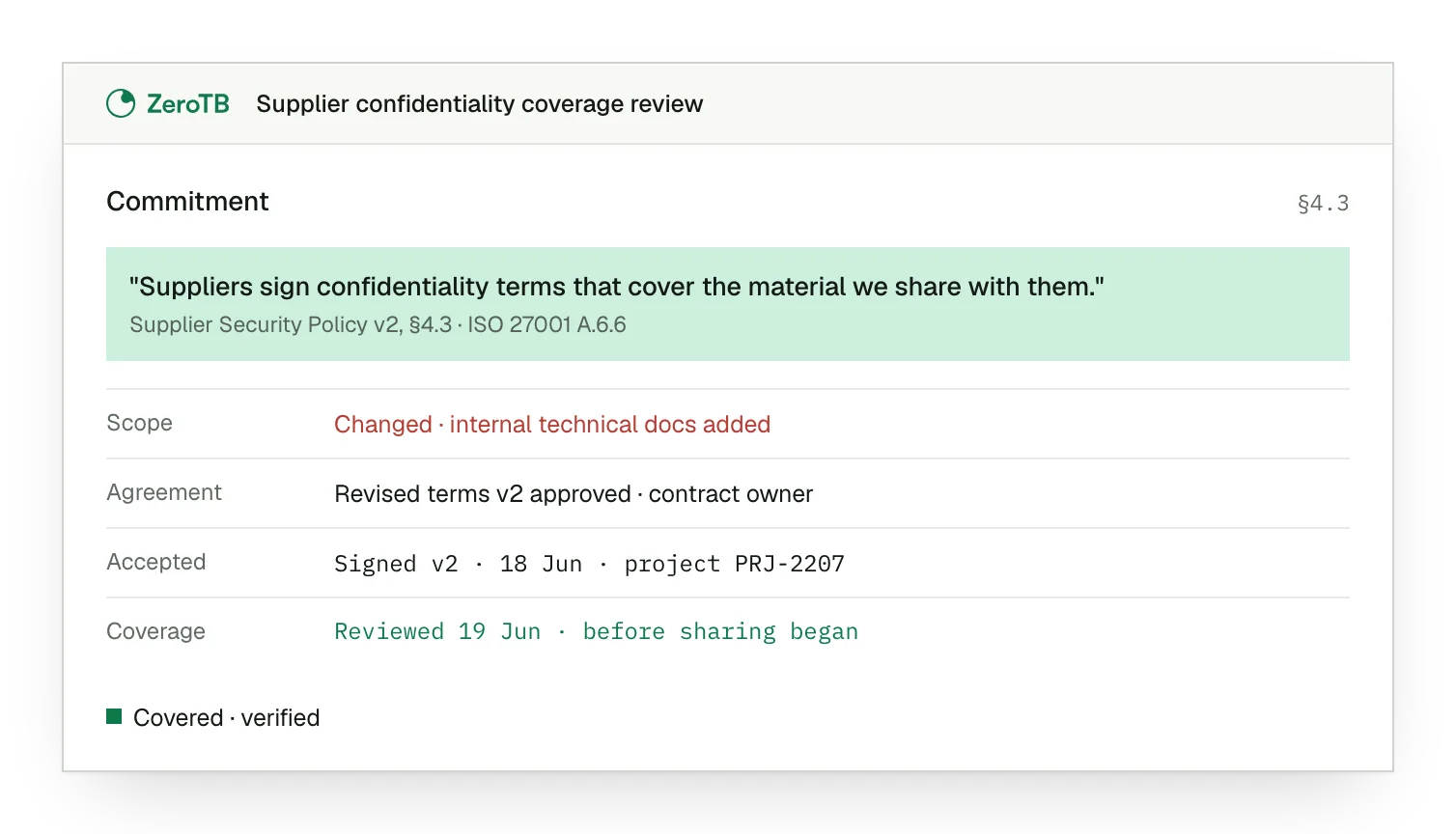
Changed project scope. Internal technical material has been added to work previously limited to public documentation.
Approved agreement update. Revised terms cover the added material and its intended use, with approval recorded.
Recorded supplier acceptance. The supplier signs the revised version, which is retained with the project reference.
Verified current coverage. A completed review records that the signed terms cover the project before sharing begins.
Confidentiality review checklist
Identify the relationship, information and intended use, then locate the agreement that applies to the current work.
Compare current activity with the last agreement review and identify changes needing the contract owner's decision.
Agree what information can be shared while any gap remains open, and communicate restrictions to the responsible people.
Connect the approved terms to the relevant party's acceptance and verify that they address the identified gap.
Keep the decision, accepted version and verification together, with an owner and conditions for the next review.
Sources
- ISO/IEC, ISO/IEC 27002:2022 overview, 2022.
- NIST, SP 800-53 Revision 5, PS-6 access agreements, 2020.
- UK Intellectual Property Office, Non-disclosure agreements, 2015.
- HHS, HIPAA audit protocol, workforce security, 2018 update.
Related pages
People controls
Find the neighboring control guides for security responsibilities throughout employment and other working relationships.
ISO 27001
Read about the wider program that establishes information security requirements and selects applicable controls.
Compliance frameworks
Compare the framework guides to understand the requirements each places on an operating control.
Start with the Pilot
Talk with our team about keeping controls working as the business changes. The eight-week Pilot maps up to 25 commitments, takes two real gaps through verified restoration and leaves records of the actions, approvals and checks of the results.