What duties continue after leaving or changing roles under ISO 27001 A.6.5?
ISO 27001 A.6.5 addresses the security duties that remain when someone leaves or changes roles. Explain the continuing duties to the person, and agree who takes over any security work they leave behind. Before closing the handover, check that the receiving owner can perform that work.
A recovery procedure can still name an administrator who has already left the company. Their account is closed, but nobody has accepted the work. This is the kind of unfinished handover to examine under A.6.5, one of the ISO 27001 people controls.
Continuing security duties
Security duties can continue after employment ends, even when the person's accounts have been disabled. Confidentiality, protection of company information and handling of knowledge gained in the role can remain relevant. The applicable employment terms or agreements establish what continues and under which conditions.
An exit reminder should identify those existing obligations in terms the person can understand. A generic statement about security may leave the treatment of particular information unclear. Connect the reminder to the person's responsibilities and the agreements that apply, including any stated duration.
Internal role changes
An internal move needs a decision about the duties that end, continue or pass to someone else. The person may still work at the company while losing responsibility for a system or procedure. Their new manager needs to understand which previous responsibilities remain with them.
Treat the old role and the new role as separate parts of the review. Record who receives each transferred security task, then agree the access needed for the new work. Otherwise, a promotion can leave the person responsible for tasks that their replacement assumes have already transferred.
Departure and transfer notifications
A departure date is useful to system owners only if it reaches them in time to act. The personnel record needs to reach the people handling access and transferred work. Each needs to know the affected role, when the change takes effect and their part in it.
Keep a changed date with the record of unfinished tasks. An earlier departure may leave a procedure without its planned handover, while a delayed transfer may change when access is needed. The manager and system owners can then decide how to complete the remaining work.
Responsibility handover
A receiving owner needs to accept the security work and have the means to perform it. Replacing a name in a register does not establish that the successor understands the procedure, can find its records or has authority to act when the task becomes due.
For a recovery procedure, the handover can identify its current location, the next scheduled check and the person who authorizes changes. The successor's acceptance should cover these practical details. Any missing access or knowledge remains an assigned task until the receiving owner can perform the work.
Company information and records
Company records need to remain available after their owner leaves. A returned laptop tells the team where the equipment is; it says little about procedures stored under the former owner's account. Those records need a known location and someone responsible for them after the departure.
The authorized owner decides which records to preserve or transfer before the account or its contents are removed. The successor then needs to check that the required material is accessible through an approved account. That check can expose a missing file while there is still time to recover it.
Communication of continuing duties
The departure record should show what the person was told about continuing duties. Retain the reminder, its date and a reference to the agreement it explains. An acknowledgment, where required by the process, belongs with the version of the reminder that the person received.
NIST's personnel security guidance includes exit discussions and reminders about continuing obligations. These are useful ways to explain what remains after employment ends. The acknowledgment records receipt of that information; a separate acceptance identifies the successor who takes responsibility for work remaining within the company.
Access changes
Account removal supports a departure, while a role change requires access that matches the new work. Connect the access decision to the same personnel change as the responsibility handover. The user access review can then explain why each permission was removed, changed or retained.
A successor may need access to a procedure that the former owner must stop using. Check both outcomes after the approved change. Any temporary access retained for a handover needs a clear purpose, an approving owner and agreed conditions for removal when that purpose ends.
Incomplete departures
Sometimes the employee is unavailable for an exit discussion. Record the communication that occurred and assign the unresolved items to an owner. If an acknowledgment is missing, that owner needs to know whether the reminder was delivered and what further action remains possible.
The required access changes can proceed through the approved process while the manager arranges a successor for unfinished security work. Neither action settles the missing communication. Keep its status visible and use the agreed escalation path when the responsible owner cannot resolve it.
Handover verification
Close the handover when evidence shows that the agreed responsibilities and protections are in place. The check should establish that continuing duties were communicated, the successor accepted the transferred work and the necessary information is available. Include the result of any related access changes.
The check needs to match the responsibility being transferred. For a recovery procedure, confirm that the successor can retrieve the current instructions and perform the agreed handover check. Keep any failed or untested part open with its own owner, even after the equipment has been returned.
Checks between personnel changes
The receiving owner may later move to another team, leaving the same responsibility unresolved again. Procedures and record locations can also change after a successful handover. The earlier record gives the reviewer a starting point: who accepted the work, what they received and what was checked.
For this kind of people-and-process control, ZeroTB uses the approved commitment to schedule work, assign it and escalate overdue tasks. People perform the human work and approve material decisions. Checking completion and retaining its evidence lets the next reviewer follow the responsibility through each change.
Handover evidence
A reviewer should be able to follow one departure or transfer through the duties, handover decisions and checks below.
| Requirement | What an auditor asks for | Where it comes from |
|---|---|---|
| Continuing duties | The duties that still apply after this person's departure or move | The relevant employment terms or agreements and the review that identifies the continuing duties |
| Communicated obligations | The reminder sent to the person and the date it was communicated | Departure correspondence, with acknowledgment where the process requires it |
| Accepted responsibilities | The receiving owner and the security work they agreed to take over | The accepted handover and the updated record of responsibilities |
| Available company information | The records transferred and confirmation that the successor can use them | The information-transfer record and the successor's check of the required material |
| Appropriate access | The approved permission changes and a check of the access that remains | The access decision and dated results for the affected accounts |
Related framework requirements
| Framework | Control | What it covers |
|---|---|---|
| ISO 27001 | A.6.5 | Continuing duties to protect information and transfer of security responsibilities when someone leaves or moves |
| SOC 2 | CC6.3 | Granting, changing and removing permissions as a person's role and responsibilities require |
| HIPAA | 45 CFR 164.308(a)(3) | Workforce access to electronic protected health information, including the procedures used when access must end |
Example of completing a responsibility handover
In this example, the administrator has returned the equipment, but nobody has accepted responsibility for the recovery procedure. The manager keeps the handover open. A successor must accept the work and complete the agreed check using the current instructions before it can close.
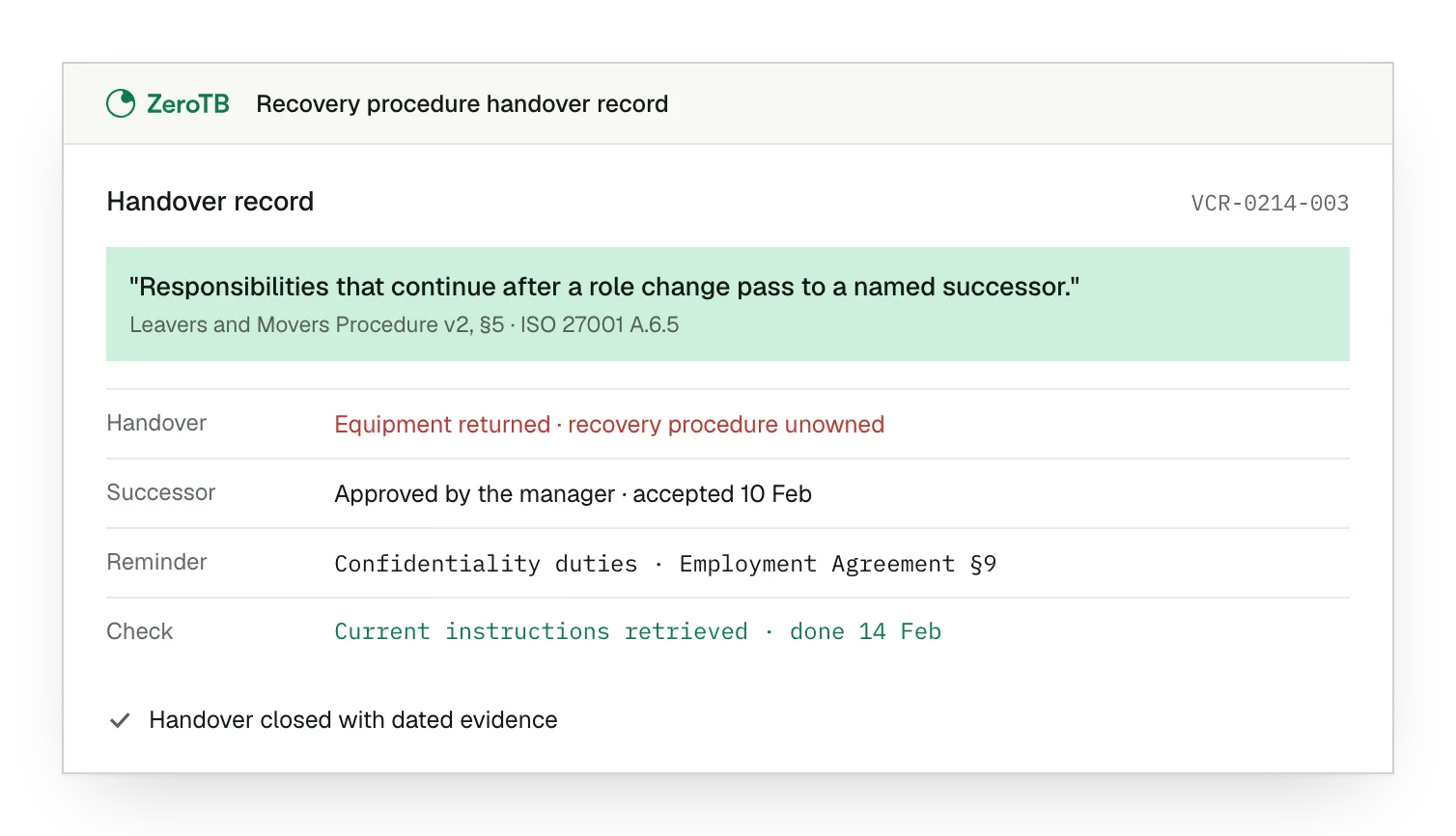
Unassigned procedure. Equipment has been returned; the recovery procedure still names the departing administrator as its owner.
Accepted transfer. The manager approves the successor's assignment and access, and the successor accepts the security work.
Duties communicated. The reminder sent at departure records the confidentiality duties established by the applicable agreement.
Handover checked. The successor retrieves the current instructions and completes the check recorded against this transfer.
Departure and transfer checklist
Check the applicable terms and record which security duties continue after this departure or change of role.
Establish who accepts each transferred responsibility and whether that person has the information and authority to perform it.
Connect removed, changed and retained permissions to the agreed duties, with approval for any temporary access during handover.
Confirm communication, acceptance and usable records; retain the results of access checks with the same personnel change.
Give incomplete items an owner and escalation path, and keep the handover open until its agreed checks pass.
Sources
- ISO/IEC, ISO/IEC 27002:2022: Information security controls, 2022. Control guidance supporting ISO 27001 Annex A.
- NIST, SP 800-53 Rev. 5: Security and privacy controls, 2020, updated 2025. PS-4, PS-4(1) and PS-5 address departures, continuing obligations and transfers.
- HHS, HIPAA audit protocol, 2018 update. Workforce security and termination procedures.
Related pages
ISO 27001
Explore the wider framework and the controls that support an information security management system.
Compliance frameworks
Find control guidance across the frameworks that your team needs to manage.
User access review
Review the permissions people need as their roles change and responsibilities move between teams.
Start with the Pilot
Talk with our team about recurring control gaps. In the eight-week Pilot, we map up to 25 commitments and take two real gaps through approved correction and verified restoration. You receive the evidence of the completed work.