SOC 2 CC2.2 addresses how a company tells its people what their control responsibilities involve. People need to understand the objective, their part in the work and how to report a problem. Check whether instructions still reach the right roles when a policy, procedure or responsibility changes.
The policy says one thing; the procedure used on a shift says another. That is a communication gap within SOC 2 CC2. CC2.2 asks how people receive the information needed for their duties, including when the work or the instructions change.
Control objectives and responsibilities
Internal communication connects a control's purpose to the actions people take. A general instruction to follow security policy leaves room for different interpretations. The person performing a task needs to know what requires approval, who decides and where to record the result.
The objective explains why those actions matter. A manager responsible for reviewing a change needs to understand which risk the review addresses. That context helps the manager recognize an incomplete request or a situation the procedure does not cover, and ask for a decision before work proceeds.
The people who need instructions
The audience for a control message follows the work it affects. Include the people performing the task, those approving it and anyone responsible for handling an exception. Where contractors perform those duties, they need the instructions relevant to their work too.
An old distribution list can omit someone who has just taken responsibility for a service. Compare the intended recipients with current roles and assignments. Record who needs the update and who received it, so a completion report can reveal a missing recipient or an unfinished follow-up.
Communication channels and timing
Instructions need to reach people where they make the relevant decision. A team may consult its own procedure much more often than the central policy library. That procedure needs to reflect the approved rule, link to its source and identify a contact who can answer questions.
The amount of explanation depends on what changed. A new contact can be announced in a notice; a revised emergency procedure may need a walkthrough. Plan the delivery around when the change takes effect. People should have the instructions before the next task requires them.
Questions and sensitive concerns
People need a usable route to report unclear instructions and control failures. The route should identify who receives a concern and how it reaches someone able to act. A report that reaches an unmonitored mailbox leaves the person reporting it without a response.
Provide a separate route when the usual reporting line is unsuitable for a sensitive concern. Check that the published contact details work and that someone handles incoming reports. Keep sensitive report contents restricted while retaining appropriate evidence that the route operates and that concerns receive follow-up.
Management and board communication
Leaders need information about control problems that require their decisions. Management and the board need a way to exchange information relevant to their oversight responsibilities. An operational update should make clear which objective is affected, what remains unresolved and which decision would help resolve it.
A useful review record connects the issue to the resulting decision and an accountable owner. This lets the next review distinguish work completed from work still awaiting action. Choose reporting detail and timing to suit the issue, including a route for urgent matters between scheduled meetings.
Policy changes and stale instructions
A policy revision can leave the procedure people use unchanged. Approval tells the company which rule now applies. It does not update the copies people have saved or the onboarding material used by another team. Those references can keep an old instruction in use.
Follow the changed action through the documents that describe it, and check the role assigned to perform it. Has that role moved to someone else? A current policy can still leave a new owner without the procedure or contact they need to do the work.
Corrections at the point of use
A communication gap closes only when the affected roles receive usable instructions. Identify the guidance they have been using and the approved rule it should reflect. Where the correction changes duties or the procedure, the responsible owner approves it before people start using the replacement.
Retire obsolete copies and send the affected people an explanation of the changed action. Questions may reveal a step that still needs clarification. Keep a record of those questions and any missed recipients, with the follow-up required before the reviewer can close the gap.
Evidence of understanding
A practical check shows whether people can apply an instruction. An acknowledgment records receipt or acceptance of a stated version. For a procedure involving several decisions, a walkthrough or exercise can also show whether someone finds the right instructions and follows the intended approval route.
Match the check to the consequence of misunderstanding the change. A corrected contact detail may need a routing test; an emergency procedure may need a scenario. Record the expected action and the observed result. If the check exposes confusion, revise the instructions and repeat the affected check before closure.
Records across the audit period
Communication evidence needs to preserve which instructions applied at the time. Save the approved version and effective date alongside the audience and delivery record. For a correction, add the follow-up and test results, so the history shows what remained open and who was responsible for it.
A reviewer can then distinguish the original failure from the later repair. The same training material may be relevant to another framework, but its audience and purpose still matter. Check those separately before using the record to support a requirement with a different scope.
Continuing ownership
A communication control needs an owner after the correction is complete. Changes to responsibilities, procedures and reporting routes can create a new gap. Tie further checks to those changes and to the schedule in the approved commitment, with a clear recipient for overdue work.
ZeroTB supports this continuing work by assigning and following up on policy reviews, training and incident exercises, then retaining evidence of completion. People assess whether the instructions are clear enough to use. A Verified Control Record connects a restored control to its commitment, action, approval and verification.
Evidence for an internal communication review
Use these records to trace the approved instruction, its audience and the follow-up that resolved a gap.
| Requirement | What an auditor asks for | Where it comes from |
|---|---|---|
| Defined responsibilities | The approved duties and instructions relevant to the control | Policies, role descriptions and working procedures |
| Intended audience | Who needed the instructions and who received them | Current role assignments, recipient lists and delivery records |
| Questions and concerns | How people report problems and how those reports receive attention | Reporting procedures, contact checks and restricted follow-up records |
| Leadership oversight | Information shared with management and the board, with resulting decisions | Meeting records, issue reports and assigned actions |
| Current instructions | What changed, when it took effect and how affected roles were informed | Version history, approved updates and communication records |
| Verified correction | The gap, approved correction and evidence that the revised instructions worked | Correction records, acknowledgments and relevant exercise or test results |
Related framework requirements
| Framework | Control | What it covers |
|---|---|---|
| SOC 2 | CC2.2 | Internal communication that helps people understand and perform their control responsibilities |
| ISO 27001 | A.6.3 | Security awareness, education and training relevant to people's responsibilities |
| HIPAA | 164.308(a)(5) | Security awareness and training for the workforce, including management, within the Security Rule's scope |
Example of restoring emergency instructions
An emergency procedure must tell the on-call team how to obtain the approval the policy requires. Suppose the guide still sends requests to the former approver. The owner corrects the guide, informs the team and uses an exercise to check whether requests now reach the duty manager.
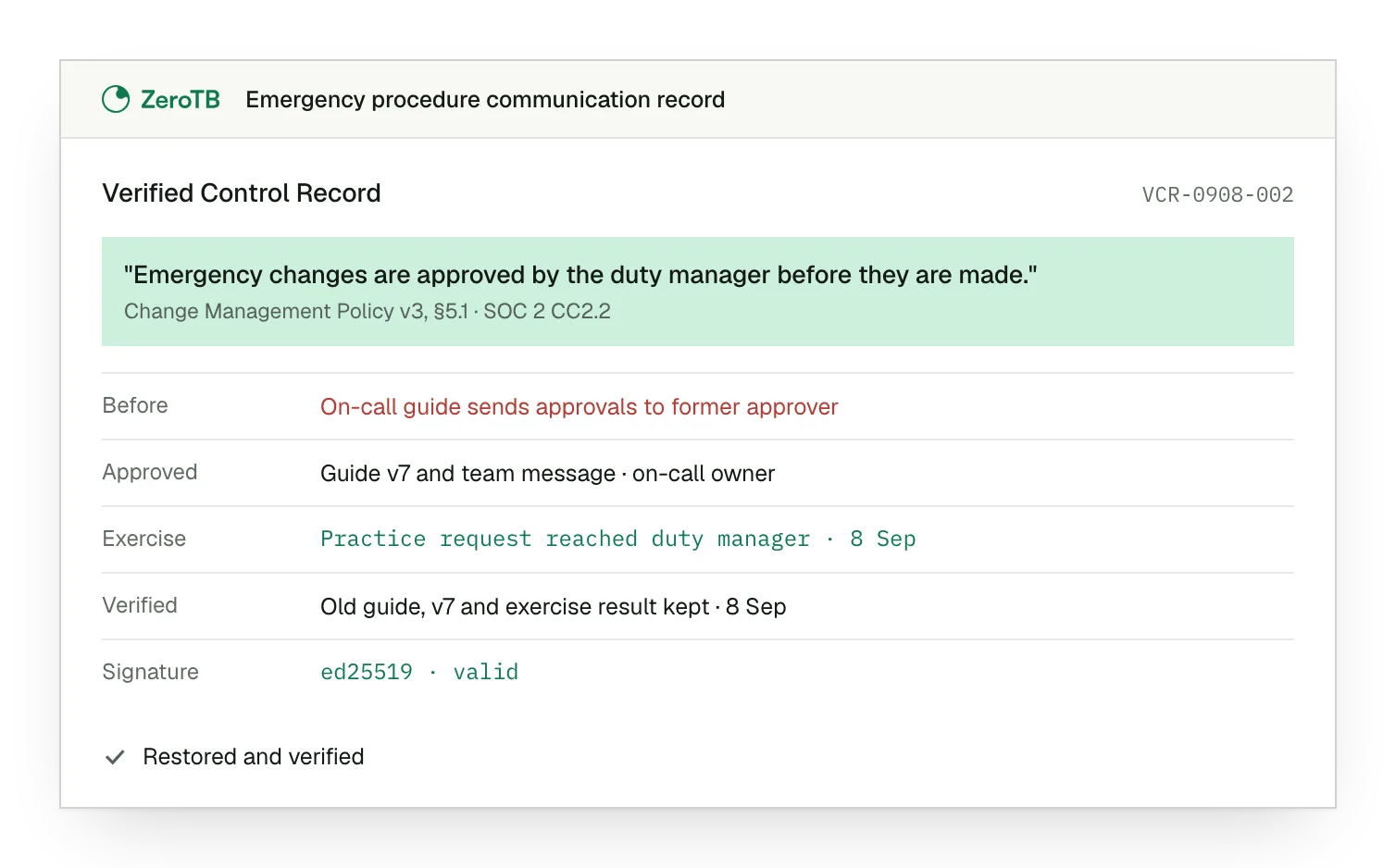
Conflicting instructions. The guide directs requests to the former approver even though the policy assigns the duty manager.
Approved procedure update. The owner approves new instructions and a message telling the team which approval route to use.
Successful practice request. The team follows the updated instructions during an exercise and reaches the duty manager for approval.
Completed correction record. A reviewer can trace the old guide through its replacement to the dated exercise result.
Internal communication review checklist
Compare the policy's responsibilities with the people performing, approving and reviewing the work, including relevant contractors.
Follow the route from the approved policy to the procedure people use, checking versions and contact details.
Confirm that questions and concerns reach an accountable recipient, including when the usual reporting line is unsuitable.
Use a proportionate exercise or routing check to establish whether the corrected instructions support the intended action.
Retain the instruction, audience, approval and results together, with an owner responsible for checking later changes.
Sources
- AICPA & CIMA, 2017 Trust Services Criteria with revised points of focus, 2022 revision.
- HHS, HIPAA audit protocol, security awareness and training, 2018 update.
- ZeroTB, SOC 2 compliance automation with human approval, 2026.
Related pages
SOC 2 framework
Read about the other criteria that sit alongside internal communication in a SOC 2 program.
Compliance frameworks
Find the framework guidance for the requirements that apply to the work your company performs.
How ZeroTB works
Read how the team follows a commitment through the work needed to keep a control operating.
Start with the Pilot
In the eight-week Pilot, our team maps up to 25 commitments and takes two real control gaps through verified restoration, with approval before correction. Talk with us about where communication breaks down and what a useful repair would involve.