SOC 2 CC2.1 addresses whether the information a company uses for its internal controls is fit for that work. A reviewer needs relevant, complete and current information to reach a sound decision. Check the sources behind the result, including missing inputs, and repeat the affected check after a repair.
A report with no exceptions can look reassuring even when an entire production account is missing. CC2.1, within CC2 information and communication, concerns the information behind that result. Its quality needs attention whenever a system, permission or report changes.
Information requirements
Start with the decision the information must support. For an access review, the useful details include accounts, permissions and owners. For a configuration review, the observation must cover the environment where the rule applies. Each review needs information that explains the resulting decision.
The report available today may cover only part of those needs. Compare its fields and scope with the approved control before accepting it as the source. A reviewer should be able to identify the subject of each record and judge its state against the rule.
Source coverage
A report needs a separate list of the systems it should cover. Compare the systems covered by the control with those represented in the collected information. A collector's own list cannot reveal a system that it has never been configured to read.
Use system or account identifiers when reconciling the lists. An unchanged total can hide one missing account and one newly added account. Resolve differences against the approved scope, and retain the reason for each exclusion so the next reviewer can understand the population.
Collection failures
A successful collection job can still leave part of the control unchecked. A connector may lose permission to read one cloud account while continuing to return information from others. The resulting report can appear healthy because the missing account contributes no exceptions.
Check collection failures alongside the control result. An empty response needs an explanation: the source may have no relevant records, or collection may have failed. Keep unavailable information visible until a fresh observation establishes what happened and which conclusions the available information can support.
Information age
Check the age of the observations inside a report. A recent export date can conceal settings collected before the latest system change. The report may have been created this morning while the information used to reach its conclusion is already out of date.
How old is too old depends on the control decision and the changes it must detect. Keep both the collection date and the period covered with the result. If that information is too old, a fresh observation or an owner's decision about the uncertainty is needed.
Processing accuracy
Information can lose meaning between the source and the report. Filters can exclude relevant accounts, and combined exports can match records incorrectly. A complete source therefore needs a check of the steps that turn its records into the conclusion the reviewer sees.
Compare selected report entries with their source records, including entries affected by a filter or transformation. Preserve the report settings used for the review. If those settings change, check whether the new output still answers the same control question before using it in a decision.
Usable control information
A reviewer needs to know what a result refers to before acting on it. Failing account identifiers need their associated systems and owners. The report also needs a visible scope and date, especially when someone other than its author will make the control decision.
Keep the underlying records available to authorized reviewers under the appropriate access restrictions. A link from the conclusion to those records lets an owner investigate a disputed finding. It also gives the next reviewer a way to follow the decision without rebuilding the collection process.
Approved source repairs
The repair proposal needs to explain which information is missing and what would restore it. For a permission failure, that means identifying the affected account and the records the collector must read. The proposed access can then be assessed against the approved control scope.
A system owner may need to approve the change before collection can resume. Give that owner the expected coverage after repair, including any records that will remain excluded. The same description gives the person testing the change a clear basis for checking what returned.
Verification after repair
Test the repaired source through the report that uses it. A working connection is only part of that test: the returned systems must match the expected population, and fresh records must reach the affected control check. Repeat that check before accepting its conclusion.
The newly visible account may fail the underlying control even though collection now works. Keep those results separate and assign the control failure to its owner. A reviewer can then see precisely what the repair achieved and which work is still needed before the control passes.
Earlier control decisions
Restoring today's collection leaves earlier decisions to review. Identify when reliable information stopped and which reviews used the affected source during that period. The control owner can then assess whether those decisions need to be repeated or supported with other available records.
A current configuration observation cannot establish every change made during a missing period. Preserve any available history and document what it can establish. Where the earlier state cannot be recovered, record the gap and the owner's decision. Keep today's successful check tied to its observation date.
Continuing ownership
Assign someone to follow changes that affect the report's meaning. A new account may need to enter its scope; a revised export may alter the records it includes. Without an owner for these changes, an established report can become unreliable between reviews.
Resolving an omission often involves both the reviewer and the team responsible for the source. Their decisions belong with the repair evidence. ZeroTB's Verified Control Record keeps the commitment, observed states, action, approval and verification together, so a later reviewer can see how the gap was resolved.
Evidence for information quality
The evidence should let an auditor follow how the reviewer reached a decision from the available information.
| Requirement | What an auditor asks for | Where it comes from |
|---|---|---|
| Defined information needs | Which decision the review supports, and the information needed to make it | Control documentation identifying the information needed for the review |
| Complete source coverage | Which systems should appear, which appear in collection and why any are excluded | The inventory used for comparison and the corresponding collection records |
| Current observations | The date of collection and the period to which each observation relates | Dated source records retained alongside the report used in the review |
| Accurate processing | How entries reach the report and whether they agree with their source | Saved filters, export settings and checks of entries against source records |
| Verified source repair | The missing input, approved repair and outcome of the repeated control check | The change approval and new observations attached to the affected review |
Related framework controls
| Framework | Control | What it covers |
|---|---|---|
| SOC 2 | CC2.1 | Whether the information used for internal controls is relevant and of suitable quality |
| ISO 27001 | A.5.33 | Protection of records; this can include the evidence kept from a control review |
| HIPAA | 164.312(b) | Recording system activity and examining it where systems contain or use electronic protected health information |
Example of restoring missing information
In this example, a daily configuration report omits one production account after its collection permission changes. The repair restores that account to the report. A fresh configuration check then determines whether the account meets the control's approved rule.
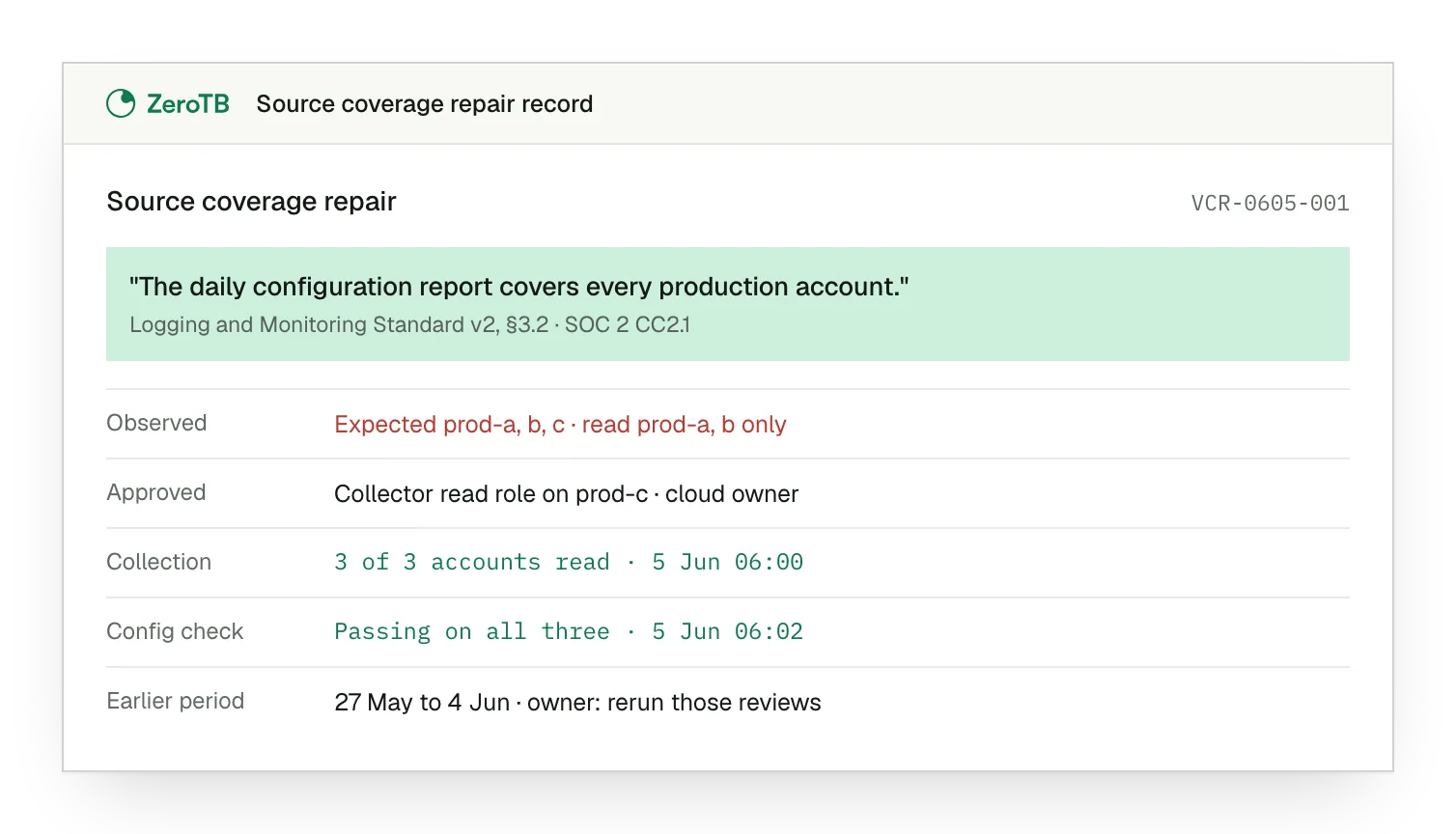
Missing account. The expected scope includes three production accounts, but the report contains observations from only two.
Approved access repair. The system owner approves restoring the collector's required read permission for the missing account.
Complete fresh collection. The next collection includes all three accounts, and the repeated configuration check shows its result.
Earlier review gap. The record identifies the affected reporting period and the owner's decision on earlier reviews.
Information quality review checklist
Identify the control question and the scope, fields and observation dates needed to answer it.
Compare expected systems with collected systems and investigate omissions before accepting the report's conclusion.
Review filters and transformations, then compare selected output entries with the source records they represent.
Agree which fresh observations and repeated checks will establish that the proposed source repair worked.
Identify earlier reviews that used incomplete information and record how the owner resolves the resulting uncertainty.
Sources
- AICPA & CIMA, 2017 Trust Services Criteria with revised points of focus, 2022 revision.
- ISO, ISO/IEC 27002:2022 information security controls, 2022.
- HHS, HIPAA audit protocol, July 2018 update.
- ZeroTB, SOC 2 compliance automation with human approval, 2026.
Related pages
SOC 2 criteria
Explore the wider requirements that the information behind a control decision helps support.
Compliance frameworks
Find control guidance across the frameworks covered by your organization's compliance program.
Verified Control Record
See how the record connects an approved repair with the observations that verify its result.
Start with the Pilot
Talk with our team about the information behind your control decisions. In the eight-week Pilot, we map up to 25 commitments and take two real control gaps through approved correction and verified restoration, with evidence of the results.