How does ISO 27001 A.8.24 govern using encryption?
ISO 27001 A.8.24 concerns using cryptography to protect information, including the rules for managing its keys. For encryption, define which data needs protection, how systems apply it and who can use the keys. Check these conditions together as systems change, then verify that corrections preserve authorized access and recovery.
An encrypted database can still be readable through permissions that exceed the approved policy. Reviewing A.8.24 means following the protection from the written commitment through the data, the keys and the systems that use them. That connection makes a gap easier to explain and correct.
Encryption scope
An encryption commitment needs a defined set of information and systems. Start with the protection the organization has agreed to provide for each kind of data. Identify where that data is stored, where it travels and which applications process it.
Describe the expected protection in terms that a reviewer can check against the system. The scope should identify its owner and any accepted exceptions. Later reviewers can use that scope when a service moves or the organization adopts another application.
Data copies
Backups and exports need the protection agreed for the information they contain. A production database and a copy restored for testing may have different settings. Review the copies covered by the commitment, including their destinations and the permissions granted there.
Record where each copy lives, who owns it and which mechanism encrypts it. When a destination changes, the reviewer can compare its settings with that record. The same information helps identify the keys and permissions needed to recover a backup.
Protection during transfer
Stored data and transmitted data need separate checks. Encryption on a disk or storage service describes protection at rest. A review of data transfer examines the connection between systems, including where encryption ends and whether the next connection remains protected.
Keep evidence for each protection with the relevant data flow. A storage configuration cannot explain how an application sends information to another service. Where electronic protected health information is involved, the HHS transmission-security guidance provides a separate basis for reviewing those transfers.
Managed encryption
Service defaults help establish encryption, but the choice of key still needs to fit the commitment. Amazon S3 encrypts new object uploads by default. Review what the service supplies and what the organization has promised about control of the key.
A provider-managed key may be enough for that purpose. A customer-managed key gives the organization more direct responsibility for permissions and lifecycle decisions. Before choosing it, establish who will manage access, handle recovery and decide when the key can be retired.
Key permissions
A reviewer needs to know who can decrypt the data and how they received that permission. Examine access to the data alongside access to its key. Include the ability to change key permissions, since an administrator can affect access by others.
For AWS KMS, examine the relevant key policy, identity policies and grants together. AWS explains their roles in key access. Follow the permissions for a particular application or role until its ability to use the key has an explanation.
Key replacement
A key needs a defined period of use and a response if its protection is compromised. The period depends on its purpose and the information involved. NIST's key-management guidance discusses these decisions alongside the other responsibilities of managing keys.
Before replacement, identify the services that use the key and the effect of changing it. Suspected exposure needs a separate investigation into affected access and information. The replacement should form part of that response, with the reason and expected result recorded.
Recovery and retirement
An old key can remain necessary long after a service has stopped using it for new encryption. Retained backups or archives may still need it. Recovery arrangements must identify that dependency and restrict who can obtain the access needed to read the information.
Retirement is the point to check whether any of that data must remain readable. Deleting a KMS key can make its protected data unrecoverable. Give the owner the affected data and recovery requirements before asking for approval to destroy the key.
Changes between reviews
A deployment can change encryption protection without changing the written policy. A new service may use a different key, or a permission update may extend decryption rights. The next check needs to compare that changed arrangement with the same approved commitment.
Preserve the affected resource and the observation that revealed the difference. This makes investigation more specific than a general encryption alert. For connected cloud systems, the cloud and infrastructure review follows configuration changes back to the controls they affect.
Correction decisions
A correction needs an owner decision about the access that should remain. Removing a permission can affect an application, an operational task or recovery. Identify those dependencies before approval, and explain which identities will lose access under the proposed change.
The owner may decide to remove an obsolete role while retaining a recovery role that uses the same key. Record the reason for retaining it, the safeguards and the next review. That decision gives the person making the change a clear intended result.
Verification tests
A successful correction blocks unintended use and preserves the access that the business still needs. Define both results before the change. Afterward, test the affected operation with the relevant identities and record what each identity could do.
A permissions export supports the result, but the test explains its practical effect. Keep dated observations with the approval and action. Use resource identifiers and test outcomes in the evidence record; secret key material has no place in an audit attachment.
Ongoing checks
Repeat checks need a reliable observation and an owner who can act on a failure. Schedule them around the commitment and relevant system changes. If the connection fails or the observation is stale, resolve that missing evidence before concluding that the protection holds.
ZeroTB follows this work from the approved commitment through checks, a drafted correction, human approval and verification of the resulting state. The Verified Control Record retains the action and evidence together. That record lets the next reviewer see why the gap was closed.
Evidence for encryption controls
Use these records to connect the approved protection to the systems, access decisions and tests that support it.
| Requirement | What an auditor asks for | Where it comes from |
|---|---|---|
| Defined protection | Data and systems covered, required encryption, control owner and accepted exceptions | Approved policies, data inventory and exception decisions |
| Encryption in operation | Settings and observations showing the protection applied to stored data and relevant transfers | Storage configurations, connection tests and dated system observations |
| Restricted key use | Identities allowed to use or administer keys, with the reasons for those permissions | Key policies, identity permissions, grants and access approvals |
| Managed key lifecycle | Decisions for replacement, recovery and retirement, including dependencies on older keys | Key inventory, lifecycle procedures and recovery test records |
| Verified correction | The gap, approved action and tests of permitted and denied operations | Change records and before-and-after observations retained in the control record |
Related framework requirements
| Framework | Control | What it covers |
|---|---|---|
| ISO 27001 | A.8.24 | Rules for cryptographic protection and for managing the keys used by the organization |
| SOC 2 | CC6.7 | Safeguards for information being transmitted, moved or removed, including encryption where it supports that protection |
| HIPAA | 164.312(e)(1) | Safeguards for electronic protected health information in transit, with encryption assessed for the relevant transfers |
Example of restricting decryption access
A completed migration can leave a permission that has no remaining purpose. In this example, the deployment role still decrypts application data. Removing that permission addresses the gap, provided the application retains its required access to the same key.
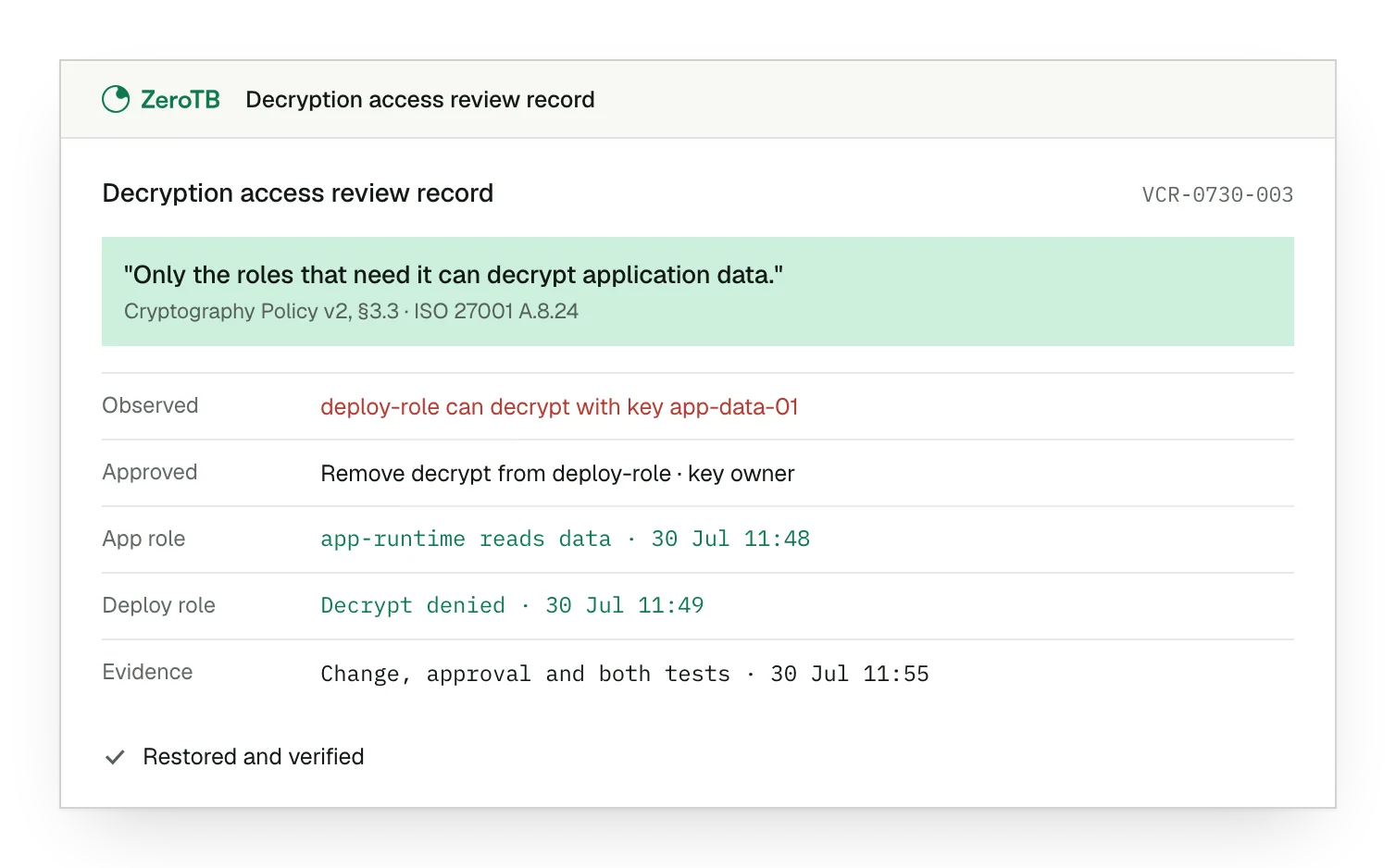
Excess permission. The migration has ended, but the deployment role can still decrypt the application data.
Approved removal. The owner approves removal of the obsolete permission, with application access retained under the change.
Tested access. After the change, application reads succeed and the deployment role cannot decrypt the protected data.
Recorded result. The reviewer can see the permission change, its approval and the dated results of both tests.
Encryption control review checklist
Identify the data, systems and transfers covered by the commitment, including relevant copies and approved exceptions.
Compare the identities that can use or administer each key with the permissions approved for their work.
Establish which retained information still needs each key before approving replacement, access changes or retirement.
Decide which access should end and which must remain, with the affected services and recovery needs in view.
Test permitted and denied operations after the change, then retain dated results with the action and approval.
Sources
- ISO/IEC, ISO/IEC 27002:2022 overview, 2022.
- NIST, SP 800-57 Part 1 Rev. 5: Recommendation for key management, 2020.
- CMS, Key management handbook, accessed November 4, 2026.
- AWS, Key policies in AWS KMS, S3 server-side encryption and KMS key deletion, accessed November 4, 2026.
- HHS, HIPAA audit protocol, updated July 2018.
Related pages
Technological controls
Explore the other controls that govern systems, software and information within this ISO 27001 theme.
ISO 27001
See how this control fits within the wider information security management system and its commitments.
Compliance frameworks
Find guidance for the other frameworks whose requirements apply to the systems and information under review.
Start with the Pilot
Talk with our team about encryption controls and the gaps that keep returning. The eight-week Pilot maps up to 25 commitments and takes two real control gaps through approved correction and verified restoration, with a record of the work.