What does ISO 27001 A.8.7 require for defending against malware?
ISO 27001 A.8.7 covers defending against malware through prevention, detection and recovery measures, supported by staff awareness. The practical question is whether those protections still work on the systems in use. Check coverage and response after changes, and retain the results that justify closing a protection gap.
An earlier successful check can stay in the console after a laptop's protection agent stops reporting. Meanwhile, its user carries on working. Before closing the gap, the reviewer needs to know what failed and what the repair changed on that particular device.
Protection scope
Malware protection has to cover the systems named in the approved control, including the routes by which they receive files. The measures can differ between a laptop and a server. An assigned owner can then address a failure wherever it occurs.
A new laptop needs an applicable rule from the time it enters use. Replacing equipment can also change which protections will run on it. When the usual mechanism cannot operate, the control owner decides how to address the risk and records the alternative chosen.
Malware prevention
Malware can arrive through files or software that people use for ordinary work. Restrictions on software and checks on incoming files help prevent it from running. Staff awareness supports those measures by helping people recognize suspicious files and report unexpected behavior to the security team.
The reporting route matters because someone has to investigate what staff notice. Technical protections need attention too, including updates and responses to detections. NIST's SI-3 guidance describes those measures and scanning. The organization can use that guidance when implementing the protections its own control calls for.
Device coverage
The protection console needs to account for the devices people use. Comparing its device list with an independently maintained inventory can reveal active systems that never enrolled or stopped appearing. A console-only review cannot account for devices absent from its records.
The comparison also needs to explain devices that have left service. A retired laptop and an active laptop with a missing agent require different actions. Device identity, assigned owner and recent activity help establish which case applies before the team removes an entry or starts a repair.
Current protection status
The date of a protection result matters as much as the result itself. A successful report from before an upgrade cannot establish what the upgrade left running. The reviewer needs a sufficiently recent observation to judge the device's current protection against the approved rule.
How recent is sufficient depends on the system and its use. The control owner sets that condition so reviewers know when to investigate. An offline laptop may be checked when it returns, while stale results from a laptop already in use leave an immediate gap to resolve.
Approved exclusions
A running protection service can still skip files or activity because of an exclusion. The exception record needs to explain what is excluded and why. It also needs an owner and review conditions so a temporary workaround does not escape later attention.
Removing an exclusion can have consequences for legitimate work. It may have been added after a false detection interrupted that work. Reviewing the reason gives the owner a basis for deciding whether to retain the exception, narrow it or protect the affected activity another way.
Reporting gaps
A silent agent needs investigation before the team can choose a repair. The device may have lost its connection to the console while local protection continues. Alternatively, the protection service may have stopped. Those situations can look similar from the central dashboard.
Recent device activity and local protection status help separate them. The investigator should retain the last known result and the first observation of the gap. Where the available evidence cannot establish protection, the record needs to preserve that uncertainty until a current check resolves it.
Incident response
Suspected compromise requires the incident response process alongside any repair to the protection tool. Restoring an agent's connection does not establish what happened while reporting was unavailable. The response team needs the relevant observations to decide whether containment or further investigation is necessary.
Incident handling and control repair can have different completion conditions. A repaired agent may report correctly while an investigation remains open. Keeping those decisions separate lets the reviewer understand which protection has been restored and which questions about the affected system still require an answer.
Approved repairs
The proposed repair needs to match the failure found during investigation. Restoring communication may be sufficient for a reporting fault. A stopped service or incorrect setting requires a different correction. Each proposal should identify the device, the change and the expected result before work begins.
The owner approves material changes with their effect on ongoing work in view. If the repair will interrupt a user's work, that effect belongs in the decision. A later change to the proposal may need a revised approval so the recorded decision still covers the action performed.
Verification after repair
Verification needs to establish that protection works and that a detection reaches the responsible team. A fresh report confirms communication, but the check also needs the protection settings and response behavior relevant to the original gap. Define those expected results before closing the repair.
Use an approved, safe test supported by the protection tool; introducing live malware would create a new risk. Record what the test checked and its outcome. If a required result is missing, keep that part of the gap open and identify the next action and owner.
Continuing evidence
A repair history should let someone who was absent follow the failure and its resolution. The device, dates and observations explain what was known. The action, approval and test results explain what changed, including whether the work restored reporting, protection or both.
That history also needs an owner for the next check under the approved schedule. Related frameworks may use parts of the evidence. HIPAA's malware protection provision involves awareness and procedures as well as protection. Device results can support that work alongside records of staff guidance and the response arrangements.
Malware protection evidence
Use these records to connect the approved malware control to its coverage, operation and any correction.
| Requirement | What an auditor asks for | Where it comes from |
|---|---|---|
| Defined protection | The approved measures, systems in scope, responsible owners and treatment of exceptions | Malware policy, system inventory and approved exception records |
| Device coverage | Evidence that active systems have the protection required by the control | Device inventory reconciled with enrollment records and recent protection reports |
| Operating protections | Current settings, update status and the reasons for retained exclusions | Protection configuration, update records and exclusion approvals |
| Detection and response | Procedures for handling detections, staff reporting guidance and evidence of their use | Response procedures, awareness records and dated alert or exercise records |
| Verified restoration | The observed gap, authorized repair and checks that establish the resulting protection | Change approval and before-and-after observations in the Verified Control Record |
Related framework requirements
| Framework | Control | What it covers |
|---|---|---|
| ISO 27001 | A.8.7 | Malware prevention, detection and recovery across the agreed scope, with awareness supporting those measures |
| SOC 2 | CC6.8 | Preventing unauthorized or malicious software from affecting the systems included in the SOC 2 examination |
| HIPAA | 164.308(a)(5)(ii)(B) | Procedures for preventing, detecting and reporting malware as part of security awareness and training where electronic protected health information is involved |
Example of restoring endpoint protection
Restoring a silent endpoint agent requires a fresh protection result and a working alert route. In this example, an upgrade leaves the protection service stopped on an active laptop. The owner approves its repair, and checks establish protection and alert delivery before closure.
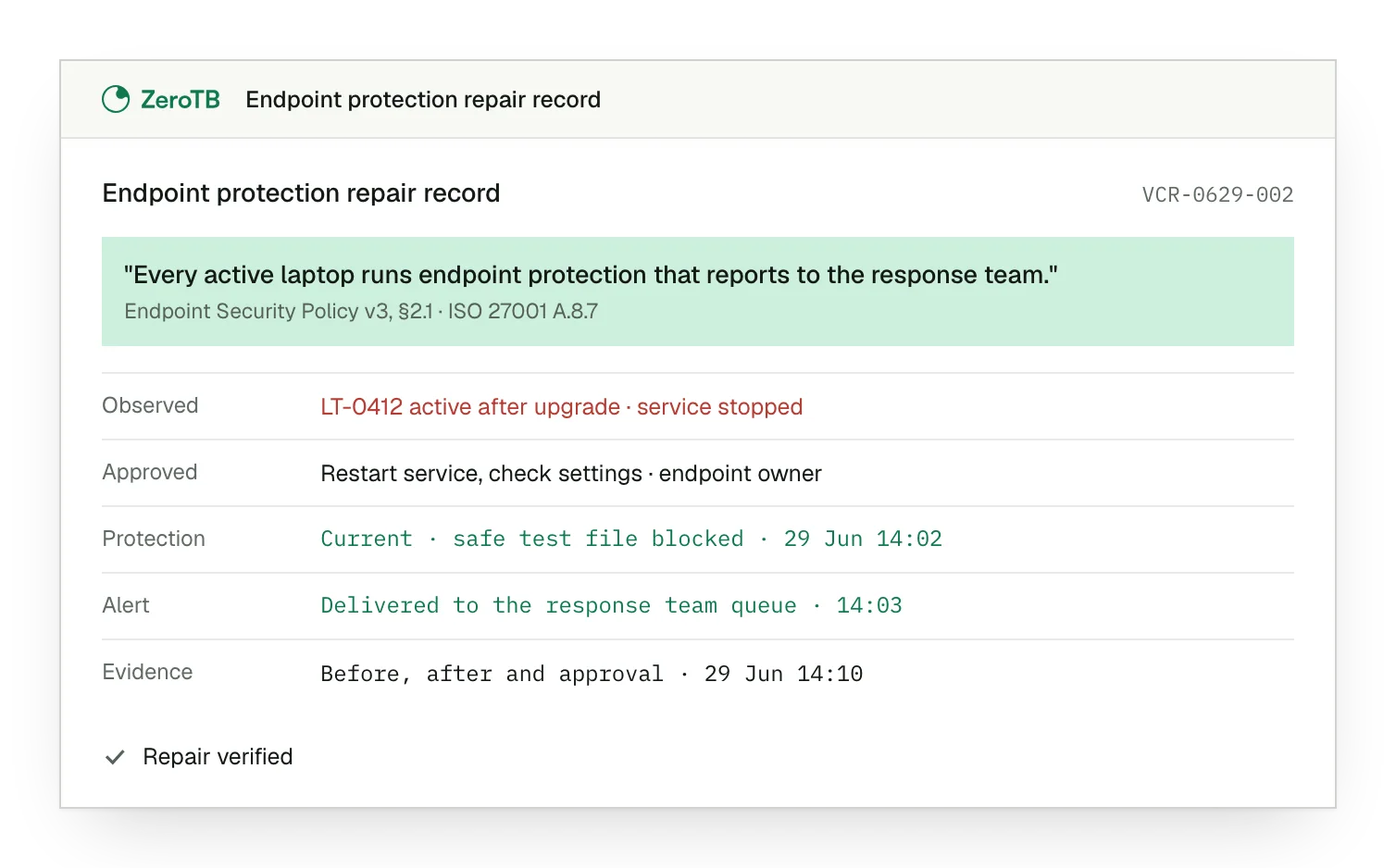
Missing protection. The laptop remains active after an upgrade, but its protection service has stopped.
Approved repair. The endpoint owner approves restoring the service and checking the settings required by the control.
Verified response. A safe test confirms the expected protection behavior and delivers an alert to the response team.
Retained evidence. The record keeps the observed gap, approval and dated results together for later review.
Malware protection review checklist
Compare the approved rule with the systems in use and decide how it applies where the usual protection cannot run.
Establish whether reporting failed, protection stopped or suspected compromise needs an incident decision before agreeing the repair.
Review the proposed action and any interruption it could cause, then agree what the checks must establish afterward.
Use current observations and a safe test to establish that protection works and that the responsible team receives detections.
Keep the failure, approval and test results together; assign further checks and any unresolved incident decisions to an owner.
Sources
- ISO/IEC, ISO/IEC 27002:2022 overview, 2022.
- NIST, SP 800-53 Rev. 5, SI-3: Malicious code protection, release 5.2.0, 2025.
- HHS, HIPAA audit protocol, protection from malicious software, 2018 update.
- ZeroTB, Continuous control monitoring guide, 2026.
Related pages
ISO 27001
Read about the wider ISO 27001 program and the controls that support its requirements.
Compliance frameworks
Find guidance on other frameworks that may cover the same systems and information.
Control surfaces
Read about endpoint checks and the other systems where ZeroTB follows controls through to restoration.
Start with the Pilot
Talk with our team about where the Pilot could help. During its eight weeks, we map up to 25 commitments and take two real control gaps through approved correction and verified restoration. You receive the records of those repairs and their results.