What does ISO 27001 A.8.6 require for capacity planning?
ISO 27001 A.8.6 covers capacity management: providing enough resources for the demand a service faces now and expects later. Check usage and forecasts against the time needed to add capacity. When those checks reveal a gap, approve a response and test whether it restores the service's agreed operating margin.
An alert may still fire at the threshold agreed during the last review, yet leave too little time to expand the service. The workload has changed while the warning has stayed the same. Capacity planning needs to detect and correct that mismatch.
Capacity scope
A capacity review needs a clear boundary around the service and the resources it uses. Storage, processing power, memory, network bandwidth and connections can each restrict operation. Include a resource when exhausting it would prevent the service from doing its agreed work.
The service owner defines that work: how much demand the service must handle and what performance is acceptable. Resource measurements can then be assessed against a concrete expectation. Without that connection, a reviewer can see rising usage but cannot judge its significance for the control.
Demand assumptions
A useful forecast accounts for the workload the service will face before its capacity can change. Historical usage provides a starting point, while planned releases, new users and changes in data retention can alter demand. Record which assumptions the forecast uses.
The forecast also needs a review condition. A new application or a change in workload can invalidate earlier estimates even when current usage looks acceptable. Microsoft's capacity-planning guidance connects planning to expected changes in usage; the practical question is whether the current forecast still represents the service.
Warning time
An alert is useful when it leaves enough time to finish the response. For a store that fills steadily, remaining space divided by daily growth gives an estimate in days. Compare that estimate with the time needed to investigate, approve, expand and test the resource.
The percentage used by the alert can stay unchanged while this response window shrinks. Faster growth consumes the same amount of spare space sooner. The owner then has a concrete choice: arrange an earlier warning or change the response so it can finish in time.
Shared resource limits
Capacity in one component cannot compensate for a limit elsewhere along the service path. An application may have spare compute while its database accepts no further connections. The review needs to locate the resource that prevents the service from handling its expected workload.
A provider may also limit how far that resource can grow. AWS guidance on service constraints covers quotas and limits in connected services. Record any provider decision needed for expansion, so the proposed correction does not depend on capacity that the team cannot yet obtain.
Automatic scaling
A scaling rule needs to add capacity before demand exceeds what the service can handle. The rule can reach its configured maximum or a provider quota. It can also respond too slowly, allowing the service to deteriorate while more resources are being added.
Testing should show how the arrangement behaves at the expected workload, including the point where expansion stops. That gives the owner a basis for deciding whether automatic scaling is sufficient. Reserved capacity or an approved workload adjustment may be appropriate where expansion cannot meet the requirement.
Recovery capacity
A service may need more spare capacity for recovery than it uses during normal operation. If a component fails, its workload moves to resources that may already be busy. Include that additional demand when reviewing the capacity available under the agreed recovery arrangement.
AWS recommends leaving room below quotas for failover. Check the receiving account or region as well as the surviving service components. A normal-operation test leaves a different question unanswered: whether those resources can support the demand the recovery plan would place on them.
Approved corrections
A capacity correction must keep the service able to do its agreed work. The owner may choose more resources or approve a different workload schedule. That choice needs to account for the forecast and the effects of delaying work on people who use the service.
Describe the proposed resource change and the capacity it should provide, including any remaining limit. With that description, the owner can assess the consequences before approving it. The reviewer can then test the intended result against the same service requirement used to make the decision.
Protection during changes
Space reclaimed from a log store can come at the expense of another control. Records deleted to make room may still be needed under the retention policy. Reducing the events collected can also leave an investigation without information or remove evidence that a control operated.
Before approval, identify the protections the capacity change could affect and how to recover if it fails. The owner can then judge the response with those effects in view. Keep the reason for any accepted exception with the change, where later reviewers can find it.
Verification under load
A completed change needs a fresh test against the workload that exposed the gap. Compare the observed service behavior with the expected result, including remaining capacity and any errors. Record what the test exercised so later reviewers can understand the conditions under which it passed.
Test the warning as well as the resource. A larger store can still have an alert that reaches the wrong person or arrives too late. Verification should establish that the service has the intended capacity and that its warning leaves time to complete the agreed response.
Continuing ownership
A capacity test has a limited scope: it establishes how the service behaved under the conditions tested. Growth, retention changes and new dependencies can move the service outside those conditions. Someone must own the decision to review the control when those assumptions no longer hold.
Keep the test conditions beside the approved change so that person can see what the previous review established. ZeroTB retains the observations in the Verified Control Record. The control restoration process links the commitment, approved action and subsequent check of the resulting state.
Capacity evidence
A reviewer should be able to trace the capacity requirement through these records to the result of the change.
| Requirement | What an auditor asks for | Where it comes from |
|---|---|---|
| Defined scope | The service, constrained resources, operating expectations and accountable owner | Approved control description and service inventory |
| Expected demand | Usage trends, forecast assumptions and reasons for revising them | Monitoring history, workload forecasts and review decisions |
| Useful warning | The threshold, response time and evidence that an alert reaches its owner | Alert settings, delivery tests and capacity response procedures |
| Approved correction | The proposed response, its effects on other protections and the approval | Change request, approval and any retained exception |
| Verified result | The workload tested, resulting capacity, service behavior and warning test | The change record with dated service observations and alert tests |
Related framework requirements
| Framework | Control | What it covers |
|---|---|---|
| ISO 27001 | A.8.6 | Capacity management for resources that support current and expected demand |
| SOC 2 | CC9.1 | Planning for business interruptions, with capacity tests supporting the scenarios they actually exercise |
| HIPAA | 164.308(a)(7) | Plans for emergencies affecting systems that contain electronic protected health information, including the resources needed during recovery |
Example of restoring storage capacity
This example shows why a log store needs enough warning time to complete expansion. It has 200 GB free and fills at 100 GB per day. Expansion takes three days: the store will fill a day before the work can finish.
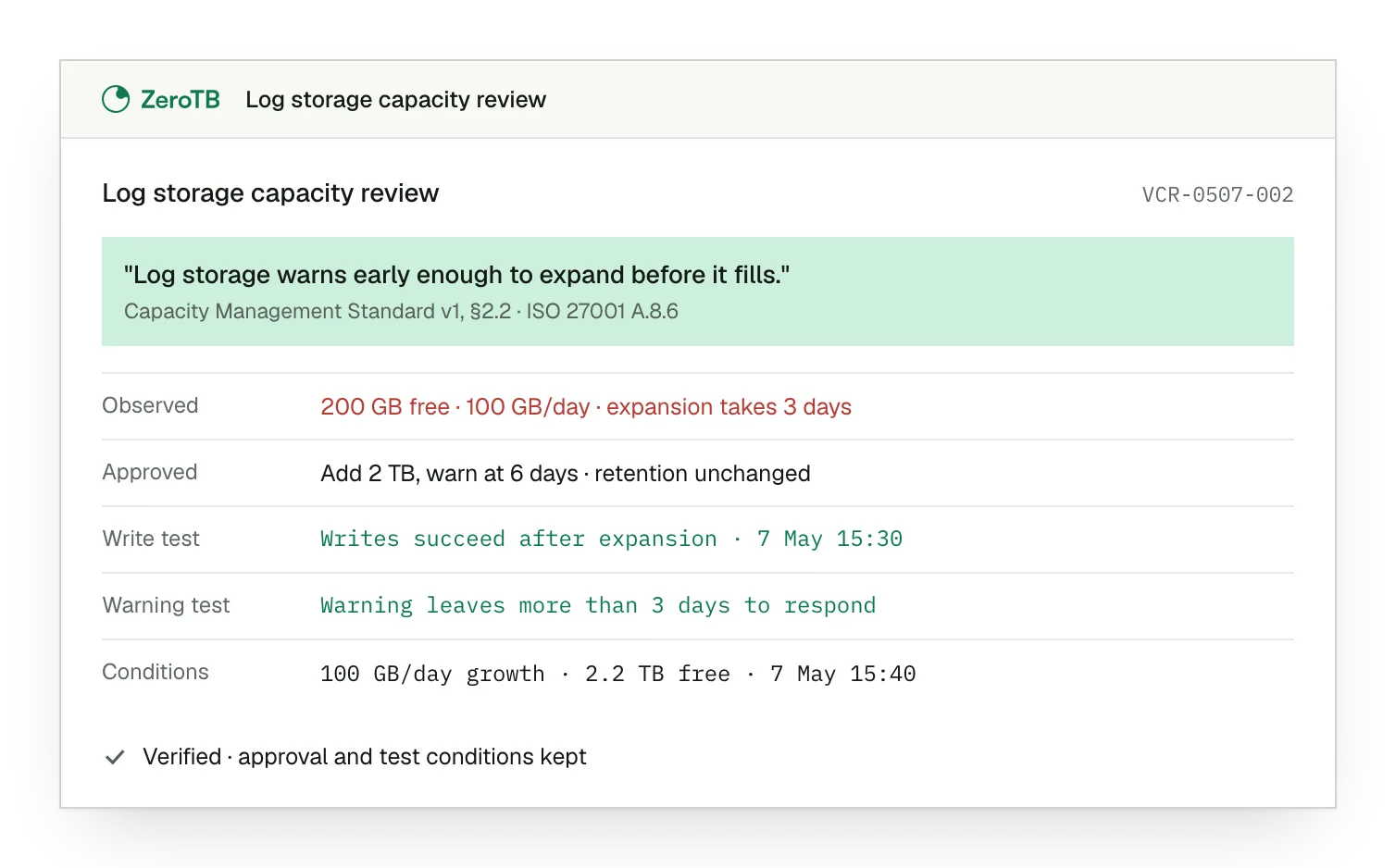
Insufficient warning time. At the current growth rate, the store fills before the expansion process can finish.
Approved storage expansion. The owner accepts more storage and an earlier alert, with the retention period unchanged.
Capacity and warning tested. Writes succeed after expansion, and the warning test leaves enough time to complete the response.
Retained test conditions. The approval and dated results accompany the growth rate and space observed during testing.
Capacity review checklist
Confirm which service, resource limits and operating expectations the control covers, including dependencies that could restrict capacity.
Compare the forecast with current growth and planned changes, then decide whether its assumptions still represent the workload.
Decide whether the warning leaves enough time for investigation, approval, implementation and verification of the proposed capacity response.
Confirm the intended capacity and the information, retention rules and service functions that the change must preserve.
Accept closure when dated tests demonstrate the expected service behavior and warning, with ownership assigned for later review.
Sources
- ISO/IEC, ISO/IEC 27002:2022 overview, 2022.
- Microsoft, Architecture strategies for capacity planning, accessed November 4, 2026.
- AWS, Manage service quotas and constraints, accessed November 4, 2026.
- HHS, Summary of the HIPAA Security Rule, accessed November 4, 2026.
Related pages
Technological controls
Read the other guides in this series on protecting systems and keeping them operating.
ISO 27001
Place this capacity control within the broader ISO 27001 approach to managing information security.
Compliance frameworks
Compare the control guidance for the frameworks that apply to your systems and information.
Start with the Pilot
Talk to our team about the capacity controls you want to improve. Our eight-week Pilot maps up to 25 commitments and takes two real control gaps through approved correction and verified restoration. Each restored control has a record of the approval and verification.