How does ISO 27001 A.8.34 protect systems during audit tests?
ISO 27001 A.8.34 concerns protecting systems during audit tests. Before work starts, the assessor and system owner agree the systems, methods, timing and access the test requires. Keep responsibility for the system through completion, including the removal of test access and checks of any protections changed for the work.
A test account that still works after an audit is unfinished security work. The report may already be delivered when someone discovers it. A.8.34 connects the arrangements made with the assessor to the checks needed when responsibility returns to the people running the system.
Agreed test boundaries
Audit testing needs an agreed scope that the assessor and system owner can both use. Identify the purpose of the test, the systems it covers, the methods allowed and the time available. The owner can then assess a request against the same boundaries as the assessor.
Include the required access and the arrangements for test results in that agreement. Approval to help with an audit says little about what an assessor may do. The scope needs enough detail to settle routine questions and identify requests that need a further owner decision.
Production testing risks
Choose a test environment and method that can answer the audit question at an acceptable operational risk. Some procedures could interrupt a service and are better run elsewhere. A separate environment, however, cannot by itself establish the state of a setting on the live system.
An isolated environment reduces exposure to the test, but differences from production limit what the result establishes. Agree those limits with the assessor before testing. NIST's testing guidance discusses this choice, including the effect on availability, sensitive information and the usefulness of results from another environment.
Access for audit work
Audit access should match the operations the agreed test needs. Reading settings may require fewer rights than testing a change. Decide which procedures need additional access and restrict those permissions to the relevant systems and activity, with a defined end to their use.
Keep the access decision with the test authorization so the system owner can review both together. If the proposed method needs broader permissions, return that decision to the owner. The fact that an account belongs to an assessor does not establish which rights it needs.
Changes to the test scope
A test becomes a control gap when its activity exceeds the authorization that governs it. An assessor might extend a procedure to an adjacent live system after finding a useful lead. The original scope then fails to describe the systems and information exposed to testing.
Pause the additional activity while the responsible owner decides whether to permit it. That decision should address the method, timing, access and possible effect on the added system. Record what already happened as well as the revised boundary, so later review can distinguish both periods.
Stop and restart decisions
The test plan needs a person who can stop the work when the system is at risk. Agree how the assessor contacts that person and how the service owner becomes involved. A contact list is useful only if it leads to someone who can act.
Stopping a test also creates a decision about its continuation. Before restarting, confirm that the method, operating window and recovery arrangements still suit the system's condition. Keep that decision with the test record, including any restrictions added after the interruption and who approved them.
Sensitive test results
Test results need protection because they can expose the weaknesses the audit is examining. Agree where results may be stored, who may read them and how copies will be handled after testing. Those decisions apply to working material as well as the final report.
The end of fieldwork does not remove the sensitivity of the findings. Keep the agreed handling rules with the records and check that retained copies have an approved purpose. NIST SP 800-115 covers collection, storage, transmission and disposal of assessment data as part of the test arrangements.
Temporary access and settings
When testing ends, check what was changed to let it proceed. Temporary permissions are one part of that review; altered settings and protections also need attention. Compare each with the agreed final state, so the owner can distinguish completed cleanup from work that still needs action.
Some permissions may still be needed for follow-up tests. Keeping them requires a decision about what the assessor can do and when that access ends. Record the owner's decision with the reason for retaining the permissions, and assign the removal to someone who can complete it.
Verification before closure
Check the system before accepting a cleanup task as complete. The person reviewing the result needs to know whether removed access still works and whether affected protections operate as intended. Dated observations answer those questions and belong with the approval and the action taken.
If a check cannot run, the gap stays open. This is the work ZeroTB's control restoration process carries through after an approved correction. The resulting observations go into a Verified Control Record, where the owner can use them to decide whether the gap is resolved.
Ownership between audits
Delivery of the audit report can leave work spread across several teams. The assessor may hold findings, an application owner may hold account permissions, and another team may verify settings. Each remaining item needs an owner, even when the assessment itself has finished.
At the next audit, the earlier record is a useful starting point for planning. Check it against the environment as it stands today. Changes to systems, access or service ownership may require different permissions or operating arrangements before an assessor repeats the same procedure.
Audit testing evidence
A reviewer should be able to follow the test from its approved scope to the checks performed after it ended.
| Requirement | What an auditor asks for | Where it comes from |
|---|---|---|
| Agreed scope | Which systems and methods the owner approved, and for what period | Approved test plan identifying its purpose and boundaries |
| Appropriate access | Which permissions the assessor needed and when their use should end | Account records and the decisions granting test access |
| Operational safeguards | Who could stop testing and authorize recovery or a restart | Test arrangements and decisions made during an interruption |
| Activity within scope | What the assessor did, including work added to the scope | Activity records with the original authorization and approved amendments |
| Protected results | Who can read the findings and what happened to working copies | Permissions for results and records of their handling after testing |
| Verified cleanup | Whether temporary access ended and the affected protections work | Dated system checks kept with the approved cleanup action |
Related framework requirements
| Framework | Control | What it covers |
|---|---|---|
| ISO 27001 | A.8.34 | Protection of the systems being examined during audit tests |
| SOC 2 | CC4.1 | Evaluation to establish whether controls are in place and operating |
| HIPAA | 45 CFR 164.308(a)(8) | Evaluation of technical and nontechnical safeguards where electronic protected health information is involved |
Example of correcting an expanded test scope
A scope correction must address activity already performed as well as the test that remains. Suppose an assessor adds a neighboring live system without approval. The record below follows the decision to remove that access, review the work already done and check the system afterward.
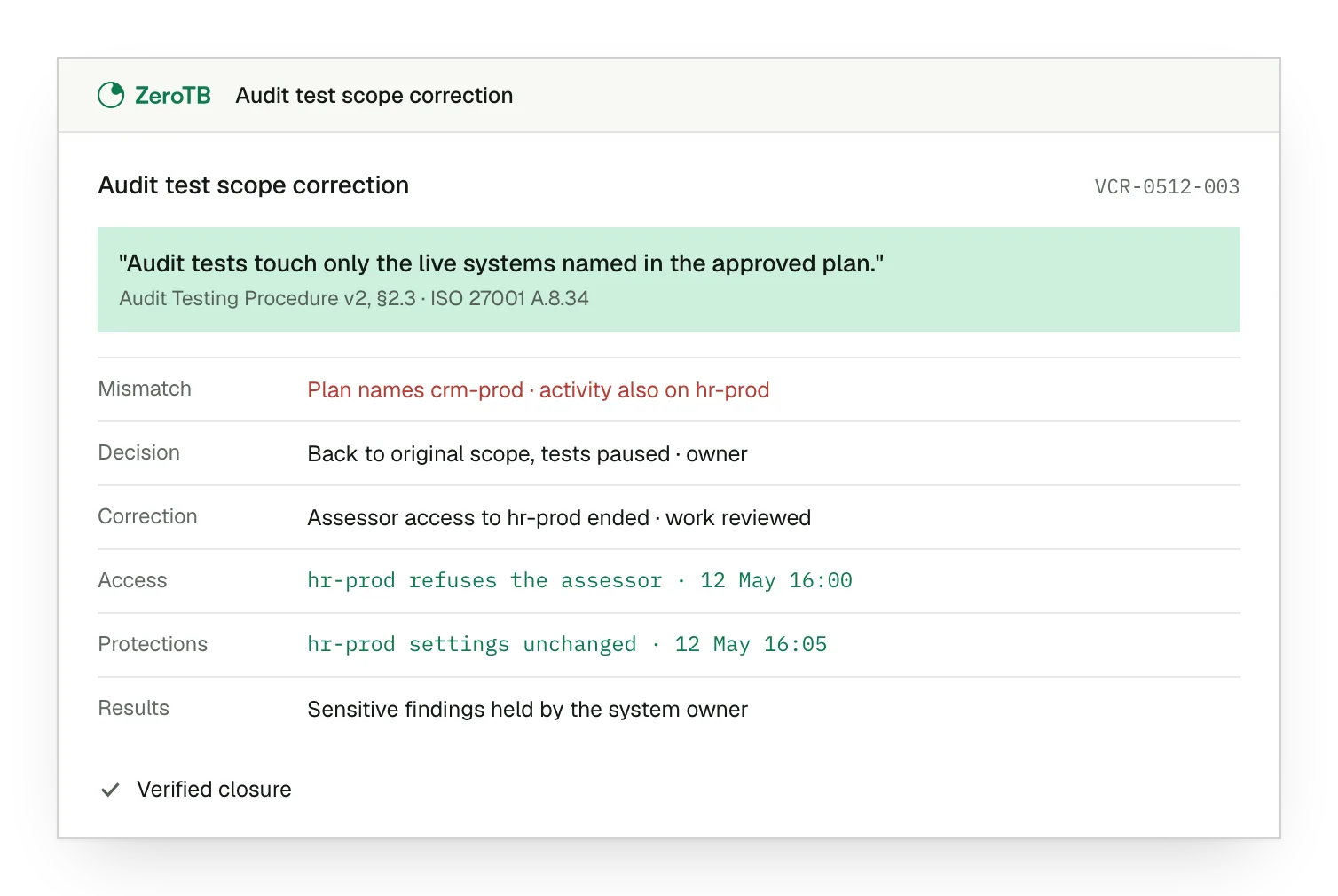
Scope mismatch. The approved plan and activity record disagree about which live systems the assessor tested.
Owner decision. The owner authorizes a return to the original scope before any further tests proceed.
Completed correction. The assessor's access to the added system ends, and the earlier activity receives a review.
Verified closure. The record contains dated checks of access and protections, plus agreed handling of sensitive results.
Audit testing review checklist
Read the approval alongside the activity record to identify any systems or methods added while testing was underway.
Confirm who can interrupt the test and who has authority to approve another attempt after the system is checked.
Locate retained findings and working copies, then compare their access and handling with the arrangements agreed for the test.
Check that temporary permissions have ended and affected protections work, and retain the results with the approved action.
Give each incomplete check or retained exception an owner and a next action before accepting the test as complete.
Sources
- ISO/IEC, ISO/IEC 27002:2022 standard overview, 2022.
- NIST, SP 800-115: Technical guide to information security testing and assessment, 2008, sections 6.3 and 7.4, Appendix B.
- AICPA & CIMA, 2017 Trust Services Criteria with revised points of focus, 2022 revision.
- HHS, HIPAA audit protocol, July 2018 update.
Start with the Pilot
Talk with our team about keeping controls effective after audit work. The eight-week Pilot maps up to 25 commitments and takes two real control gaps through approved correction and verified restoration, with a record of each result.