What does ISO 27001 A.8.33 require for test data?
ISO 27001 A.8.33 concerns the information used for testing: choose data suited to the test and protect it throughout its use. Prefer the least sensitive dataset that can support the test. When sensitive information is necessary, control access and copies, define when its use ends, and verify cleanup afterward.
A production export can remain accessible long after the investigation that needed it has closed. The test may be finished while its data still needs attention. A.8.33 connects the original reason for using that information to the protection and removal of each test copy.
Test purpose
Choose the dataset by working backward from what the test must establish. Which fields does it read, and which relationships must survive? These questions help separate information that affects the test from sensitive records included only because the production export already contains them.
The test owner can then judge whether a smaller selection would do the job. Invented records and transformed production values are other options. Try the proposed data against the test's purpose before deciding that the team needs access to the original production information.
Synthetic test data
Invented records can replace production data when they reproduce the conditions needed for the test. Their structure matters as much as their individual values. If the test follows links between records, the substitute data must preserve the links it needs to exercise.
Run the test against the substitute and check whether it can answer the original question. Some failures depend on particular production values and cannot be reproduced this way. In that case, identify the necessary values and limit the production selection to what the investigation needs.
Masked production data
Masked data needs a review of what someone could still learn from it. Replacing visible identifiers may leave other identifying details in the records. NIST's de-identification guidance explains that masking tools do not necessarily provide enough protection to establish that information is de-identified.
Review the transformed dataset against both the test purpose and the remaining disclosure risk. A useful transformation must preserve what the test needs while addressing sensitive values that users could still infer. Treat remaining sensitive information according to its access and retention requirements.
Sensitive data approval
A decision to use sensitive test data needs a defined purpose and an end condition. The responsible owner should understand why the test needs that information, which records are included and who will use them. The decision also needs to cover removal after testing.
Record these conditions with the test so the team can check whether its use remains within the approval. An extension to the investigation may change the necessary data or duration. Review that change before treating the original approval as permission for the extended use.
Test access
Access to the test environment must reflect the sensitivity of the information inside it. A shared environment can give more people access than the investigation requires. Compare the accounts that can reach the dataset with the people and permitted uses covered by the approval.
The review needs the permissions currently in effect, including access to exported results. A list of intended participants alone cannot establish who can read the information. Correct unnecessary access and retain the reason for any access that must continue while the test remains active.
Copies and exports
The cleanup scope includes exports and derived files as well as the main test dataset. Removing a database copy can leave information in files created during the investigation. Those files need the same decisions about permitted use and removal as the information they contain.
Identify the locations involved in the test and connect them to its record. Use dataset identifiers and safe descriptions so the record itself does not become another sensitive copy. The reviewer should be able to trace the cleanup scope without opening the original records.
Retention decisions
Once a test finishes, its data needs another decision. Some copies may have no further use and can be removed through the agreed process. Others may support a test that is still running. Review each retained copy against the work it is supposed to support.
For information that will stay, record the reason, the owner and the condition that will trigger review or removal. This gives the next reviewer something specific to assess. The presence of a copy should lead to a current explanation for keeping it.
Changes after approval
Check the approval again when the test data or its users change. A refreshed production export may include additional fields. A change to a shared group may let more people read the information. Either can alter the exposure that the owner originally considered.
The review should compare those changes with the approved conditions, including the purpose and duration of the test. It can then identify the decision that needs attention. A copy used for a different investigation, for example, needs review against that investigation's purpose and access needs.
Approved cleanup
Agree on what should remain before removing test information. The owner may decide to delete an obsolete copy, replace production values with less sensitive records or restrict access while testing continues. The choice depends on what information the remaining work actually needs.
Write the decision against the affected copies so the person making the change can follow its scope. Include any information that must stay and the protection it needs. Keep that approval with the action record; it will also tell the reviewer what result to look for.
Verification before closure
Check the affected locations after the cleanup to establish what changed. A completed deletion task needs evidence that the unwanted copy is gone. Where the correction restricted access, test that restriction and confirm that the remaining information has the protections the owner approved.
If a location cannot be inspected, keep its cleanup open until a reviewer can check it. ZeroTB's control restoration process keeps these observations with the action and approval in a Verified Control Record. The record lets someone reviewing closure see the basis for that decision.
Continuing checks
Each new use of a test environment can change the information that needs protection. A successful cleanup from the previous investigation says nothing about a later export. Check the new data, its users and the conditions for ending its use against the current test purpose.
Assign these checks to someone who can follow the test through to completion. If copies keep being left behind, examine where cleanup falls out of the testing process. Correct that omission and review the next completed test to see whether the change worked.
Test data evidence
The evidence should explain why the data was used and show what happened to it when testing ended.
| Requirement | What an auditor asks for | Where it comes from |
|---|---|---|
| Suitable selection | The test objective and the information needed to meet it | The test plan, including the reason for the selected dataset |
| Approved sensitive use | The decision to permit sensitive information for the test | An approval identifying the owner, datasets, permitted use and end condition |
| Controlled access | The accounts that can read the data and their approved purpose | Permissions checked in the test environment and wherever results are exported |
| Managed copies | The locations included in cleanup and any approved retained copies | Export history and the test record with the reasons for retention |
| Verified cleanup | The result of the change, including any location still awaiting review | Dated observations linked to the approved removal or access change |
Related framework requirements
| Framework | Control | What it covers |
|---|---|---|
| ISO 27001 | A.8.33 | Selection, protection and management of information used for testing |
| SOC 2 | CC6.1 | Logical access protections; test access evidence can support the organization's scoped access controls |
| HIPAA | 164.312(a)(1) | Access controls for electronic protected health information where the Security Rule applies |
Example of verified test data cleanup
In this example, a closed investigation leaves a production export in a shared test environment. The owner confirms that the export and a derived file have no remaining purpose. The correction covers both locations, with a separate check before closure.
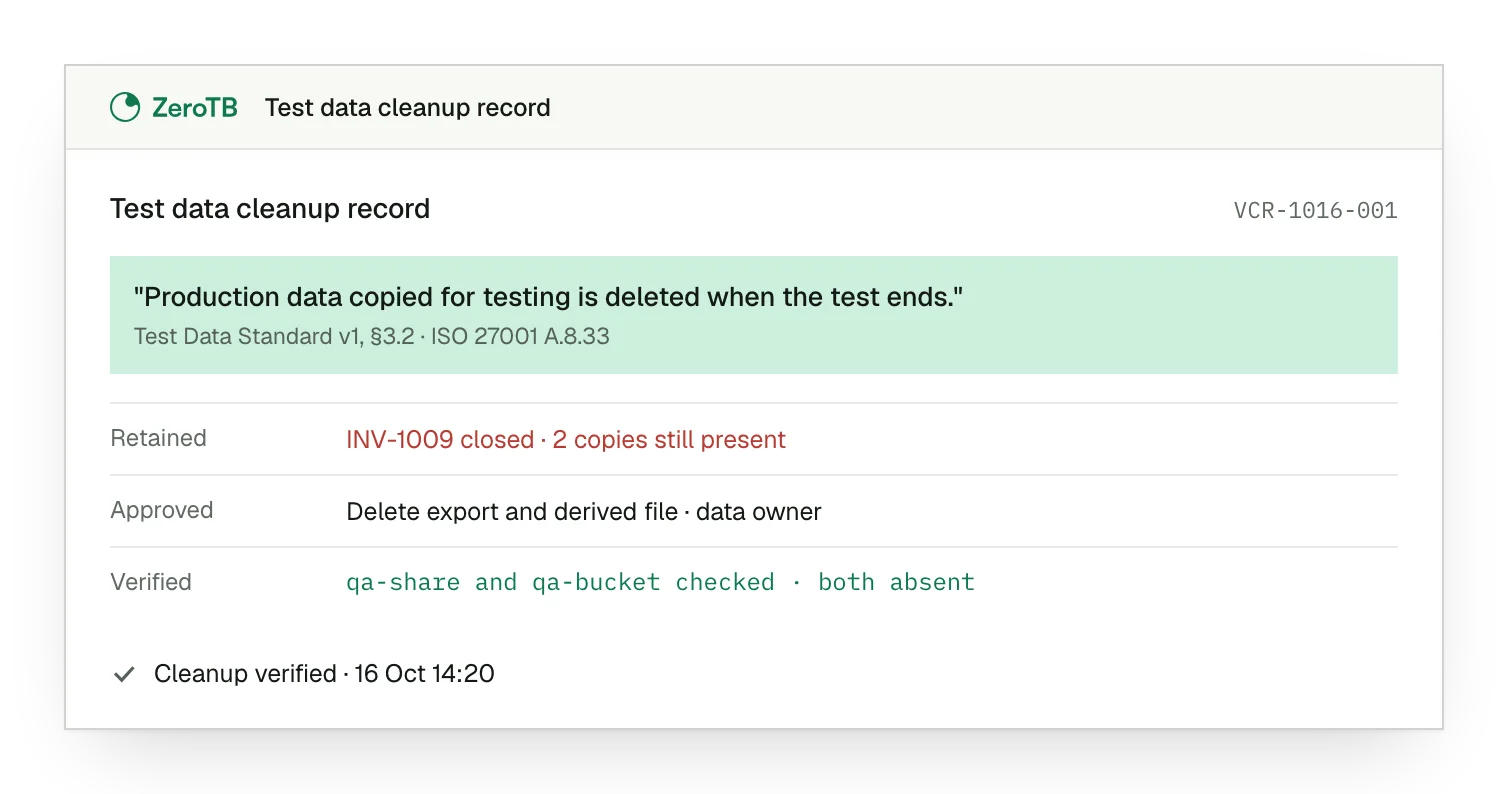
Retained test copies. The investigation has closed, but the production export and derived file remain accessible.
Approved removal. The owner approves deleting both copies after confirming the test no longer needs them.
Verified cleanup. A fresh check confirms both copies are absent from the locations recorded for this test.
Test data review checklist
Check which test needs the information and whether a less sensitive dataset can support the same work.
Compare current permissions with the people and uses covered by the approval for sensitive test information.
Include exports and derived files in the review, with a reason for retaining each remaining copy.
Decide which copies to remove, replace or restrict, and record the intended result before changes proceed.
Verify the resulting state across the agreed locations and retain dated observations with the action and approval.
Sources
- ISO/IEC, ISO/IEC 27002:2022 standard overview, 2022.
- NIST, SP 800-188: De-identifying government datasets, 2023.
- HHS, Summary of the HIPAA Security Rule, accessed November 4, 2026.
Related pages
Technological controls
Find the other ISO 27001 control guides for the systems involved in testing.
ISO 27001
Read how the wider framework connects information security decisions with controls in practice.
Compliance frameworks
Explore the framework guides for related requirements across the programs your organization manages.
Start with the Pilot
Talk with our team about the controls you need to keep working. The eight-week Pilot maps up to 25 commitments and takes two real control gaps through verified restoration, with records of the actions, approvals and results.