How does ISO 27001 A.8.31 separate development, test and production?
ISO 27001 A.8.31 concerns separating and protecting development, test and production environments so experimental work cannot compromise live systems or information. Define the permitted connections between them, then check identities, credentials, networks and data transfers. After a repair, verify that prohibited access fails and approved work still succeeds.
A test environment can have its own name and network while retaining a credential that works in production. The separation described in an architecture diagram then differs from the access a test job has. That difference is where an environment review should begin.
Environment scope
The scope of separation includes every service through which development or testing could affect production. Application servers are only part of that scope. Deployment automation and data stores also belong in the environment design, especially when several environments share them.
For each connection, the design needs to explain what may pass through and for what purpose. Moving a tested release into production is one permitted use. A test job that needs test data has a different purpose, and its access should reflect that difference.
Separation design
The right separation gives each environment its own effective restrictions on access and change. Physical or logical boundaries can provide separation. AWS recommends separating production and non-production workloads; separate accounts still need permissions that match the intended restrictions.
For an existing environment, examine the restrictions before deciding whether its design needs to change. Shared credentials or cross-account permissions can connect otherwise distinct systems. The important design question is which actions a development or test identity can perform against production, including through shared services.
Human and service access
Each production permission needs a reason, whether a person or a service uses it. An engineer investigating an incident may need production access. A job running tests may need only test resources, even if that engineer created the job and operates both environments.
Review the credentials available to automation as well as the accounts people use. Troubleshooting can leave a copied credential behind after the work ends. The person may stop using it, but a job can still use its permissions until the access is removed.
Release permissions
An approved release route allows tested changes into production while restricting who can use that route. Define the identity that performs the deployment and the decision that authorizes it. This makes the permitted crossing explicit within the wider separation of development, test and production.
Shared deployment automation needs particular attention because one service may act in several environments. Review which jobs can obtain production credentials and change deployment settings. Keep evidence of testing and approval with the release, as part of the change and development controls.
Production data
A separated test system can still expose production information if someone copies live data into it. Review data transfers alongside network and account access. A database copy changes where information is available, even if the test system has no connection back to the live service.
Decide what information the test needs and which protections must apply at its destination. Use data prepared for that purpose where it can support the test. If sensitive production information is necessary, assess and approve its use, including who can access the resulting copy.
Changes after the audit
A change to a credential, network rule or automation job can undo an earlier separation decision. The diagram may remain the same while effective access changes. That is why a successful audit check needs follow-up when someone changes the systems that enforce the boundary.
Compare the changed identity or connection with its approved purpose, and retain the observation against the affected environment. Its owner can then investigate the difference. If the check cannot reach the system, record the missing observation and when the last successful check took place.
Approved repairs
The owner needs to know what will stop working before approving removal of a shared credential. Identify the jobs using it and the resources each job needs. That gives the repair a specific aim: remove unintended production access while keeping the permitted test functions available.
Sometimes several jobs need new credentials, although only one exposed the problem. The proposal should cover all of those changes. With that scope visible, the system owner can decide whether the repair preserves the necessary work and authorize it before implementation starts.
Boundary verification
A repair needs two results: the prohibited action fails, and the permitted work continues. Test the identity and route that exposed the gap. An edited configuration alone leaves a question unanswered if another copy of the credential could still provide the same production access.
A failed connection also needs interpretation: the target might be unavailable, or the test itself might be broken. Use safe tests that distinguish those outcomes. Check the authorized work separately; NIST CM-4(1) provides related guidance on separating tests from operational systems and information.
Temporary exceptions
An exception needs a defined purpose and an end condition so temporary access does not become the normal arrangement. Record the affected environment, permitted actions, approving owner and conditions for review. That record explains why access remains and which restrictions apply during the exception.
When the purpose ends, the removal needs its own verification. If the owner extends access, retain the new decision and its conditions. This gives a later reviewer a way to distinguish an intentional exception from a forgotten connection that survived the task it supported.
Continuing evidence
The separation record needs enough detail for another reviewer to understand the repair. Keep the affected environment and identity with the original observation, approved change and dated result. This lets the reviewer follow what happened without having to reconstruct the investigation from separate tickets.
The record also needs an owner for subsequent checks and a clear indication when observations become stale or unavailable. ZeroTB keeps the commitment, correction and verification in the Verified Control Record. Evidence of environment separation should show which crossing was blocked and which approved work remained possible.
Evidence of environment separation
A reviewer should be able to follow the environment rule through the access decisions and tests that demonstrate it.
| Requirement | What an auditor asks for | Where it comes from |
|---|---|---|
| Defined separation | Which environments the rule covers and which connections it permits | The environment design, inventory and access rules approved for those systems |
| Restricted access | Who and what can reach production, with a reason for each permission | Permission exports, service-account records and credential references with secret values excluded |
| Controlled transfers | The decisions allowing a release into production or a data copy into test | Release records with tests and approvals, plus decisions authorizing data transfers |
| Managed exceptions | The reason for retained access, its approver and the conditions for reviewing it | The exception record for that environment, including the actions allowed |
| Verified restoration | What failed, what the owner approved and what the tests showed afterward | The repair record with dated observations, approval and tests of both access outcomes |
Related framework requirements
| Framework | Control | What it covers |
|---|---|---|
| ISO 27001 | A.8.31 | Keeping development, test and production environments separated and protected |
| SOC 2 | CC8.1 | Changes to systems and code, including the approval of releases into production |
| HIPAA | 164.312(a)(1) | Access limited to authorized people and software programs for electronic protected health information in scope |
Example of restoring environment separation
This example follows a test job whose production credential remained after troubleshooting ended. The repair gives the job test-only access with its owner’s approval. Verification then checks what happens to the job, its former production access and the authorized release route.
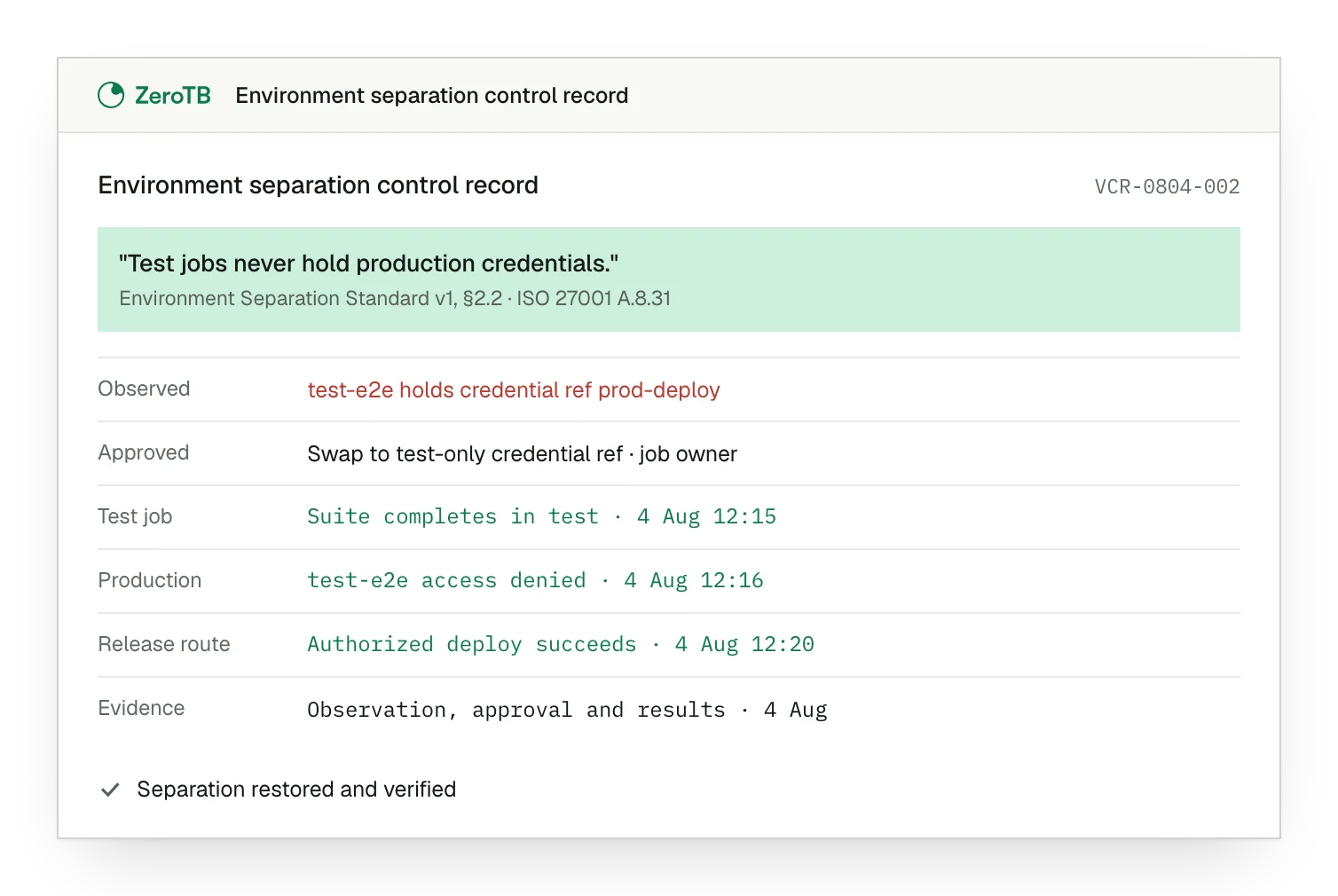
Unintended production access. Production accepts a credential that was copied into the test job during earlier troubleshooting.
Approved credential replacement. The test job receives a test-only credential after its owner approves the required access.
Paired verification results. The repaired job completes its tests, production denies its access, and authorized deployment succeeds.
Retained control evidence. The dated results remain with the original observation and approval for the next reviewer.
Environment separation checklist
Check the environment design for permitted connections, including the shared services and information that cross between environments.
Review what human accounts and test jobs can do in production through their credentials and network routes.
Approve the correction after identifying which jobs depend on the affected connection and what access they still need.
Check that the unintended access is blocked, then test the functions that the repair was meant to preserve.
Keep dated results beside the original gap and approval, and assign ownership of further checks and exception decisions.
Sources
- ISO/IEC, ISO/IEC 27002:2022 overview, 2022.
- AWS, Design principles for a multi-account strategy, accessed November 2026.
- NIST, SP 800-53 Rev. 5, CM-4(1), 2020, with December 2020 updates.
- eCFR, 45 CFR 164.312, technical safeguards, current November 2026.
Related pages
Technological controls
Browse the other technological controls that apply to development work and the systems supporting it.
ISO 27001
Read about the information security management system that gives environment separation its wider purpose and scope.
Compliance frameworks
Compare related requirements across the frameworks covering the systems and information that the organization manages.
Start with the Pilot
Talk with our team about the separation gaps affecting development and production. During the eight-week Pilot, we map up to 25 commitments and take two real control gaps through approved correction and verified restoration, retaining the resulting evidence.