What does ISO 27001 A.8.30 require for outsourced development?
ISO 27001 A.8.30 concerns security oversight of outsourced development, from agreed requirements through delivery and subsequent changes. The organization needs to direct and review the supplier's work against those requirements. Make security evidence part of acceptance, connect it to the delivered version, and resolve gaps before treating the relevant conditions as met.
A supplier can deliver a working feature while the security review remains unfinished. The acceptance record then needs to distinguish what works from what has been checked. That distinction becomes harder to maintain when delivery, security and supplier management sit with different teams.
Development scope
A.8.30 applies to the development work entrusted to an outside supplier. Define which software, systems and information that work involves. A contract for a feature may also involve repository access, test environments and changes to an existing application.
Those connections determine who needs visibility into the work. The supplier may control its development environment while the organization controls release to production. An agreed scope tells both parties which protections they operate and which evidence they exchange before acceptance.
Security acceptance conditions
Security requirements become useful when the agreement says how acceptance will be judged. Before work starts, both parties need to know what evidence the reviewer will expect. Otherwise, the supplier may consider its work complete while the organization still has unanswered security questions.
The checks should address how the software will be used. If a feature changes permissions, ask for results covering both permitted and blocked access. NIST's secure development guidance offers a reference for expressing supplier requirements and assessing delivered software against them.
Supplier responsibilities
An acceptance decision needs an owner on each side of the agreement. The supplier needs to know who receives its evidence and raises findings. The organization needs to know who can explain the delivery, correct defects and answer questions about the development process.
Agree how those people handle changes to scope and unresolved security conditions. A delivery manager may confirm that a milestone is complete while a security owner still needs to assess a finding. Record who can authorize an exception so that a schedule decision cannot silently become security approval.
Oversight during development
Supplier oversight needs to follow the work before the final delivery arrives. Milestone reviews let the organization examine whether the planned tests still fit the developing software. If the design has changed, the supplier and reviewer can resolve the testing implications before release.
The agreement also needs to settle how reviewers see the work. They may already have access to the organization's repository and its test results. When the supplier develops elsewhere, reports or review access must provide the evidence needed to judge progress against the requirements.
Evidence for each delivery
Security evidence must identify the version that the organization will accept. A test report for an earlier build may leave later changes unexamined. The reviewer needs to connect the supplied code or package, the assessed configuration and the results used to approve release.
Retain the release identifier with the test scope, findings and review decision. This makes a later question answerable: did the assessment cover the software now in use? NIST's guidance on preserving software releases supports keeping the files and supporting data needed to investigate problems after delivery.
Missing security evidence
Missing evidence leaves a security acceptance condition unresolved. It may mean the supplier omitted a report, tested a different version or never performed the agreed assessment. Each possibility calls for a different response, so the first task is to establish what happened.
Record the missing condition and its effect on the release decision. A passed functional test cannot establish that an untested security requirement holds. Where the owner permits an exception, its reason, safeguards and review date should remain visible alongside the condition that has yet to be satisfied.
Approved corrections
A correction needs to resolve the failed condition and pass a separate check. Start with the agreed requirement and the observed gap, then identify the action and its owner. People approve material changes before implementation and check the resulting state before closing the gap.
For connected controls, ZeroTB keeps the commitment, action, approval and before-and-after evidence in the Verified Control Record. That record supports the review of a correction. Supplier acceptance still depends on the authorized review of the delivery and any conditions that remain unresolved.
Changes after acceptance
A supplier update can change the conditions behind an earlier acceptance decision. An added dependency, revised configuration or new access path may affect an established protection. Review the change against the affected requirements and identify which earlier results still apply to the new version.
The same question arises when coding agents change systems: which protections still hold after the change? Keep responsibility for later findings clear through the support arrangement. A closed delivery should still have a route for reporting a vulnerability and deciding who will correct it.
Supplier handover
Handover should leave the organization able to maintain the delivered software. Release materials, configuration details and unresolved findings belong with the team taking responsibility for it. When a problem appears later, that team can examine the accepted work and the decisions made about it.
At the same handover, decide which supplier access is still needed. A support agreement may justify continued access to some systems after development ends. The owner should approve its scope, and a permissions check should confirm that access now matches the supplier's remaining work.
Evidence for supplier acceptance
The reviewer should be able to identify the requirement, the delivered version and the reason for accepting it in these records.
| Requirement | What an auditor asks for | Where it comes from |
|---|---|---|
| Agreed security scope | The outsourced work and the security conditions agreed before its acceptance | The development agreement, its scope and the attached security requirements |
| Ongoing oversight | The findings raised during development and how the supplier addressed them | Records of milestone reviews and the supplier's responses to findings |
| Assessed delivery | The tested version, the results and the decision to accept the delivery | Test reports linked to the release identifier and its acceptance record |
| Controlled exceptions | The conditions left unresolved, their safeguards and the owner's reason for acceptance | Exception records showing approval and the date for another review |
| Verified correction | The failed condition, the approved change and the result of checking it again | Change records and dated evidence in the verification record |
Related framework controls
| Framework | Control | What it covers |
|---|---|---|
| ISO 27001 | A.8.30 | Security requirements and oversight throughout a supplier's development work |
| SOC 2 | CC9.2 | The organization's approach to risks from vendors and business partners |
| HIPAA | 164.308(b)(1) | Contractual assurances where a business associate relationship involving electronic protected health information applies |
Example of verified supplier acceptance
A supplier release can remain pending while its security evidence is completed. In this example, the required access tests are missing from the delivery. The acceptance record connects the assessed release to the completed tests and the owner's decision.
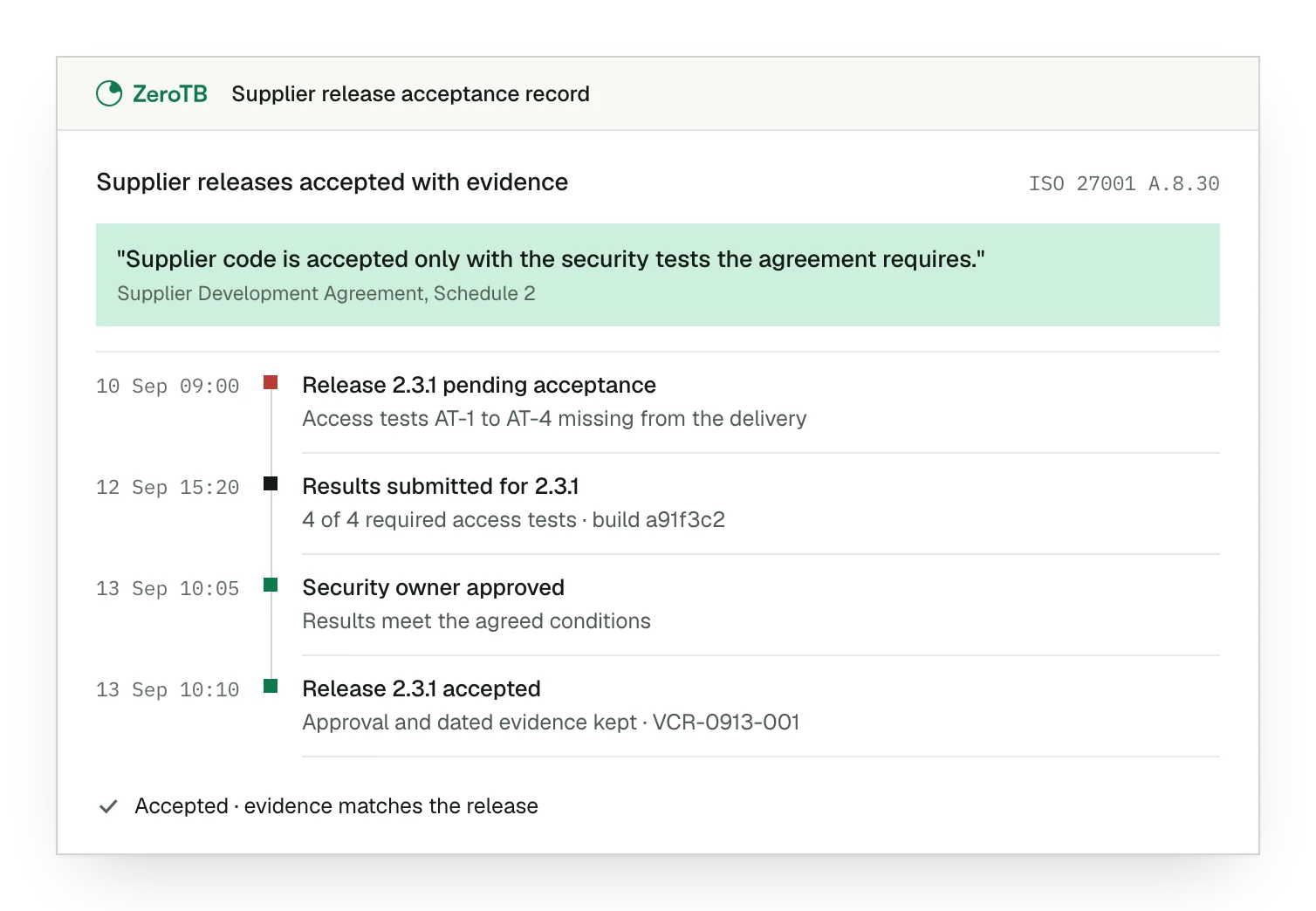
Pending acceptance. The delivery record identifies the missing access tests required by the development agreement.
Matching release. The supplier submits results for the exact release awaiting acceptance, with each required test identified.
Reviewed results. The security owner checks that the results satisfy the agreed conditions before approving acceptance.
Recorded decision. The record retains the approval and dated evidence beside the release identifier for later review.
Outsourced development checklist
Identify the supplier release and the approved security conditions that govern its acceptance into the organization.
Compare those conditions with the delivered version, review results and tests, recording any missing or mismatched evidence.
Confirm who can resolve each gap and who can approve a correction or an exception to acceptance conditions.
Verify that the corrected release satisfies the affected condition before closing the gap or approving its acceptance.
Keep the release, evidence and approval connected, with responsibility for later changes and supplier support assigned.
Sources
- ISO/IEC, ISO/IEC 27002:2022 standard overview, 2022.
- NIST, Secure Software Development Framework, SP 800-218 version 1.1, 2022.
- HHS, Business associates guidance, accessed November 4, 2026.
- ZeroTB, Continuous control monitoring guide, 2026.
Related pages
Technological controls
Explore the related controls for development, testing and changes across the ISO 27001 technological theme.
ISO 27001
Read how individual controls fit within the organization's wider information security management system.
Compliance frameworks
Compare the framework guidance available for the commitments that apply to the systems in scope.
Start with the Pilot
The eight-week Pilot maps up to 25 commitments and takes two real control gaps through approved correction and verified restoration. Talk with our team about supplier oversight and the evidence needed to keep acceptance decisions current.