How does ISO 27001 A.8.29 govern security testing before release?
A.8.29 calls for security testing during development and before acceptance of new or changed systems. Use the system's security requirements to decide which tests must run and what results permit release. Check that the required tests still run when the pipeline changes, including changes made by coding agents.
A build can finish successfully after someone removes a security test. The release then has a passing result with a gap in its coverage. For ISO 27001, compare the results with the testing commitment: which required checks ran against the change being delivered?
Security acceptance criteria
A release decision needs security criteria that a test can demonstrate. Start with the application's requirements and the behavior each one calls for. Refusing an unauthorized request, for example, gives a tester an observable result to compare with the approved requirement.
A failed test leaves the release owner with a decision. The criteria should identify which findings block release and who may accept remaining risk. With those conditions agreed before testing, the person reviewing the result can explain why release should proceed or wait.
Tests matched to risk
Testing should follow the risk introduced by the change. Code, configuration and data flows can each affect security, but the same check may tell little about all three. Choose a method that produces an observable result for the requirement under examination.
NIST's secure development guidance recommends choosing tests for the software's stage, recording their results and handling discovered issues. Automated checks make it easier to repeat the same test. Specialist testing can investigate high-risk behavior beyond the scan's coverage, such as interactions between security features.
The tested release
Security results support acceptance only when they cover the version and conditions being released. The record needs to identify the tested change and the relevant configuration, including settings that affect access. A later edit can alter the behavior that the earlier test was meant to establish.
The environment matters as much as the version. A configuration difference from production can change what a passing result means. Record the relevant differences and decide whether further testing is needed before acceptance. The release owner can then judge which results apply to production.
Skipped security checks
A build can pass even though a required security test never ran. Removing a job or changing its execution condition can cause this gap. Compare the jobs that ran with the approved test set; a missing job needs its own investigation.
A required status check does not always establish execution. GitHub's protected-branch documentation permits successful, skipped or neutral statuses for required checks. If the commitment says a test must run, look at the execution record behind that status. That record should identify what the job tested and whether it completed.
Release bypasses
The testing rule must reach every route that can deliver the change. A protected merge route can coexist with an emergency release path or permissions that bypass its checks. Trace the reviewed version through the route that delivered it, including any bypass used.
Urgent changes need an explicit decision about the testing that can happen before release and any remaining work. An approved exception should explain its scope, authority and follow-up conditions. A reviewer can use that decision to explain the departure from the normal testing requirement.
Approved corrections
A repair should restore the agreed test requirement without changing the release policy by accident. The proposed correction identifies the missing check, the affected release route and the intended behavior. The owner can then assess the proposed behavior and authorize the correction.
Restoring the job can correct a configuration error. If the requirement itself has changed, the owner must decide which tests now establish acceptance. That decision belongs with the repair, so a narrower test set cannot silently become the new standard. Keep the revised requirement with its approval and rationale.
Verification after repair
Verification must test the release decision as well as the restored security job. Run the required check against the affected version and inspect its result. If it identifies a weakness, resolve the finding or obtain the authorized risk decision before acceptance.
Then check how the release route responds when the required result is absent or fails. Include the urgent route where it applies. The gap remains open until the observed behavior meets the agreed conditions; a completed configuration change alone leaves that question unanswered.
Evidence for release acceptance
A reviewer should be able to follow the release decision using the records kept at the time. Link the tested version, scope, dated results and finding decisions to the approval. The release owner should be able to explain the approval from those records without searching through unrelated pipeline runs.
For a repaired testing gap, retain the observation that exposed it and the check performed after correction. The Verified Control Record holds the commitment, before-and-after state, action, approval and verification. Together, the records explain what changed and why the team considered the testing requirement restored.
Ongoing control ownership
A repaired test can disappear again when the pipeline changes. An owner needs to compare the approved testing commitment with the pipeline as it operates now. Otherwise, the next workflow edit can recreate the omission while the earlier gap remains closed in the records. Review coverage after relevant pipeline changes.
ZeroTB carries that ongoing work from the commitment to verified restoration, with people authorizing material changes. For release testing, this gives the release owner evidence about whether the required checks still run and govern acceptance. Engineering and compliance can review that evidence together.
Release testing evidence
The records below explain the testing requirement and show what happened before the owner approved release.
| Requirement | What an auditor asks for | Where it comes from |
|---|---|---|
| Defined test scope | The security requirement, tests chosen and conditions for accepting the change | Application requirements and the approved plan for testing |
| Tests actually executed | Execution dates, test results and the version and configuration tested | Individual job histories and reports from security tests |
| Findings resolved or accepted | The finding, its resolution or risk decision, and the decision maker | Issue histories, corrective changes and records of approved exceptions |
| Release authorized | The release approval, its scope and any conditions on delivery | Approval records linked to the delivered version and its tests |
| Repair verified | The omitted test, permission to repair it and checks of the repaired rule | Observations before and after repair, with approval and verification |
Related control coverage
| Framework | Control | What it covers |
|---|---|---|
| ISO 27001 | A.8.29 | Security tests during development and the acceptance of a new or changed system |
| SOC 2 | CC8.1 | Authorization, testing and control of changes to code and systems |
| HIPAA | 164.308(a)(8) | Technical and nontechnical evaluation where electronic protected health information needs protection |
Example of restoring a required test
This example follows a release candidate whose build passes after a required security job is removed. The repair puts that job back and checks whether its result controls release. The owner can use the new evidence to decide whether the candidate meets acceptance conditions.
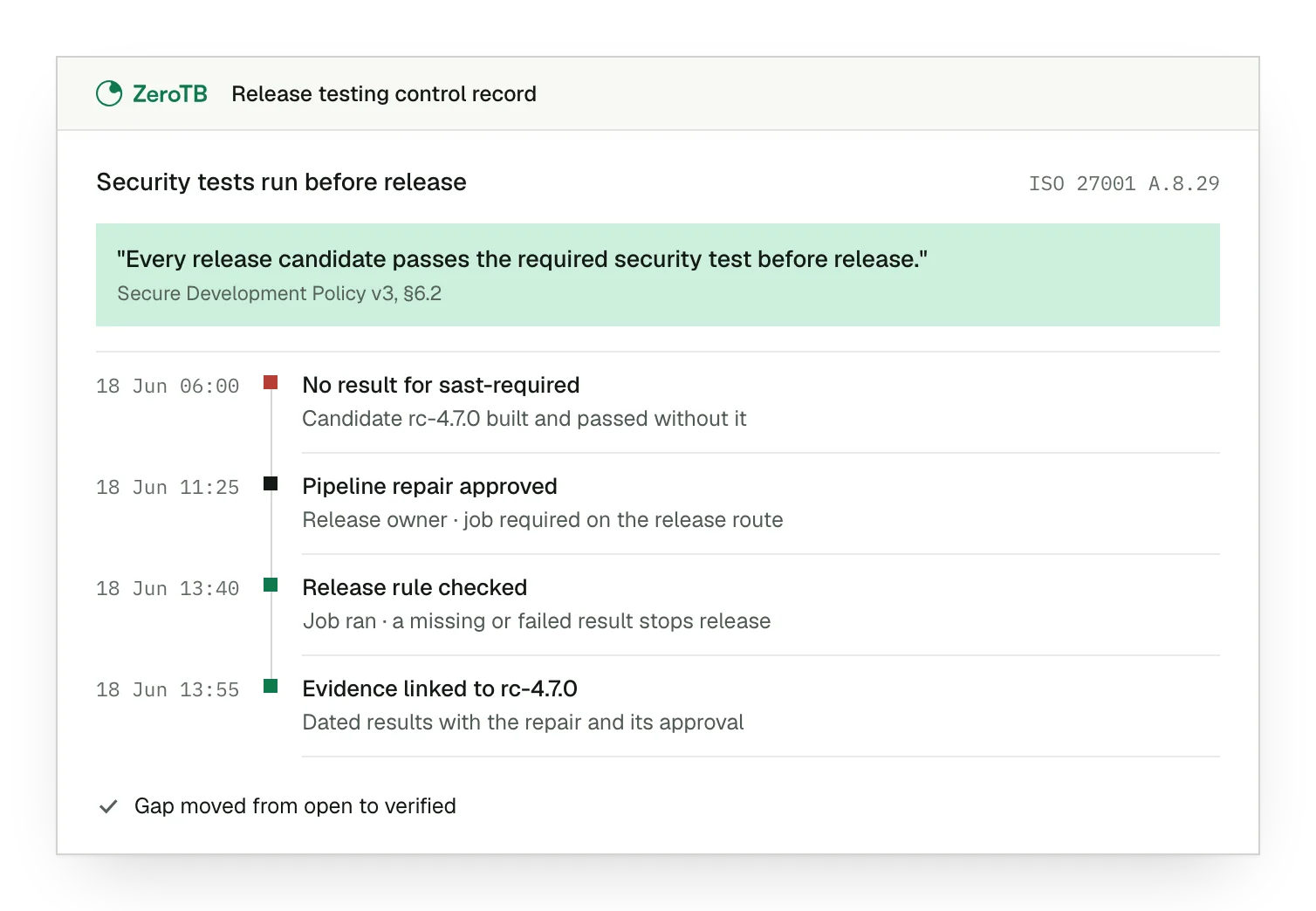
Missing test result. The build passed for this candidate, while the required job has no execution in its history.
Approved pipeline repair. The approved correction reinstates the missing job and requires its result on the affected release route.
Release rule checked. The job runs again, and checks confirm that missing or failed results stop the release.
Connected release evidence. Dated results and the candidate identifier appear with the correction and permission to make it.
Security testing review checklist
Match the relevant security requirements to their tests and identify who decides whether a remaining finding prevents release.
Compare the candidate's execution history with its required tests, checking skipped jobs and configurations that affect the results.
Inspect normal and urgent release paths for the agreed conditions, then check the authority behind any exception used.
Trace the repair from its approval to the rerun, then inspect the results for the release rule itself.
Sources
- ISO/IEC, ISO/IEC 27002:2022 overview, 2022.
- NIST, Secure Software Development Framework v1.1, PW.8, 2022.
- GitHub, About protected branches, accessed November 4, 2026.
- HHS, HIPAA audit protocol, evaluation, updated July 2018.
Related pages
ISO 27001 controls
Read how individual controls support the wider information security management system and its commitments.
Compliance frameworks
Find the requirements that apply across frameworks when reviewing the same systems, changes and evidence.
Coding agent controls
See how ZeroTB handles control gaps as coding agents change code, configurations and development workflows.
Start with the Pilot
The eight-week Pilot maps up to 25 commitments and takes two real control gaps through approved correction and verified restoration. Talk with our team about recurring testing gaps and the evidence needed to show that the controls work.