What does ISO 27001 A.8.28 require for secure coding?
ISO 27001 A.8.28 addresses secure coding: applying security principles while software is written and changed. Turn those principles into guidance, reviews and checks suited to the application. When a weakness appears, verify that the approved correction restores the intended protection and retain the tests with the change record.
A code change can pass its build and still let a user alter someone else's record. The secure-coding commitment becomes useful when reviewers can connect it to that behavior. An earlier audit sample gives little help with an endpoint added since the review.
Development scope
A.8.28 concerns the practices used to write secure code across the software your organization develops. The relevant practices depend on the language, the application's purpose and the information it handles. A coding standard needs enough detail to guide decisions within that setting.
The ISO 27001 framework provides the wider context for the control. Within a development team, the practical starting point is the approved coding commitment and the applications it covers. That scope lets a reviewer decide whether a new service or development path needs the same protections.
Coding guidance
A developer needs guidance that applies to the operation being changed. “Validate input” leaves several decisions open: which input, what values are allowed and what happens when the value fails the check. Guidance for the application should make those decisions explicit.
The same applies to secrets and record permissions. An example of the approved operation gives a reviewer something concrete to compare with the proposed code. NIST's secure-development guidance supports choosing practices for the language and environment in use, so the rules remain relevant to the work.
Security review
Security review needs someone who understands the effect of the change on the application's users and data. A reviewer can then assess whether the code preserves the intended permissions. A successful build establishes that the code builds; the access decision needs its own examination.
A record identifier, for example, tells the application which record was requested. It does not establish whether the requester may change it. OWASP's code-review guidance explains why business logic and context need human judgment alongside automated analysis. Review comments should explain the security decision that follows.
Automated checks
Automated checks help apply repeatable coding rules to changes before they reach users. Code analysis can flag unsafe patterns, while tests examine specified behavior. These checks serve different purposes, so a passing result needs to identify what ran and which version it examined.
Coverage matters as much as the result. A check limited to one directory says little about a new service outside that directory. The review needs to distinguish a completed check from one that was skipped, failed to run or returned a result from an earlier version.
Changes after the audit
A review rule can remain in the policy after it has stopped reaching some of the code. A new repository without required reviews is one example. Another is a release path that omits a security check used by the older path.
On the change and development surface, these differences become observable gaps. The reviewer can compare the promised review process with the path taken by a release. A successful run from before the path changed remains useful history, but the current path needs a check of its own.
AI-generated code
The security rule applies to AI-generated code regardless of which tool produced it. A generated endpoint still needs to check permission before changing a protected record. Familiar code structure or a plausible explanation of the change cannot establish that the check works.
A reviewer working with coding agents needs to inspect that behavior just as they would in a person-written change. Tool access is a separate concern, covered in Claude Code security. Approving what an agent can access does not answer whether its proposed code enforces application permissions.
Approved corrections
The owner approves the behavior a repair is meant to restore. For a record update, that decision identifies the accounts allowed to change the record and those that must be refused. It also preserves the legitimate work that the application needs to support.
ZeroTB reads the commitment and checks the gap against the observed state before drafting a fix. People approve material changes; the result is checked before closure. The Verified Control Record holds the approval, action and verification together so a reviewer can follow what happened.
Verification after a change
The repair needs a fresh test of the behavior that failed. In the update example, the account without permission should receive a rejection. The account with permission should still succeed. A test of only the rejection would miss a repair that blocks all updates.
OWASP's authorization guidance recommends testing the permissions the application should enforce. Record which version those tests examined and the conditions under which they ran. If a test fails, or its result is unavailable, the reviewer still lacks evidence to close the gap.
Prevention of repeat weaknesses
Repairing one endpoint leaves a further question: where else does the same coding pattern appear? Another path may still accept the update without checking permission. A review of similar paths establishes whether the correction needs to extend beyond the first reported failure.
Keep a regression test for that failure and explain its purpose in the coding guidance. A later developer can then understand why removing the test would matter. NIST's SSDF practice RV.3 recommends examining causes and related vulnerabilities, including patterns that could produce the same weakness again.
Evidence for later review
A reviewer should be able to follow the requirement from the original gap to the tested correction. The record needs the affected code version, observed behavior, approved action and dated verification. Together, these explain why the team considered the particular weakness resolved.
Retained exceptions need their own decision and conditions. A test result showing that one route is protected cannot settle an exception on another route. Recording which route each result covers helps the next reviewer identify work that still needs investigation or approval.
Secure-coding evidence
These records let an auditor examine what the coding rule required and what happened when a change failed it.
| Requirement | What an auditor asks for | Where it comes from |
|---|---|---|
| Coding guidance | The coding rules used for the application under review | The approved standard and the application guidance that implements it |
| Security review | What the reviewer decided about the security of the change | Pull-request review comments, including the code version reviewed |
| Effective checks | Which checks ran on the changed code and what they found | The run log, check configuration and associated findings |
| Approved correction | The change the owner authorized to correct the unsafe behavior | A repair proposal linked to the finding and approval |
| Verified result | Results for the prohibited operation and the operation that should still work | The control record, with dated tests identifying the corrected version |
Framework relationships
| Framework | Control | What it covers |
|---|---|---|
| ISO 27001 | A.8.28 | Secure-coding practices used to prevent weaknesses in software as it is developed and changed |
| SOC 2 | CC8.1 | Control over system changes, including their review, approval and testing |
| HIPAA | 164.312(c)(1) | Protection of electronic protected health information against improper alteration or destruction, where that information is in scope |
Example of restoring an update restriction
This example follows a repair to an endpoint that lets an account update a record without permission. The correction adds a check before the update. Testing then establishes whether the account is blocked and whether an account with permission can still make the change.
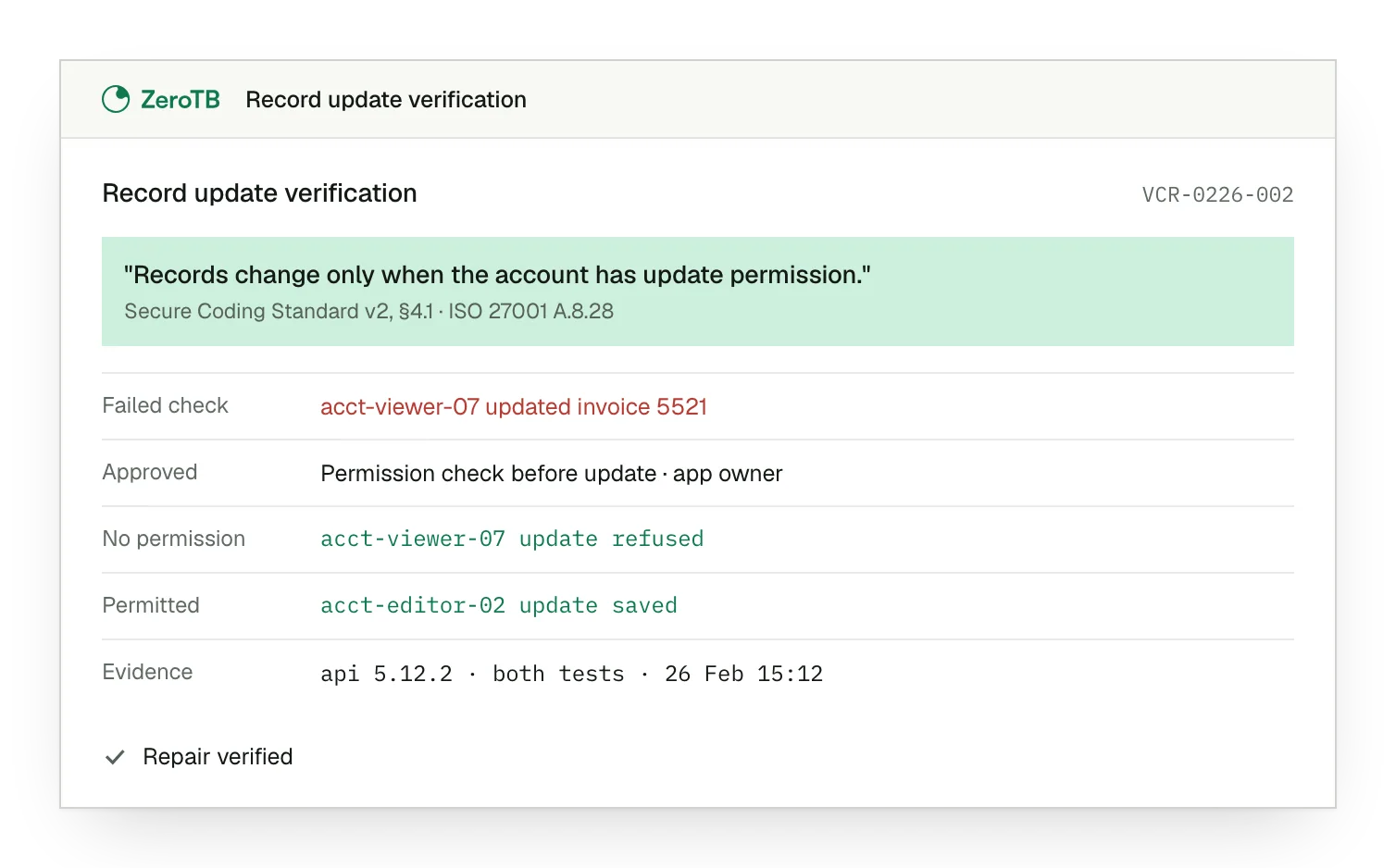
Failed update rule. An account without permission submits an update, and the application incorrectly accepts the change.
Approved permission check. The proposed repair checks permission before making the update, with approval from the application owner.
Verified account behavior. After the repair, one account is blocked while the account with update permission succeeds.
Retained test evidence. Both results identify the version tested and remain attached to the approved repair record.
Secure-coding review checklist
Select a coding rule and establish which application operations it permits and which it should prevent.
Inspect the review rules and checks on the release path, including paths added since the last assessment.
Agree the intended result with the owner, including the legitimate operations that the repair must preserve.
Run the prohibited and permitted operations against the corrected version, then use those results to decide closure.
Inspect similar paths for the same weakness and keep a regression test that will catch its return.
Sources
- ISO/IEC, ISO/IEC 27002:2022 overview, 2022.
- NIST, Secure Software Development Framework, SP 800-218 v1.1, 2022, practices PW.5, PW.7, PW.8 and RV.3.
- OWASP, Secure Code Review Cheat Sheet and Authorization Cheat Sheet, accessed November 4, 2026.
- HHS, HIPAA audit protocol, July 2018 update, integrity standard.
- ZeroTB, Continuous control monitoring, 2026.
Related pages
Technological controls
Explore the other ISO 27001 controls that address the technology behind information security.
ISO 27001
See how the secure-coding control fits into the wider information security management framework.
Compliance frameworks
Find control guidance across SOC 2, ISO 27001 and HIPAA for related security commitments.
Start with the Pilot
The eight-week Pilot maps up to 25 commitments and takes two real control gaps through approved correction and verified restoration. Talk with our team about secure-coding concerns and how the Pilot could fit your development work.