What does ISO 27001 A.8.27 require for secure architecture?
ISO 27001 A.8.27 concerns the architecture and engineering principles used to keep systems secure through design, development and change. In practice, an architecture review needs to explain how the system protects information. Later checks establish whether those protections still work as new services connect and permissions change.
A new integration can bypass a boundary that passed its architecture review. Reports arrive on time and the application stays available, while the integration uses a connection nobody assessed. The next review needs to account for that connection and the access it permits.
Architecture commitments
A.8.27 connects security principles to the choices made when systems are built or changed. The architecture explains where those principles apply across applications, infrastructure and external services. Engineers need enough detail to understand the reasons for a design before they modify it.
A decision record can supply that detail: the information being protected, the permitted way to handle it and the assumptions behind the choice. With those reasons available, a reviewer can identify which part of a proposed change needs closer examination.
Engineering principles
Engineering principles help a reviewer judge a proposed design. Least privilege concerns the authority a component needs for its work. Layers of protection reduce reliance on a single safeguard. Failure behavior matters because a dependency can stop working while sensitive information still needs protection.
NIST's engineering guidance discusses these principles. Their value in a review comes from applying them to a specific choice. For example, least privilege can determine whether a reporting service needs to read selected records or can also modify the database.
Trust boundaries
At a trust boundary, the system checks whether a request is allowed to proceed. External services often cross such a boundary when they contact an application. Components inside one environment can also have different permissions, requiring checks between them as information moves.
Each connection on the diagram should have an identifiable purpose. The reviewer needs to know which identity uses it, what that identity can request and where access is enforced. Those details make it possible to compare the diagram with actual permissions and connections.
Changed assumptions
Architecture drift occurs when the running system departs from a security assumption behind its design. A new integration might connect directly to a database that external services previously reached only through the application. The new path changes where access decisions take place.
Routine service checks may continue to pass because the integration returns the expected reports. Availability therefore leaves an important question unanswered: does the new connection preserve the intended protection? Comparing current information flows with the approved design gives the reviewer a way to investigate.
Design review
Changes to trust relationships deserve a design review. An external dependency, broader service permissions or another route to sensitive information can change the reasoning behind an earlier approval. Routine changes can follow established patterns where the assumptions supporting those patterns remain valid.
Systems security engineering addresses security throughout a system's life. For the reviewer, that means considering what a change does to existing protections. Identifying the affected information and the consequences of a failed protection helps determine how much review the change requires.
Design trade-offs
A correction needs to protect information and preserve the operations the service requires. Returning an integration to the approved application route may achieve both. Where requirements have changed, the owner may need to consider a replacement design and assess the access it introduces.
The choice depends on the work the integration performs. Reducing a permission may be enough when access is too broad. A separate interface may be appropriate when the required operation needs its own checks. The review record should explain why the selected approach fits.
Approved exceptions
An accepted exception needs to remain understandable after the person who requested it moves on. Its purpose, owner and review conditions explain why the departure was allowed. Without that context, a temporary connection can remain in use long after its original purpose ends.
The approval also depends on any safeguards agreed at the time. A different identity or a changed network route may invalidate those safeguards. Recording these dependencies gives the owner a reason to review the exception when circumstances change, even if the connection still works.
Checks between reviews
Permissions, network rules and deployment configuration can show whether an architecture decision still holds. Recurring checks compare these settings with an agreed state. Each check needs to identify which protection it assesses, so a failed result has a clear meaning for the reviewer.
ZeroTB performs these checks against approved commitments in connected systems. Its observations help the architecture owner investigate a change and decide what access remains acceptable. The service workflow connects that decision to an approved correction and a check of the resulting state.
Control restoration
Restoring a boundary requires attention to how the unwanted connection was created. If it came from deployment configuration, the next deployment could recreate it after a manual repair. The correction needs to cover that configuration as well as the current connection.
The owner first decides what access the service should retain and approves the material change. The implementation and design record can then be updated together. If the correction introduces another route, testing it before removing the existing route helps preserve the required service.
Verification tests
A successful correction has two results: the prohibited path is closed, and the approved operation still works. An integration test can check both by attempting the direct database connection and requesting a report through the permitted interface. Each attempt tests a different expectation.
Useful test evidence identifies the environment, the service identity, the attempted operation and when the test ran. A failed result shows what still needs attention. If the system cannot be checked, its state remains unknown and the gap stays open until verification is possible.
Evidence for later changes
A later reviewer should be able to understand why a correction was accepted. The Verified Control Record connects the commitment, observed gap, approved action and checked result. Keeping them together preserves the reasoning that could otherwise disappear between a design discussion and a completed ticket.
Some of this evidence may also help with technology controls or security risk reviews under another framework. Reuse depends on what that requirement covers and which systems are in scope. The following mapping identifies related requirements so a reviewer can make that assessment.
Audit evidence
A reviewer needs to trace the design's security purpose through the change decision to the behavior checked afterward.
| Requirement | What an auditor asks for | Where it comes from |
|---|---|---|
| Defined principles | The principles used in the design and the security purpose of the selected protections | Engineering guidance and design decisions showing how the principles apply to the system |
| Understood boundaries | The information allowed across each boundary, the requesting identities and the checks applied there | Current diagrams compared with deployed connections, access settings and the configuration that controls them |
| Reviewed changes | The assumption affected by a change and the owner's reason for accepting the design | Review records and approvals identifying the dependency, interface or deployment affected by the change |
| Bounded exceptions | The purpose of a departure, its responsible owner and the safeguards required to retain it | Exception records with review conditions and the dependencies on which the agreed safeguards rely |
| Verified restoration | The correction approved for a gap and results for both prohibited and permitted operations | Dated tests and system observations attached to the approved change and its control record |
Related framework requirements
| Framework | Control | What it covers |
|---|---|---|
| ISO 27001 | A.8.27 | Security principles used in system architecture and engineering, including decisions about later system changes |
| SOC 2 | CC5.2 | General controls over technology; a design decision can explain how a selected protection supports an objective |
| HIPAA | 164.308(a)(1) | Security management for electronic protected health information, including analysis and management of risks to that information |
Example of restoring an application boundary
This example follows a reporting integration that bypassed the application's access checks by connecting directly to its database. The correction returns reports to the approved application route. Testing must establish that reporting still works and that the direct connection is blocked.
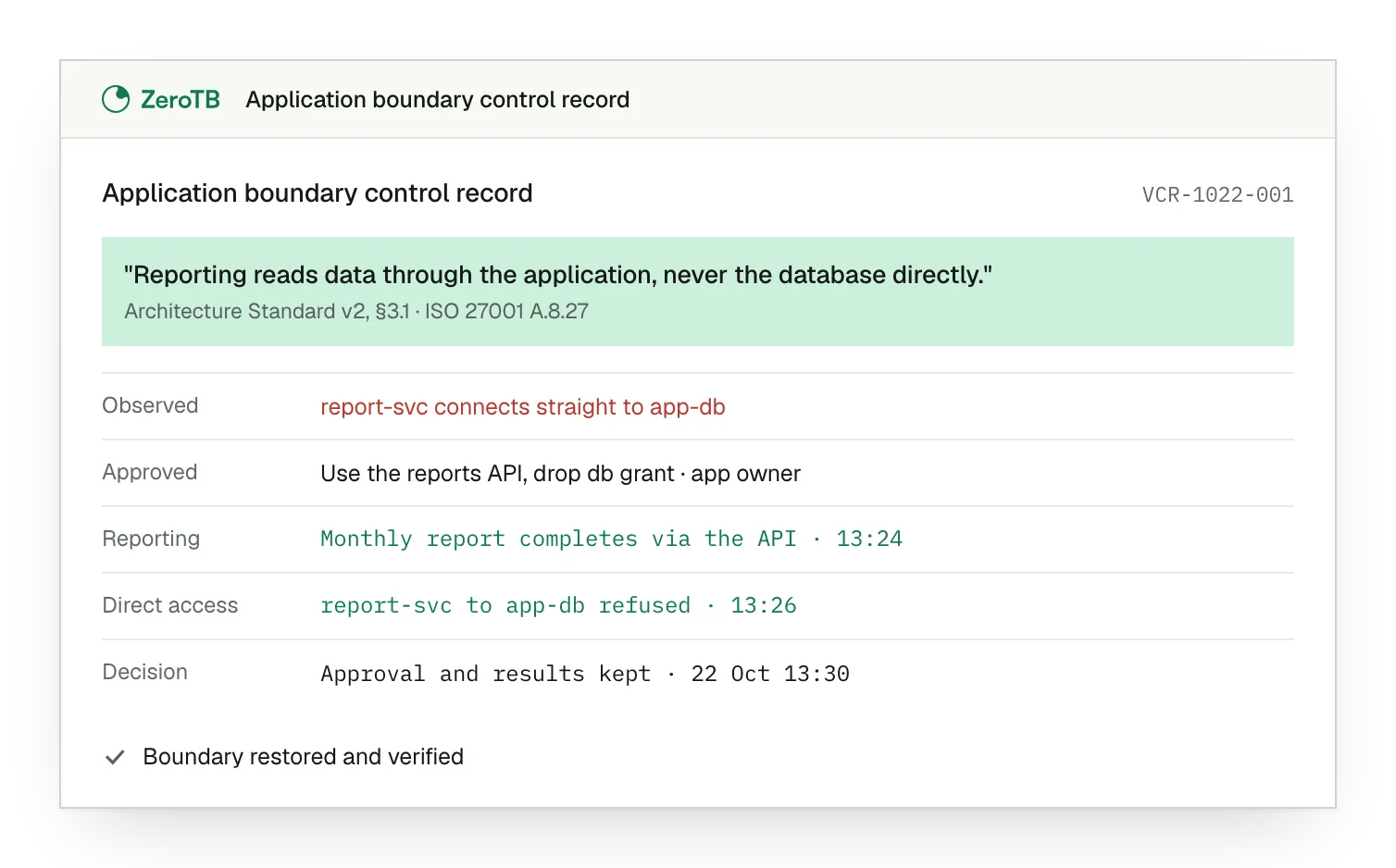
Bypassed application boundary. The new database connection lets the reporting service avoid checks applied by the application.
Approved route change. The owner approves the application route and removal of the service's direct database permission.
Verified reporting access. A report completes through the application, while a test of direct database access fails.
Retained design decision. The approval and dated test results explain why the reviewer accepted the restored boundary.
Architecture review checklist
Select an architecture decision and establish which information, operations and system boundaries its protection covers.
Compare the approved information flow with deployed permissions and connections, including dependencies added since the design review.
Assess the changed assumption and approve a correction or revised design that preserves the required protection.
Verify that prohibited requests fail and required operations still succeed through the approved route after the change.
Retain the design decision, approval and dated results with the owner and conditions for the next review.
Sources
- ISO/IEC, ISO/IEC 27002:2022 overview, 2022.
- NIST, SP 800-53 Rev. 5, security and privacy controls, 2020, with 2025 updates; SA-8 and PL-8.
- NIST, SP 800-160 Vol. 1 Rev. 1, engineering trustworthy secure systems, 2022.
- HHS, Summary of the HIPAA Security Rule, accessed November 4, 2026.
- ZeroTB, Continuous control monitoring, 2026.
Related pages
Technological controls
Explore the other ISO 27001 controls that address systems, software and technical protections.
ISO 27001
See how architecture principles fit within the wider information security management framework.
Compliance frameworks
Explore related requirements across the frameworks your organization uses to manage its controls.
Start with the Pilot
Talk with our team about keeping architecture controls effective as systems change. The eight-week Pilot covers up to 25 commitments and two real control gaps, with approved corrections, verified results and the records that explain them.