How does ISO 27001 A.8.25 build security into the development lifecycle?
ISO 27001 A.8.25 concerns security throughout the software development lifecycle, from planning through release and maintenance. An ISO 27001 SDLC needs defined security activities, responsible owners and evidence that the work happens. Check those activities against actual delivery paths, especially when a new workflow changes how software reaches production.
A development policy can describe security reviews that a new deployment workflow never performs. Following a recent change through its actual delivery path helps reveal the difference. The review needs to connect the policy owner, development team and release owner around the same requirement.
Lifecycle responsibilities
A.8.25 connects security work to the stages where software decisions are made. Planning establishes the security needs; development implements them; testing examines the result. Release and maintenance carry those decisions into the software people use and the changes that follow.
Each activity needs an owner who can confirm that the required work occurred. Trace a representative change through those responsibilities, including handovers between teams. A policy that names a review should lead to a review record for the change, with a decision someone can explain.
Security requirements
Security requirements tell developers what the software must protect before they decide how to build it. For an operation restricted to certain users, the requirement should say who may perform it. The design and tests can then address that specific restriction.
Keep the reasons for those decisions with the requirements. NIST's secure development guidance recommends retaining requirements, risks and design decisions throughout development. When a later change affects the restriction, a reviewer can use those records to understand what still needs protection.
Review and testing
Review and testing need to address the security requirements of the change. A code scan can identify certain implementation problems, while a design review examines the decisions behind the code. Application tests can establish whether the resulting behavior matches an agreed requirement.
Connect each result to the version and scope it examined. A passing test for an earlier version leaves a question about later changes. Where work spans several repositories or services, the review should identify which parts each result covers and which still need examination.
Release decisions
A security check needs a defined consequence for the release. A scan may finish successfully while reporting a problem that still requires attention. The acceptance rules should explain which results allow deployment and who decides whether an unresolved finding can be accepted.
NIST's Secure Software Development Framework (SSDF), practice PO.4, describes defining and using security-check criteria during development. Compare those criteria with the release workflow. Examine what happens when a result fails, when no result arrives and when the owner approves an exception.
Delivery path coverage
Security activities need to reach every delivery path covered by the approved lifecycle. Adding a deployment workflow can change the jobs that run before software reaches production. Checks on the older route may still work, even as releases through the new route miss them.
Inspect recent runs alongside the workflow configuration. A job can be present in the configuration and never run for the releases being examined. Include manual deployments in the review of change and development controls, so coverage reflects the routes people actually use.
Exceptions and urgent changes
An exception needs an explicit decision about the security work that will change. Record its purpose, the affected release path and the person responsible for accepting it. The decision should explain any safeguards and the conditions under which the exception ends.
An urgent release route may have different approved checks from a routine release. Compare its operation with those agreed rules before treating the difference as a failure. If an exception remains active after its purpose ends, its owner needs to decide whether to remove or renew it.
Control restoration
Restoration starts with the specific security activity the delivery path has lost. Establish whether the gap lies in the rule, the workflow or its execution. A correction should identify the affected route and explain how the missing activity will influence the next release.
ZeroTB reads the commitment, checks connected systems and drafts a fix for human approval. After the approved change, it verifies the result and retains the evidence in a Verified Control Record. For development controls, this work can include branch rules, required reviews and continuous integration gates.
Verification after a change
A repaired release check needs evidence that it blocks failure and permits an acceptable change. Test those outcomes through the affected route in a safe environment. A workflow edit alone does not establish that the release decision now depends on the required check.
Keep the test results with the approved correction and the configuration that produced them. Without a test result, the gap remains open. If the test succeeds through one route, inspect the remaining affected routes before concluding that the same protection covers them as well.
Maintenance and ownership
The release does not end the security work. Maintenance changes need to follow the lifecycle too, including when they alter the tools used to deliver software. A new repository or replacement workflow can change which activities apply and who is responsible for them.
Check those responsibilities when work moves between teams. Someone needs to review whether the control still operates and investigate failures. Keeping the results of recurring checks helps the team identify a later edit that removed enforcement after an earlier repair had passed verification.
Secure development evidence
An auditor should be able to follow a change from its security requirements to the work performed and accepted.
| Requirement | What an auditor asks for | Where it comes from |
|---|---|---|
| Defined security work | The security activities assigned to each lifecycle stage and the people responsible | Approved development procedures, requirements and design decisions |
| Completed review and testing | What was reviewed or tested, which version was examined and what the results showed | Code reviews, security tests and findings linked to development records |
| Release acceptance | Why the release was accepted, including decisions on findings that remained open | Release approvals, acceptance criteria and exception records |
| Delivery path coverage | Which delivery routes were examined and whether their required security work occurred | Workflow configuration and execution records for the relevant delivery paths |
| Verified restoration | What failed, who approved the correction and how the team checked that it worked | Before-and-after observations and test results retained with the control evidence record |
Related framework requirements
| Framework | Control | What it covers |
|---|---|---|
| ISO 27001 | A.8.25 | Security activities across software development, release and maintenance |
| SOC 2 | CC8.1 | Controlled changes to systems and software, including authorization, testing and implementation |
| HIPAA | 45 CFR 164.308(a)(1) | Security risk analysis and management for electronic protected health information |
Example of restoring a release check
A scan that reports failure can still leave the deployment job running. In this example, that behavior breaks the approved rule requiring a passing scan. The release owner approves a workflow correction, then checks that the next test runs follow the rule.
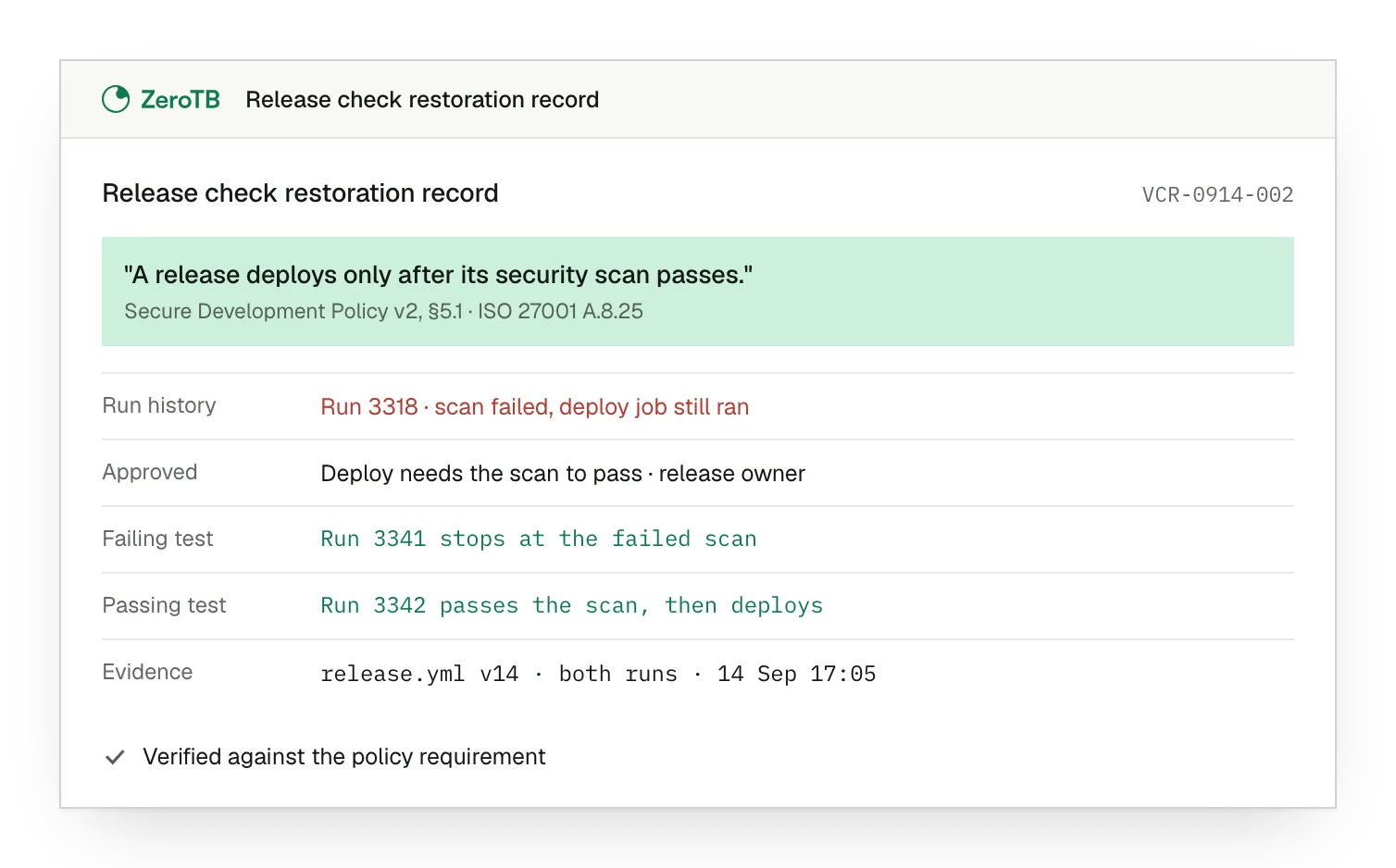
Missing release condition. The run history shows that deployment continued after the scan reported a failed result.
Approved workflow change. The proposed change requires the scan to pass, and the release owner records approval.
Verified release behavior. One test stops at the failed check; another passes the check and proceeds to deployment.
Retained control evidence. The workflow version and both test results sit with the approval and the policy requirement.
Secure development review checklist
Find the lifecycle rule that applies to the release path and identify the owner responsible for it.
Compare records from recent releases with the rule, checking which reviews and tests took place.
Review any existing exception with the owner, then agree on the correction for work that was missed.
Test the revised path with a failing check and a passing check, then examine both release decisions.
Save the results beside the approved change and identify who will check the control when the workflow changes again.
Sources
- ISO/IEC, ISO/IEC 27002:2022 standard overview, 2022.
- NIST, Secure Software Development Framework, version 1.1, 2022, practices PW.1 and PO.4.
- HHS, Summary of the HIPAA Security Rule, accessed November 4, 2026.
- ZeroTB, Continuous control monitoring, 2026.
Related pages
ISO 27001
Explore the framework that places secure development within the organization's wider information security management system.
Technological controls
Read the neighboring controls for the systems and technical processes that support information security.
Compliance frameworks
Find guidance on the different requirements that shared control evidence can help your team address.
Start with the Pilot
Talk with our team about security controls in the development lifecycle. The eight-week Pilot maps up to 25 commitments and takes two real control gaps through approved fixes and verified restoration, with evidence of the completed work.