What does ISO 27001 A.8.22 require for separating networks?
ISO 27001 A.8.22 addresses separating networks with different security and business needs. The organization decides which groups to separate and which connections to allow between them. Check those decisions against the routes and rules in use, then test that each correction blocks unwanted access while preserving necessary connections.
Separate boxes on a network diagram can conceal an open connection. A rule added during troubleshooting may still join the test environment to production. The control review has to follow that path and establish whether it still serves an approved purpose.
Network groups and boundaries
The information and services in each network group determine the protection it needs. Production systems may hold information that development systems should never reach. Guest devices introduce a different access decision again. These differences explain why the organization establishes a boundary.
Describe the systems on each side and the communications allowed between them. Routing and filtering rules then enforce those decisions. A reviewer should be able to follow a network name back to its purpose and identify the rules that keep the groups separate.
Approved connections
An approved connection describes who can communicate, with which destination and for what purpose. For a network rule, that usually means a source, destination, protocol and port. Those details let an engineer compare the intended access with the configured access.
The description also needs the service owner's reason for allowing the connection. A rule that permits an entire network may give more systems access than the service needs. AWS security groups illustrate how sources, destinations, protocols and ports define the permitted traffic.
Effective network paths
The complete path determines whether two network groups can communicate. Route tables, security groups and network access rules can each affect the result. A review of one rule needs the context of the other components along the connection it governs.
Configuration analysis helps identify that path. AWS Reachability Analyzer models network configuration without sending packets or examining live traffic. Its result describes what the modeled configuration permits. A service test answers the additional question of whether the necessary connection works.
Changes after the audit
Infrastructure changes can give separated groups a new way to communicate. Adding a route or broadening a filtering rule may create access that the network diagram never shows. The earlier audit evidence then describes a boundary with different permissions from those in use.
For each affected path, compare the new access with the approved communications. A troubleshooting rule deserves the same review as a planned infrastructure change. Include changes made through cloud and infrastructure automation, since the resulting access has to satisfy the same commitment.
Temporary access
Temporary access should come with a reason to end it. The exception can identify a completion event or a review date, along with its owner. Record which systems it connects and any safeguards that apply while the permission remains in place.
At review, the owner decides whether the original need has ended. If work continues, the record needs the remaining purpose and the conditions for retaining access. If it has finished, the owner can approve removal without another investigation into why the connection exists.
Dependencies before correction
A safe correction preserves the connections that the service still needs. Before narrowing a rule, the proposal needs to identify the affected systems and their legitimate communications. The service owner can then judge whether removing the unwanted path would interrupt necessary work.
Several services may depend on the same shared rule. A narrower replacement may preserve one approved flow while removing another. When that dependency is unclear, the engineer needs to trace the affected connections before proposing a change that could interrupt production.
Approval and rollback
The change proposal should show the access being removed and the access that must remain. Attach the observed gap, the proposed rule change and the expected test results. The responsible owner can assess the effect before authorizing the correction.
Agree how to recover if the change interrupts an approved connection. Reinstating an earlier rule may restore service while reopening the original control gap. That outcome needs an explicit owner decision and further work before the team can treat separation as restored.
Verification of both outcomes
Verification must establish that prohibited traffic is blocked and approved traffic still works. Define the source, destination and expected result for each check before changing the rule. This prevents a successful deployment from becoming the only evidence that the boundary is effective.
After the approved change, compare the observed results with those expectations. Configuration analysis and service tests provide different evidence, so record the method used. Keep the gap open if prohibited access remains possible or a necessary connection fails its agreed test.
Evidence freshness
Evidence needs a date and enough configuration detail to show which boundary was checked. A passing result from before a rule change says little about the new permission. The reviewer needs an observation that reflects the configuration now under assessment.
When observation stops, show the missing or stale result as unresolved. The owner can then arrange to restore the connection used for checks and obtain a current result. A previous success remains useful history, but cannot establish what the network permits today.
Ongoing boundary checks
Someone needs to own the response when a boundary check fails. That work crosses responsibilities: an engineer can explain the path, while a service owner decides whether access remains necessary. An alert needs to reach the people who can resolve that decision.
ZeroTB compares connected systems with approved commitments and drafts a correction for human approval. It checks the resulting state after the change. The Verified Control Record keeps the action, approval and verification together so the next reviewer can understand why the gap was closed.
Network separation evidence
Keep the decision, configuration and test results connected so an auditor can trace what happened to the boundary.
| Requirement | What an auditor asks for | Where it comes from |
|---|---|---|
| Defined boundary | The systems on each side and the reason they belong in separate groups | Approved design matched to the system inventory |
| Permitted traffic | The connections the business allows across that boundary | Source, destination, protocol and port in the rules, linked to the owner's access decision |
| Controlled exceptions | The reason an exception remains open and the conditions for reviewing it | Exception record with its owner, safeguards and review date or completion event |
| Authorized correction | The unwanted access identified and the decision to remove or narrow it | Approved change and copies of the affected rules before and after it |
| Verified separation | Results showing that unwanted access stopped and required access remained available | Path analysis and service tests with their dates, methods and configuration details |
Related controls across frameworks
| Framework | Control | What it covers |
|---|---|---|
| ISO 27001 | A.8.22 | Separation between network groups according to their security and business needs |
| SOC 2 | CC6.6 | Protection against threats originating outside the system boundary, including controls on external access |
| HIPAA | 45 CFR 164.312(a)(1) | Authorized access to systems holding electronic protected health information, where the network boundary supports that restriction |
Example of removing temporary network access
The correction in this example removes access left behind by a troubleshooting exception. A test subnet can still reach the production database on TCP port 5432. The owner approves removing the test source, with a check that the production application's database connection keeps working.
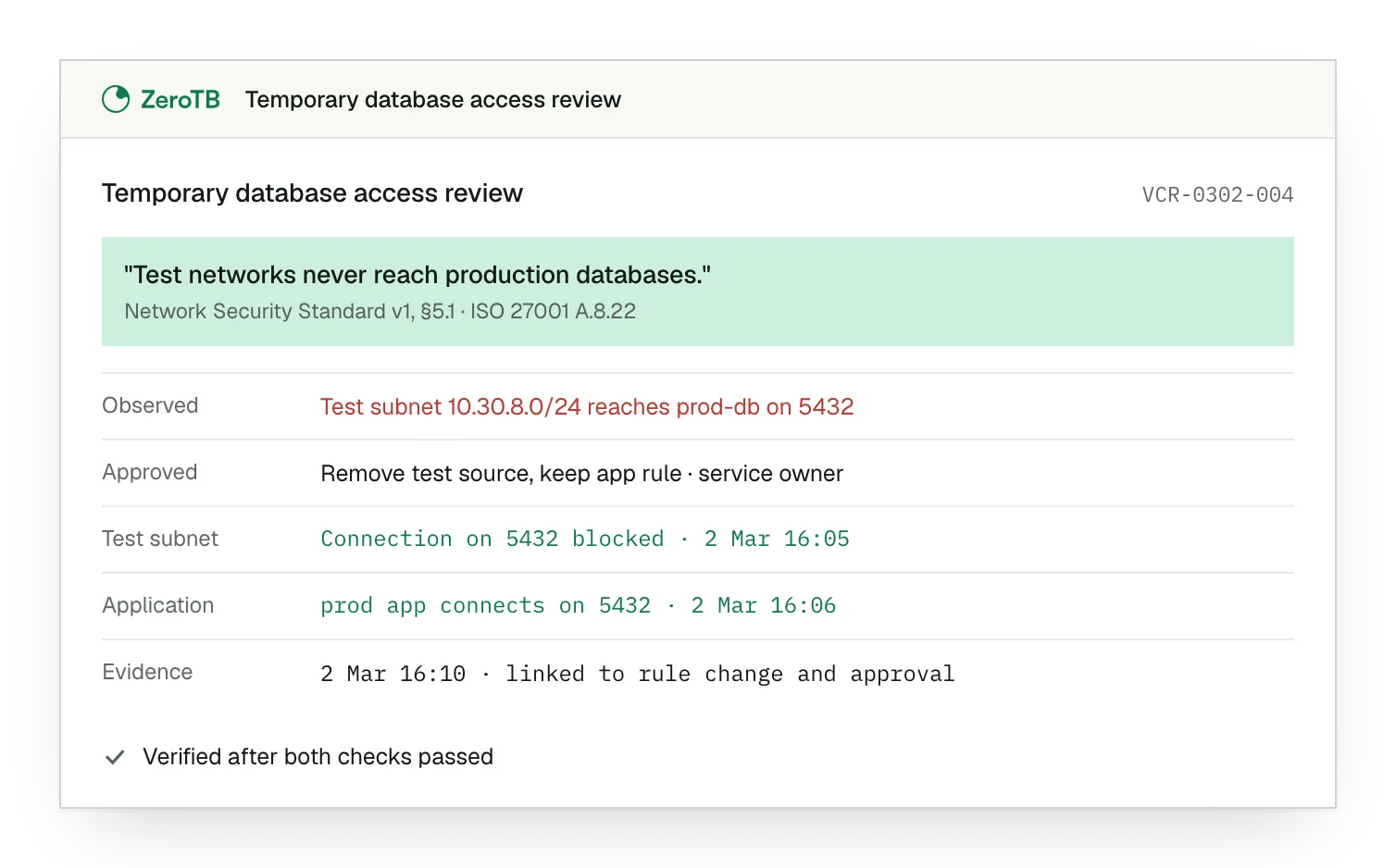
Unwanted connection. Troubleshooting has finished, but the test subnet retains the database access granted for that work.
Approved rule change. The service owner authorizes removal of the test source while preserving the application's approved permission.
Paired test results. Checks show the test connection blocked and the production application still connecting on port 5432.
Recorded outcome. Dated results accompany the approved rule change, allowing the reviewer to follow the closure decision.
Network separation review checklist
Name the groups on each side and establish which communications the approved boundary permits.
Follow the connection through its routing and filtering rules to see whether the current access matches that decision.
Ask the owner which temporary connections still have a purpose and which can be removed.
Establish the effect on dependent services and the recovery plan so the owner can approve a specific change.
Record both blocked and working connections after the change, with dates, methods and the configuration tested.
Sources
- ISO/IEC, ISO/IEC 27002:2022 standard overview, 2022.
- AWS, Security groups and How Reachability Analyzer works, accessed November 4, 2026.
- AICPA & CIMA, 2017 Trust Services Criteria with revised points of focus, 2022 revision.
- HHS, Summary of the HIPAA Security Rule, accessed November 4, 2026.
- ZeroTB, Continuous control monitoring, 2026.
Related pages
Technological controls
Find guidance on the other technical controls that protect systems, networks and the information they hold.
ISO 27001
Read about the wider information security management system in which network separation has a defined role.
Compliance frameworks
Browse requirements across frameworks and identify the controls relevant to your organization's systems and information.
Start with the Pilot
Talk with our team about keeping network boundaries effective as systems change. During the eight-week Pilot, we map up to 25 commitments and take two real control gaps through approved correction and verified restoration. You receive evidence from the completed work.