What does ISO 27001 A.8.21 require for securing network services?
ISO 27001 A.8.21 asks organizations to define and check the protections and service levels they need from network services. This applies to services run internally and by providers. Agree who is responsible for each protection, then review whether it still works when the service changes.
Keeping a connection available tells only part of the story. The service agreement may require restricted management access, yet a replacement interface may accept connections the old one rejected. A.8.21 brings the service agreement and the way the service operates into the same review.
Service scope
A.8.21 covers the security of network services used by the organization, including services operated internally and supplied by providers. The review needs to identify the service, its users and the information it carries. These details establish where an agreed protection must apply.
A connection used by employees and a managed service used to administer infrastructure can expose different access routes. Include the management interface alongside the service itself. Otherwise, a review may cover ordinary traffic while overlooking the route through which someone can change its protections.
Testable security requirements
A useful service requirement describes a protection that someone can check. For administrative access, specify the users or networks allowed to connect. For transmission protection or service levels, state the expected condition. The reviewer then has something definite to compare with the observed setting or provider record.
The response to a failed requirement also belongs in the agreement. NIST's external service guidance, SA-9, describes service agreements with measurable outcomes and response requirements. These give the organization a basis for asking the provider to correct a failure and report the result.
Service responsibilities
Each protection needs an owner who can act when it fails. The provider might run the network service while the customer decides who can use it. A failed access check needs to reach whoever controls that setting, with enough information to identify the affected service.
Some corrections depend entirely on the provider. An internal owner can follow that work through the agreed escalation route and review the evidence returned. This arrangement preserves oversight where the organization cannot inspect or change the provider's configuration directly.
Provider assurance
Provider assurance is useful when its scope matches the service and protection being assessed. A report covering another service or an earlier period leaves questions about current operation. Read the coverage and relevant findings alongside the requirements that the organization relies on.
Customer-controlled settings need their own evidence. A provider's report may describe its infrastructure while leaving the customer's access choices outside the assessment. The reviewer should distinguish what the report establishes from the conditions that require a configuration check or further evidence from the provider.
Changes after approval
A service change can introduce an access route that the original security review never examined. A changed provider arrangement can have the same effect. Review what has changed in the service, the information it carries and the people using it before relying on the earlier approval.
The original requirements provide the comparison. A service might remain reachable while its new access path needs a different restriction. Identify the affected protection and its owner, then establish what evidence would demonstrate that the changed service meets the requirement.
Checks between reviews
Checks need current observations from the parts of the service that enforce the requirement. A successful connection shows that the service was reachable. Administrative access, restrictions on that access and records of security events each need observations that address the particular protection being checked.
Choose a review schedule that reflects changes to the service and the consequences of failure. If observations stop arriving, assign someone to investigate. The record needs to show the missing evidence so a reviewer can distinguish an unknown condition from a successful check.
Correction decisions
The service owner needs to choose a correction that restores protection while preserving necessary connectivity. Explain the affected service and proposed change in the approval request. The owner needs to understand what permitted use depends on the current arrangement before deciding whether to authorize the correction.
A setting can be corrected technically; an unresolved responsibility calls for an agreement between the parties. If the correction would interrupt essential work, the owner may need to decide a temporary exception. Its safeguards and review conditions belong with the recorded decision.
Verification after a change
Verification should test the protection that failed and the service that must remain available. For an access restriction, this means checking that the unwanted route is blocked and permitted use still works. Define those expected results before accepting the correction as complete.
A provider's completion notice can support the record, but the reviewer still needs evidence of the agreed result. Direct tests, configuration observations or relevant provider evidence can supply it. Failed checks and unavailable results leave work outstanding, with the next action assigned to an owner.
Evidence for the next review
A useful record lets another reviewer follow the service requirement through the decision and its result. Dates and service identifiers connect each result to the system tested. A test of the former management interface says little about its replacement unless the record makes that distinction clear.
The Verified Control Record in ZeroTB holds the commitment, before-and-after state, action, approval and verification. Those details explain why a correction was accepted. If the gap returns after another service change, the reviewer can find the previous restriction and see which conditions the earlier tests covered.
Network service evidence
The evidence should connect each agreed protection to the service, responsible party and observed result.
| Requirement | What an auditor asks for | Where it comes from |
|---|---|---|
| Defined service protections | The service scope and security requirements relevant to its use | Service descriptions, approved requirements and agreements |
| Assigned responsibilities | Who operates each protection and who handles a failure | Service agreements, responsibility records and escalation arrangements |
| Relevant provider assurance | Evidence covering the provider service and protections relied on | Provider reports, scope details and follow-up responses |
| Operating protections | Current observations showing whether agreed protections apply | Configuration records, service checks and relevant operational logs |
| Verified correction | The gap, authorized change and evidence of the resulting protection | Change records, approvals and dated verification results |
Related control mapping
| Framework | Control | What it covers |
|---|---|---|
| ISO 27001 | A.8.21 | Security requirements and protections for internally operated and externally supplied network services |
| SOC 2 | CC9.2 | Risks arising from vendors and business partners, including providers of network services |
| HIPAA | 164.312(e)(1) | Protection against unauthorized access to electronic protected health information during electronic transmission |
Example of restoring protected service access
A new management interface can leave a network service outside its approved access restrictions. Here, a provider migration has allowed connections from an unapproved network. The proposed restriction must block those connections and leave the permitted route usable before the owner can accept the result.
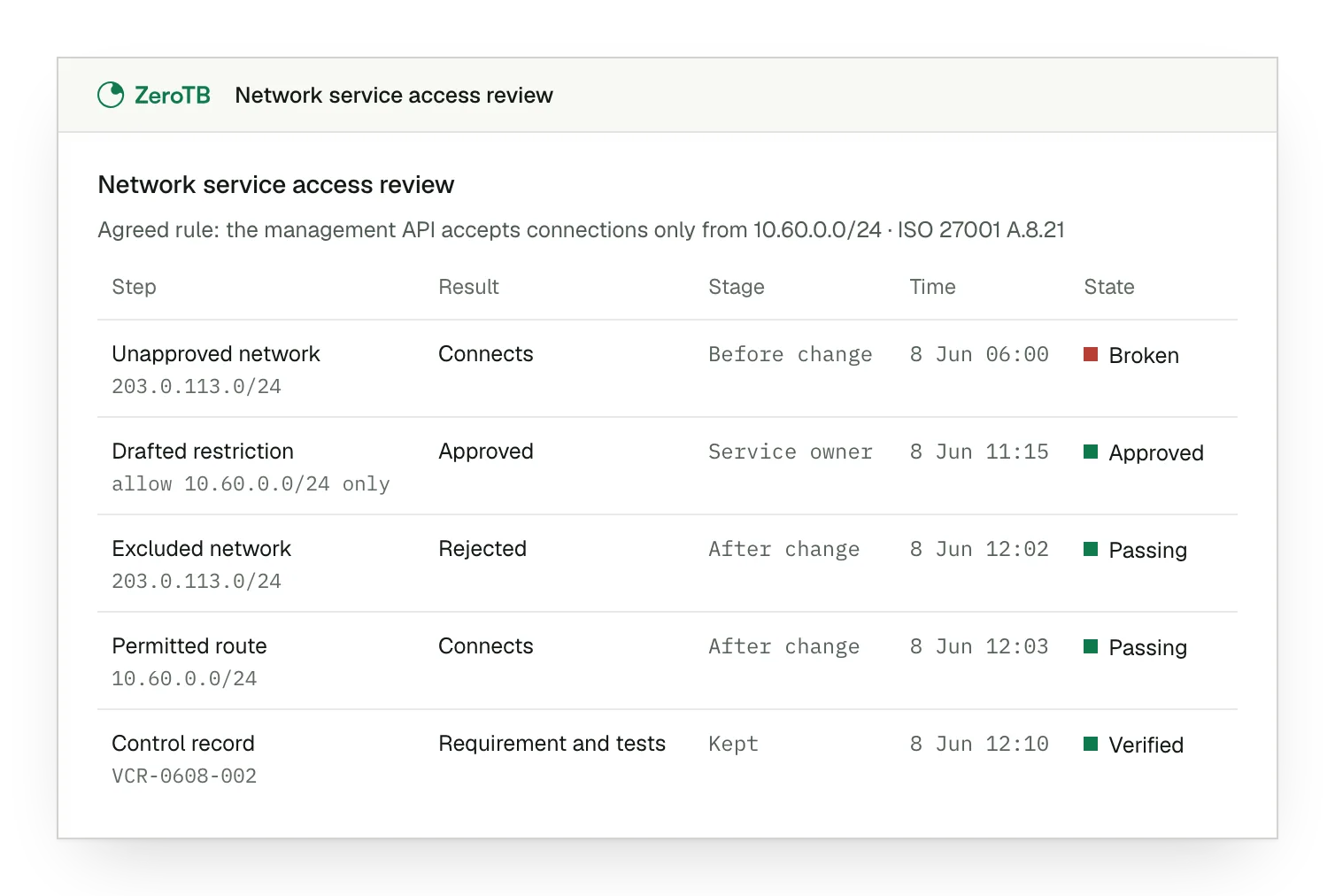
Observed access gap. The connection succeeds even though the agreed rule excludes the network used for this test.
Proposed restriction. The draft identifies the network that should retain access and the owner who must approve it.
Verified service access. Tests after the approved change confirm that excluded connections fail and the permitted route still works.
Retained control evidence. The dated results remain linked to the requirement, approved restriction and owner responsible for the service.
Network service review checklist
Select the service under review, find its agreement and identify the protections needed for its business use.
For each protection, establish who can change the settings and who will follow work that depends on the provider.
Compare current observations with the agreed protections, including any replacement interface or changed arrangement introduced since approval.
Decide what a successful correction must demonstrate, including permitted use, and retain the resulting tests with the approval.
Sources
- ISO/IEC, ISO/IEC 27002:2022 standard overview, 2022.
- NIST, SP 800-53 Rev. 5, external system services, SA-9, 2020, catalog updated 2025.
- HHS, HIPAA audit protocol, transmission security, 2018 update.
- ZeroTB, Continuous control monitoring guide, 2026.
Related pages
ISO 27001
Place network service requirements within the wider information security program and its other controls.
Compliance frameworks
Explore related requirements and control guidance across the frameworks that apply to the organization.
Cloud and infrastructure
See how service and configuration changes become checks, approved corrections and evidence of restored protection.
Start with the Pilot
Talk with our team about the network service gaps that keep returning. The eight-week Pilot maps up to 25 commitments and takes two real control gaps through approved correction and verified restoration, with evidence of the completed work.