What does ISO 27001 A.8.17 require for synchronized clocks?
ISO 27001 A.8.17 addresses synchronized clocks so records from different systems can be compared. Use approved time sources and define how much difference the work can tolerate. Check that clocks stay within that limit, and verify new event times after a repair while retaining context for older logs.
An incident timeline depends on clocks that agree across the systems recording it. One host running ahead can make an event appear before its cause. The repair therefore has two parts to check: the clock setting and the times attached to new events.
System scope
The clock control covers the systems whose event times need to agree for security and operational work. An application, its host and the logging service can each contribute timestamps to the same investigation. Their owners need a shared understanding of which clock produces each timestamp.
That scope also determines where the team can act. Infrastructure owners can usually inspect the hosts they manage, while a managed service may require provider documentation. Record who reviews each service and who can change its time settings. Extend those responsibilities when a new service enters scope.
Acceptable clock differences
An acceptable clock difference depends on how the organization uses its event records. If events occur fractions of a second apart, a small difference may reverse their apparent order. A process reviewed by the minute may need less precision. The tolerance should follow that use of the records.
Record the limit and what happens when a clock exceeds it. NIST's time controls cover timestamp precision and synchronization with an authoritative source. They offer technical guidance for the design; the chosen settings still need to reflect the systems and activities covered by the organization's control.
Approved time sources
A documented time source gives each system a reference that its owner can check. Network Time Protocol (NTP) is one way to synchronize a host with that reference. The configuration should identify which sources the host can use and how the choice matches the approved design.
A source listed in a configuration file may be unreachable or unused. The operating check therefore needs to identify the source the host selected. Where a fallback source is configured, its use should remain consistent with the required accuracy and the approved configuration.
Timestamp interpretation
Accurate clocks still need timestamps that an investigator can compare without guessing the time zone. Coordinated Universal Time (UTC) gives records a common reference; an explicit offset from UTC also allows comparison. Two users can see different local display times while the recorded timestamps identify the same moment.
There may also be two times for one event: when it occurred and when the logging service received it. A delayed delivery changes the second time. The record needs to distinguish them, or an investigator may mistake the delay for a difference between system clocks.
Drift after deployment
A replacement host can lose the time settings that made the previous host's logs reliable. A changed system image, a stopped synchronization service or an unreachable source can leave the new host using a clock that gradually diverges from its peers.
An earlier audit sample describes the state that existed when it was collected. The next review needs to cover the replacement host and the configuration used to create it. Otherwise, correcting one running instance can leave the same problem waiting in the next deployment.
Current synchronization checks
A useful check records the clock's actual relationship to its approved source. The reviewer needs the selected source, measured difference and time of observation. A configuration file answers what the system was set to use; a current measurement shows whether that arrangement is working.
On an EC2 host using chrony, AWS documents `chronyc sources -v` and `chronyc tracking` for these checks. Read their results alongside the approved tolerance. If a check cannot return current results, record that missing observation and leave the state unknown until it can be established.
Safe clock corrections
The system owner needs to approve how a clock correction will affect running applications. Software that depends on time can be interrupted by a sudden adjustment. Describe the proposed source and correction method before the change, so the owner can judge its effect on the application.
The same review should cover the configuration that introduced the gap. If the host came from an incorrect deployment definition, repairing that definition prevents it from recreating the error. Keep both changes together so the reviewer can see what each action addresses.
Verification after correction
Verification must show that the affected clock and newly recorded events meet the agreed rule. After the clock has had time to synchronize, obtain another source and offset reading. Compare that measurement with the approved tolerance and retain it with the record of the change.
Then inspect a known sequence of new events across the affected systems. Their timestamps should let the investigator follow that sequence correctly. If the readings exceed the tolerance or cannot be retrieved, the gap stays open. Closure needs a result that another reviewer can examine.
Historical log context
Correcting a clock leaves earlier event records with their original timestamps. Investigators need the known period of unreliable time and any measured differences to interpret those records. Keep that context with the correction so a later review can distinguish affected events from those recorded after verification.
A measurement taken when the problem was found does not establish the exact offset throughout the earlier period. Preserve the original records and describe what the available observations establish. Any reconstructed timeline should make its assumptions clear, especially where the start of the drift is unknown.
Continuing control ownership
Clock synchronization needs an owner who can respond when checks fail or systems change. A host added to the inventory needs to enter the checks as well. Missing observations need attention too: otherwise a monitoring history can appear complete while omitting a system involved in an investigation.
ZeroTB handles the work between an approved commitment and its verified state: it checks system observations, prepares repairs for approval and tests the result. The Verified Control Record keeps the commitment, change, approval and before-and-after evidence together, so another team can follow what happened.
Evidence of clock restoration
A reviewer needs to connect the expected time behavior with the observed gap, approved correction and subsequent checks.
| Requirement | What an auditor asks for | Where it comes from |
|---|---|---|
| Defined time behavior | Systems in scope, approved time sources, acceptable differences and responsibility for responding to failures | The approved control and system inventory |
| Observed synchronization | The selected source, observed offset and observation time for each system under review | Current host or service observations |
| Approved correction | The proposed repair, its effect on running applications and the owner's decision | The change record and approval |
| Verified result | New measurements and event comparisons that show the agreed time behavior after correction | Dated checks linked to the Verified Control Record |
| Historical context | The known period of unreliable timestamps and the limits of any reconstructed event sequence | Original logs, offset observations and investigation notes |
Related framework requirements
| Framework | Control | What it covers |
|---|---|---|
| ISO 27001 | A.8.17 | Agreement between relevant system clocks and the approved sources from which they obtain time |
| SOC 2 | CC7.2 | Monitoring for unusual activity across systems; event times help reviewers establish what happened and in which order |
| HIPAA | 164.312(b) | Records and examination of activity in systems containing electronic protected health information; timestamps help interpret those records |
Example of restoring event order
A host with a drifting clock can make a response appear to happen before its request. In this example, a replacement application host uses an unapproved time source. The correction record shows how the team restores comparable timestamps and preserves the context of earlier events.
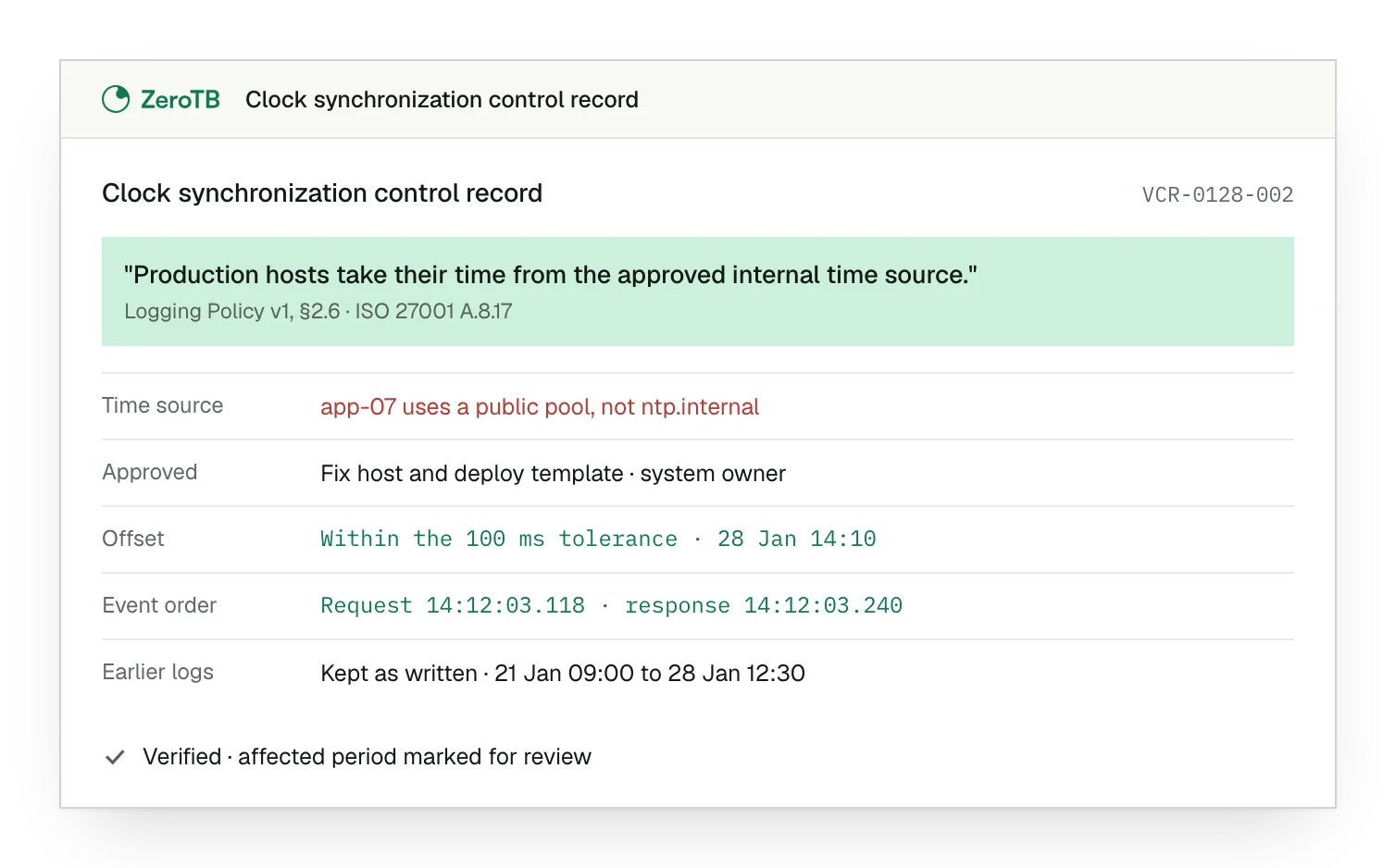
Source mismatch. The replacement host uses a different source from the one in the approved configuration.
Approved repair. The system owner approves correcting the host and its deployment configuration after reviewing application effects.
New events checked. Fresh measurements meet the agreed tolerance, and the request appears before its response.
Earlier logs retained. The record identifies the affected period and preserves the original logs for later investigation.
Clock synchronization review checklist
Establish which systems must agree on time, their approved sources and the acceptable difference between clocks.
Collect the selected source and measured clock difference from each system, together with the time of the check.
Ask the owner to approve the method after assessing application effects and any necessary deployment changes.
Use fresh measurements and a known event sequence to establish whether affected systems now meet the rule.
Keep earlier logs and the known affected period with the repair evidence so later investigators can interpret their timestamps.
Sources
- ISO/IEC, ISO/IEC 27002:2022 overview, 2022.
- NIST, SP 800-53 Rev. 5.1 control catalog, AU-8 and SC-45, 2020, updated 2023.
- AWS, Local Amazon Time Sync Service configuration and checks, accessed November 4, 2026.
- HHS, Summary of the HIPAA Security Rule, accessed November 4, 2026.
Related pages
Technological controls
Continue through the ISO 27001 guides for systems that hold and protect the records used in investigations.
ISO 27001
Read about the wider information security management system that gives individual controls their scope.
Compliance frameworks
Browse the framework guides when the same operating evidence needs to serve more than one compliance program.
How it works
See the operating method behind the checks, approved repairs and evidence described in this guide.
Start with the Pilot
Talk with our team about recurring control gaps. The eight-week Pilot maps up to 25 commitments and takes two real gaps through approved correction and verified restoration. You receive the evidence in a record for review.