What does ISO 27001 A.8.12 require for preventing data leaks?
ISO 27001 A.8.12 addresses data leakage prevention across the systems that hold, use or send sensitive information. It calls for measures to protect that information against unauthorized disclosure. To judge whether those measures work, follow the routes people use and test the response to both prohibited and permitted transfers.
A successful check of a repository says little about a copy stored elsewhere. That copy may have different recipients or a public link. The review therefore has to reach the services where information is shared, even when the original storage settings still look correct.
Protected information and permitted use
A useful leakage prevention rule names the information it protects and the uses it permits. Start with the information categories and handling rules already approved within the ISO 27001 program. Those decisions identify which transfers need protection and who can decide whether a particular use is acceptable.
Make the permitted destination specific enough to test. A rule that allows a supplier to receive a document should identify the approved sharing method and recipients. The reviewer can then distinguish necessary collaboration from a transfer that exposes the same information more widely.
Routes beyond the main repository
The source repository is only one place where a transfer can be controlled. Once someone downloads a file, that copy may move through email, a collaboration space or removable media. The review needs to account for the relevant routes beyond the original storage location.
NIST's information-flow guidance considers the information and the path between its source and destination. Use that distinction to locate the system that can inspect or restrict each transfer. Permission to read a document does not, by itself, settle where the reader may send a copy.
Detection rules and their limits
A detection rule is useful only where it can recognize the information and activity it is meant to protect. The review needs to establish what the rule examines and which routes it covers. A rule attached to one service cannot establish the behavior of another service.
Use safe representative data to test the conditions that should trigger the rule. Keep the expected response with the observed result so a reviewer can explain a missed detection. Where a route cannot be inspected, record that limitation and the protection used there, such as restricting its permitted destinations.
Responses that preserve approved work
The response should match the risk of the transfer and the approved business use. A prohibited destination may justify blocking. An uncertain match may need investigation, while legitimate external collaboration may need an exception with a defined recipient, purpose and review condition.
Test the effects of a proposed response before widening its use. DLP simulation can show likely policy matches without enforcing restrictions. This helps identify permitted work the rule would block. Simulation establishes what the policy would detect; a separate test must establish the response once enforcement is enabled.
Coverage after system changes
A new sharing service can leave sensitive information outside rules that still work elsewhere. A team may copy a protected document into a new collaboration space whose default allows public links. The original repository's successful check says little about access to that new copy.
Review coverage when services, sharing settings or approved uses change. Compare the current destinations and affected information with the scope recorded for the control. Include retained exceptions in that comparison: an exception approved for an earlier project may no longer describe the work that now uses the service.
Approval of the proposed correction
The information owner and system owner need a clear account of what a proposed restriction will change. The proposal should identify the affected route, the observed gap and the access that must remain available. That lets the owners assess the correction against the work it could interrupt.
Record the decision before making a material change. If an exception remains necessary, keep its purpose, owner and review conditions alongside the approval. The person applying the correction can then see which access to remove and which access approved recipients still need.
Investigation of earlier exposure
A repair answers what can happen now; earlier disclosure needs its own investigation. A public link may already have been used before it was disabled. Where the observations suggest exposure, preserve the event context and involve the incident owner while the control correction proceeds.
Available transfer records may identify the information, destination and time. They may also leave gaps that the investigation cannot resolve. Record those findings under the investigation's status, alongside a separate result for the corrected control, so a passed test does not imply that earlier activity has been explained.
Tests of the corrected route
Verification needs to show that the restricted transfer fails and the approved transfer still works. Define those expected results before testing, using safe representative data and identities that reflect each access condition. The test should exercise the route affected by the correction, including any retained exception.
Record the rule version, test time and observed response. If the protection should alert an owner, confirm that the expected alert reaches the responsible team. A saved configuration alone cannot establish that response. Keep the gap open when the test fails or the necessary observation is unavailable.
Evidence without extra sensitive copies
Alerts and tickets can create additional copies of the information the rule is meant to protect. The information category, route, event details and decision may give a reviewer enough context to understand the gap. Keep the material needed to explain why it was closed.
Where an investigation requires sensitive evidence, hold it under appropriate access restrictions and refer to it from the control record. This keeps the evidence in its designated location. The approval and dated test results should remain available to the people reviewing the control.
Ownership between reviews
Leakage prevention needs someone to act when a rule loses coverage or a check stops reporting. Assign the response to a team that can reach the relevant system owner. A quiet alert queue is useful only when the underlying observations are current and cover the intended routes.
This continuing work is part of how ZeroTB operates controls: checks of approved commitments lead to proposed fixes, human approval, verification and a retained record. For a sharing rule, the recurring question is whether current destinations and exceptions still match the protection that the company agreed to maintain.
Evidence for a leakage prevention review
These records let a reviewer compare the intended protection with the behavior observed during a transfer test.
| Requirement | What an auditor asks for | Where it comes from |
|---|---|---|
| Defined information and routes | Information categories and destinations included in the control | Handling rules and the sharing settings used by the services in scope |
| Effective transfer response | Evidence that the restriction or alert responded as intended | Test results linked to the transfer event, date and version of the rule |
| Controlled exceptions | A reason for retaining access outside the general rule | The owner's decision, including the purpose and conditions for reviewing the exception |
| Verified correction | Results for blocked access and the access that must remain | Approved change and dated observations in the Verified Control Record |
| Earlier exposure considered | The team's decision about investigating activity before the repair | Relevant event details, investigation reference and restrictions on access to sensitive evidence |
Related framework requirements
| Framework | Control | What it covers |
|---|---|---|
| ISO 27001 | A.8.12 | Preventing leakage of sensitive information through the systems and channels where it is handled |
| SOC 2 | CC6.7 | Restricting information transmission, movement and removal, and protecting information during those activities |
| HIPAA | 45 CFR 164.312(e)(1) | Guarding electronic protected health information against unauthorized access during transmission across a communications network |
Example of restricting public file access
This example follows a sensitive document copied into a collaboration space. The copy allows anonymous access, contrary to the approved recipient-only rule. The owner's correction removes public access, and the record shows the tests used to confirm that the intended recipients can still work.
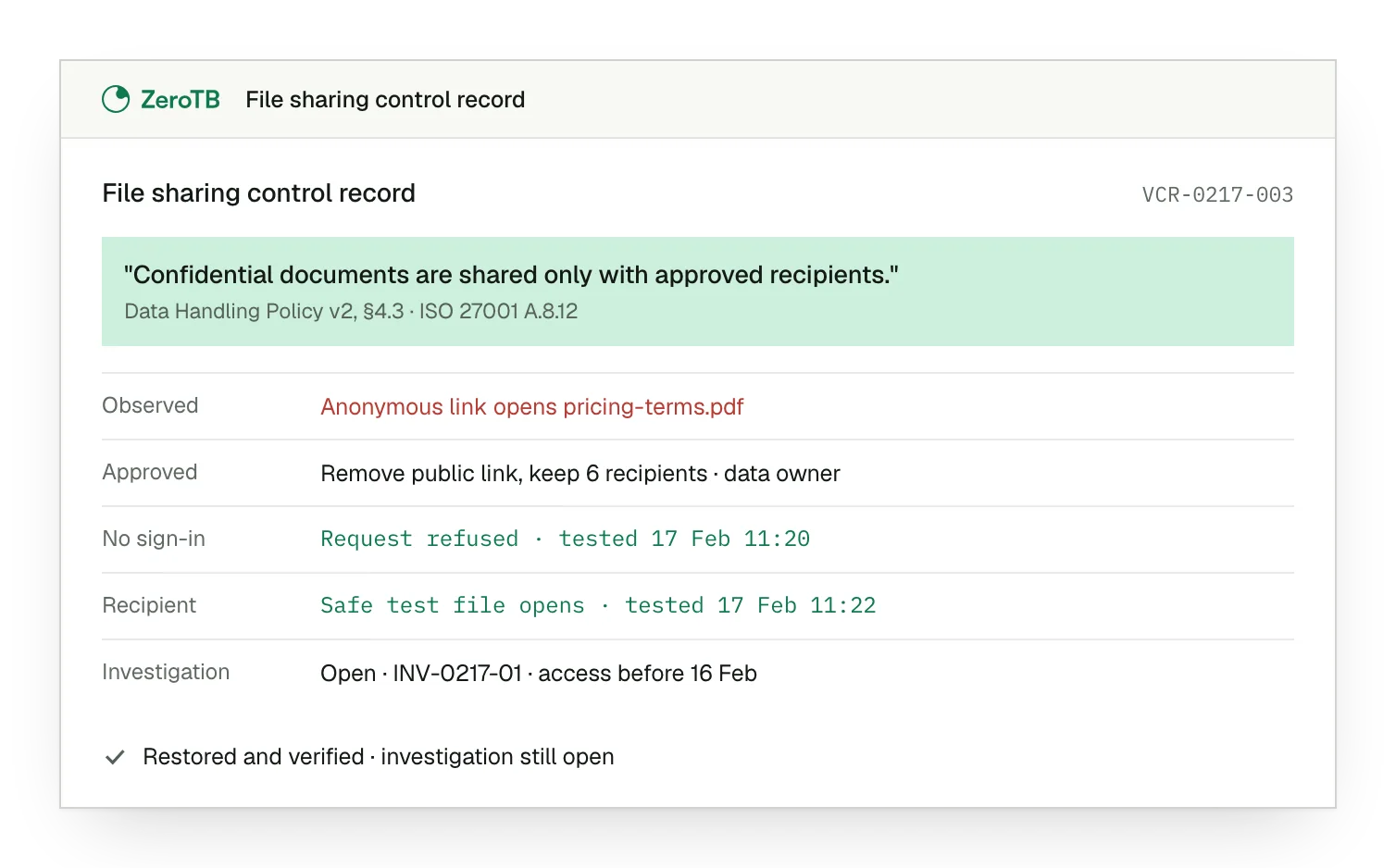
Sharing gap. The public link opens a file that should be available only to approved recipients.
Owner decision. The approved change removes anonymous access and keeps access for recipients with a continuing need.
Paired test results. A request without credentials fails, while the approved recipient successfully opens the safe test file.
Separate investigation. A linked investigation remains open to examine access events from before the sharing rule changed.
Data leakage review checklist
Choose the information and sharing route to review, with an agreed destination and expected restriction or alert.
Inspect the services holding or sharing that information, including copies and the exceptions that apply to them.
Confirm the change with its owner and record the access to keep, including any approved exception.
Test the changed route using safe representative data, checking the response to prohibited and permitted transfers.
Link dated results to the approval and any exposure investigation, then assign the next checks to an owner.
Sources
- ISO/IEC, ISO/IEC 27002:2022 overview, 2022.
- NIST, SP 800-53 Rev. 5, security and privacy controls, 2020, with subsequent releases; AC-4 information-flow guidance.
- Microsoft Learn, Data loss prevention simulation mode, accessed November 4, 2026.
- HHS, HIPAA audit protocol, July 2018 update; transmission security.
- ZeroTB, Continuous control monitoring, 2026.
Related pages
Technological controls
Find the other ISO 27001 control guides covering systems, information processing and technical safeguards.
ISO 27001
Read how the management system connects control decisions with the wider information security program.
Compliance frameworks
Explore related requirements across the frameworks that apply to the information and systems in scope.
Start with the Pilot
The eight-week Pilot maps up to 25 commitments and takes two real control gaps through approved changes and verified restoration. Talk with our team about data-sharing concerns and whether the Pilot fits the controls you need to keep working.