What does ISO 27001 A.8.10 require for information deletion?
ISO 27001 A.8.10 calls for deleting information that no longer needs to be kept. Start with the retention decision, including any hold, and follow it through the systems holding that information. Completion means checking what happened to the relevant copies and documenting the approved treatment of anything that remains.
A support export can survive the account it came from. Deleting the account removes the application record, while the export stays in a shared folder. Both locations belong in the deletion review, even though separate owners may need to approve and carry out the work.
Retention decisions
Deletion starts with a decision that the information no longer has an approved reason to remain. The retention schedule should connect each information category to its purpose, applicable requirements and deletion trigger. A legal hold can change when otherwise eligible information may be removed.
The owner resolves that decision before a deletion job runs. When different records need different treatment, the approved scope should distinguish them. This gives the people operating the system a basis for removing eligible information while preserving records that still have a valid purpose.
Deletion scope
Deletion scope follows the information into the places that hold copies. The system inventory is a starting point for this work. Exports, temporary stores and retired applications also matter, since they can contain information after the main record has disappeared.
Each location needs an owner and an expected outcome. Direct removal may be available in one store while another uses a separate expiry process. The deletion record should make that difference clear, so a reviewer can understand why the locations reach completion at different times.
Copies outside the application
A working application deletion can leave information in a separate workflow. Support staff may export a record, and a test process may copy production data. Each destination needs a deletion route that follows the relevant retention decision and reaches its own stored copies.
Supplier-held information needs the same clarity about scope. The service owner's deletion arrangements should explain which records the provider removes, what it keeps and when that retention ends. A completion response is useful when it identifies the covered data and any remaining copies.
Deletion methods
A deletion method needs to suit the medium and the information it holds. An application can remove a record through its own functions. Retired media requires a decision about sanitization, with a method appropriate to the information's sensitivity and the medium's intended use.
NIST's media sanitization guidance treats verification and acceptance as separate questions. First comes the result of the sanitization operation; then someone decides whether it is acceptable. A disposal record needs enough evidence to support that decision for the particular method used.
Versioned storage
A deleted object can still have retrievable older versions. In a versioning-enabled Amazon S3 bucket, a delete request without a version ID adds a delete marker. The earlier object remains as a noncurrent version, so the ordinary object view can give an incomplete picture.
AWS documents separate handling for object versions, including lifecycle rules that permanently remove noncurrent versions. The retention decision should cover those versions before the method is chosen. Verification then needs to examine the relevant versions and their status to establish whether removal is complete.
Backups and recovery
Backups need an explicit retention and recovery decision of their own. A backup may contain information already removed from an active application. Where its approved treatment is expiry, the deletion record should identify that remaining copy and the conditions under which it will expire.
Recovery procedures also need to account for information previously deleted. A restore can return an older state that contains those records. The recovery process should check the restored data against the deletion decisions before normal use resumes, while preserving information that remains necessary for recovery.
Approval before deletion
An owner approves deletion against a defined set of records and locations. The decision needs to account for the method and any hold before the action becomes irreversible. It also needs to identify the records that the operator must leave in place.
Agree how to handle a failed location before starting the work. Its records still need an owner even if deletion succeeds elsewhere. When the proposed change affects the rule itself, consider future records too: the changed rule will continue acting after this particular deletion finishes.
Checks after deletion
A completed deletion needs a check of the resulting state. An execution log explains what the job attempted and whether it reported success. A separate observation of the affected store helps establish whether the information received the treatment required by the decision.
The check should match the method and location: application records, stored versions and retired media need different evidence. Missing access or an unavailable system leaves a gap in that evidence. Keep the affected work open until the result can be checked or an authorized exception resolves it.
Evidence without sensitive content
The deletion record should explain the action without recreating the information removed. Useful evidence includes the approved scope, record identifiers, locations, method, time and result. Copying the deleted content into a ticket can create another store that needs its own deletion decision.
Keep the approval beside the result so a reviewer can follow why the action was permitted and whether it completed. Evidence may itself contain sensitive identifiers. Its access and retention arrangements should preserve a usable history without keeping unnecessary copies of the underlying data.
Changes after the audit
Changes to information flows can break deletion coverage between audits. A new export or migration store may never enter the existing job's scope. That job can keep reporting success because it continues to remove everything it knows about, leaving the new location untouched.
Review the affected deletion routes when those flows change. Recurring checks also need to follow failed jobs and copies awaiting expiry. The finding's owner can compare the remaining copy with its retention decision and determine whether it needs removal or has an approved reason to remain.
Closure and continuing ownership
Closure depends on the results across the agreed deletion scope. Each remaining copy needs an explanation: an approved reason to keep it, or unfinished work with an owner. Passing results from other locations cannot resolve a failure in a store that still holds the information.
Keeping these checks and decisions connected is part of ZeroTB's control operations. It compares commitments with connected systems, proposes corrections that people approve, and checks the result. The Verified Control Record preserves that history, including the action, approval and before-and-after observations.
Deletion evidence
The evidence should let an auditor follow which information was eligible, where the action applied and what remained afterward.
| Requirement | What an auditor asks for | Where it comes from |
|---|---|---|
| Eligible information | Why the records could be deleted, including their retention rule and hold status | The retention schedule and the owner's decision about the records selected for deletion |
| Covered copies | Which locations held the information and how the action accounted for their copies | The system inventory and information flows compared with the scope of the deletion |
| Authorized action | Which method the owner approved, who acted and when the action took place | The approval, job history and any provider response for the locations involved |
| Retained copies | Why a copy remains, who owns it and when its retention will be reviewed | Backup settings, hold decisions and exceptions kept with the relevant deletion record |
| Checked completion | What each check found after deletion and which locations still need further work | Observations from the affected systems and results from the selected verification method |
Related framework requirements
| Framework | Control | What it covers |
|---|---|---|
| ISO 27001 | A.8.10 | Deleting information when its purpose and retention requirements no longer justify keeping it |
| SOC 2 | CC6.5 | Protecting information during the disposal of assets and addressing the risk of recovering their data |
| HIPAA | 164.310(d)(1) | Device and media handling, including disposal and removal of electronic protected health information before media reuse |
Example of removing an overlooked export
In this example, a closed customer account has disappeared from the application, but its support export remains in shared storage. The owner confirms that the export has no remaining retention requirement. Its removal needs approval and a check of the storage location before closure.
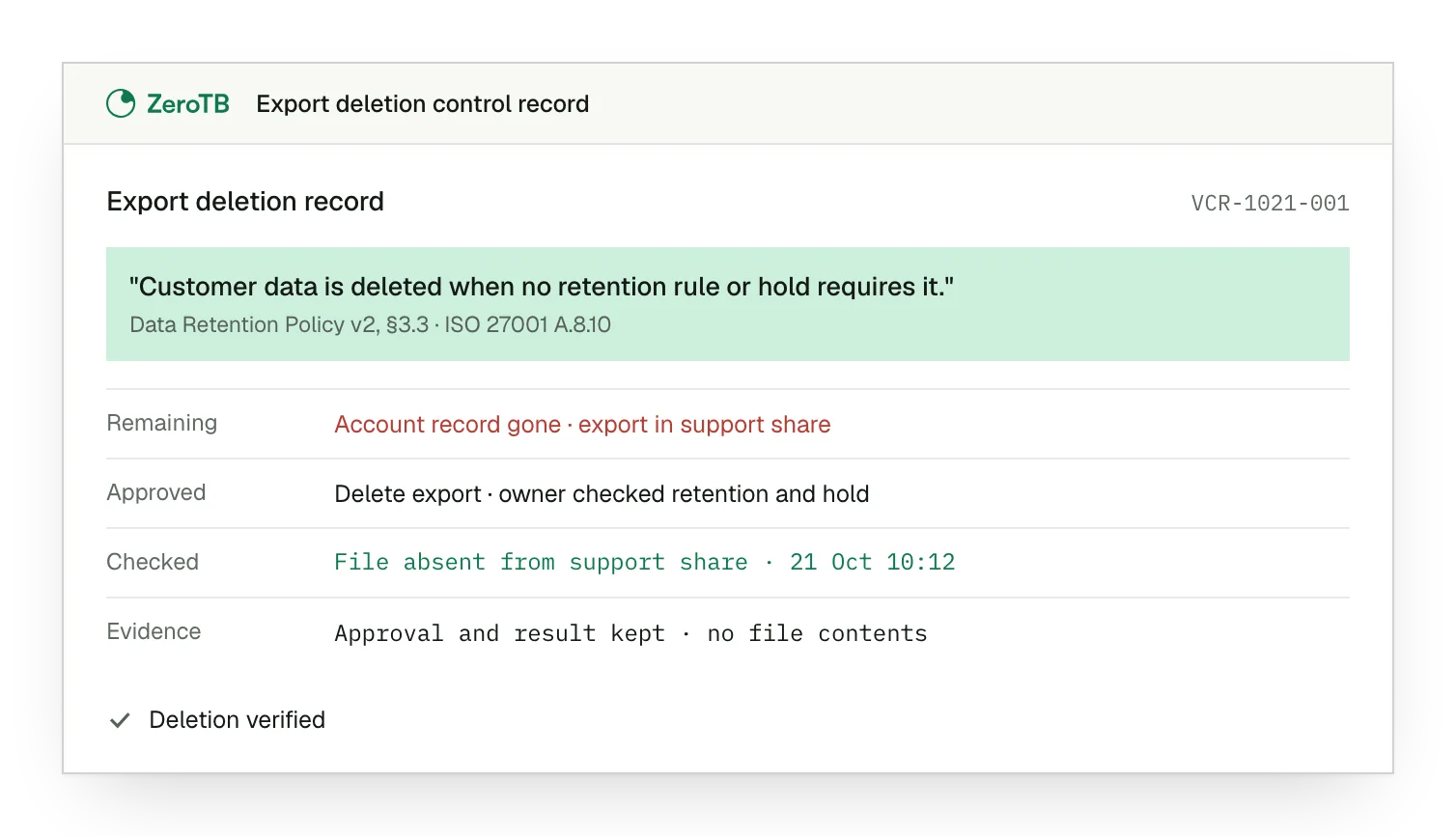
Remaining export. The application record is gone, while the support file remains in the identified shared folder.
Approved removal. The owner approves deletion of the export after checking its retention rule and hold status.
Checked result. A fresh check confirms the identified file is absent from the storage location after deletion.
Recorded evidence. The record keeps the approval and dated result without attaching the contents of the deleted file.
Information deletion checklist
Check the applicable rule, deletion trigger and hold status before deciding which information is eligible for removal.
Identify the locations covered by the decision, including exports, older versions and backups with separate expiry arrangements.
Match the method to the storage location and define the evidence needed to establish its intended result.
Confirm which records the action removes, which must remain and who owns any incomplete work or exception.
Inspect the resulting state, keep unresolved locations visible and save the approval with evidence that excludes deleted content.
Sources
- ISO/IEC, ISO/IEC 27002:2022 overview, 2022.
- NIST, SP 800-88 Rev. 2: Guidelines for media sanitization, September 2025.
- AWS, Deleting object versions from a versioning-enabled bucket, accessed November 4, 2026.
- HHS, Disposal and reuse of electronic media holding protected health information, accessed November 4, 2026.
Related pages
Technological controls
Explore the other ISO 27001 controls that govern information and the systems handling it.
ISO 27001
See how individual controls contribute to an information security management system and its operation.
Compliance frameworks
Explore the broader requirements alongside these related controls across SOC 2, ISO 27001 and HIPAA.
Start with the Pilot
Talk with our team about the controls that need continuing attention. The eight-week Pilot maps up to 25 commitments and takes two real gaps through approved correction and verified restoration, with records of the work and its results.