What does ISO 27001 A.6.8 require for security event reporting?
ISO 27001 A.6.8 concerns how people report observed or suspected information security events through an established channel. Give staff clear instructions and a route to someone who can assess their concern. Check that the route still works when its owners, systems or instructions change.
A reporting address can remain in the staff handbook long after its owner leaves. An employee may follow every instruction and still receive no response. Checking A.6.8 means following the report far enough to establish that someone responsible receives it.
Reportable concerns
Staff should be able to report a suspected security event before they know whether it is an incident. A lost device, an unexpected access request or an apparent weakness can all warrant attention. The receiving team decides how to assess the concern.
Instructions should help people describe what they observed, when it happened and which system or information may be affected. Requiring a technical diagnosis before accepting a report can delay that assessment. An incomplete account can still give the receiving team enough information to begin asking questions.
Reporting channels
The reporting channel must be available to the people expected to use it. A mailbox, form or service desk can provide a route, provided staff can find it and submit a concern. Check access for the groups covered by the procedure, including relevant contractors.
A second route helps when the normal channel is unavailable. For example, a person locked out of a work account may also lose access to the reporting form. Instructions should explain how to reach the responsible team in that situation, using a contact method that remains accessible.
Responsible recipients
Each reporting route needs someone responsible for receiving and assessing concerns. A shared mailbox still depends on people who can access it, recognize a security report and act on it. The procedure should identify that responsibility and the arrangement for covering an absence.
Check whether the current recipients match the documented responsibility. A departed employee may remain the only mailbox delegate, or a service desk may receive reports without knowing where to send them. A backup recipient needs access and instructions that allow them to take over the work.
Reporting times
The procedure needs timing for both reporting and assessment. Staff may send a concern as soon as they notice it, yet wait for a team that checks the queue only occasionally. Set expectations for both sides and explain how staff can escalate an urgent report.
NIST's reporting assessment checks whether an organization has defined a period for reporting suspected incidents. Use that as a reference when setting expectations for the team. The chosen period belongs in staff instructions and test criteria; the NIST reference does not set an ISO deadline.
Assessment and escalation
Receipt starts the assessment; it does not settle whether an incident has occurred. The receiving team needs to establish what happened and decide whether incident handling is required. Record the decision and the next responsible person so a concern does not stop at acknowledgment.
A report may reveal a control weakness without establishing a security incident. That weakness still needs an owner and a decision about corrective action. When the assessment identifies an incident, connect the report to the response record so the response team can read the original observations and subsequent decisions.
Changes after the audit
A change in staff or systems can break reporting while the written procedure stays unchanged. Mailbox access, routing rules and service desk assignments may change independently. An instruction that worked during the audit can therefore point to a destination that nobody currently monitors.
Compare the route in the policy with the one in induction material and the staff directory. Different addresses can send reports to different teams. Where several routes remain in use, check each route's ownership and destination before treating one successful report as evidence that the entire arrangement works.
Tests of the reporting path
A controlled test shows whether the published instructions lead to a responsible recipient. Use a message marked as a test with harmless content and agree the exercise with the receiving team. Follow the route from an ordinary user's account so administrator access cannot hide a permissions problem.
Check submission, receipt and the recipient's assessment of the test against the procedure's expected timing. A successful send alone cannot establish that someone received the concern. If the normal route is unavailable during the exercise, test the alternative and retain the result for that route separately.
Approved corrections
The failed test identifies where a repair is needed. Compare its result with the reporting procedure: the intended recipient may have lost access, or a rule may redirect the message. The proposed correction should identify that fault and any instruction changes for the owner to approve.
Repeat the test after the repair, then keep its result and the approval together before closing the gap. This is part of ZeroTB's control restoration process. The people assigned to receive security reports remain responsible for assessing them and deciding what action they require.
Evidence of receipt and assessment
A report needs a record of what happened after it arrived. Record who received it, when they assessed it and what they decided. References to an incident or corrective action let the reviewer continue through the work without reconstructing it from separate messages.
Keep sensitive details in a restricted record and link to it from the control review. That gives an authorized reviewer access to the facts behind the decision. Exercise records also need a test designation, so nobody mistakes a successful exercise for evidence of handling an actual event.
Ongoing checks
The reporting control needs another check when its people, instructions or supporting systems change. An owner can include those changes in a recurring review of the reporting procedure. The review should establish which routes were checked and identify any route whose current state remains unknown.
A failed check needs an assigned follow-up and a result before the owner accepts the route as working. Keep review responsibility with the control owner, even when another team maintains the mailbox or service desk. The owner can then trace a later failure to the team that can repair it.
Reporting evidence
These records help a reviewer follow the reporting process from staff instructions to a documented outcome.
| Requirement | What an auditor asks for | Where it comes from |
|---|---|---|
| Clear reporting instructions | What staff should report, where to send it and when to escalate | Approved procedure, staff handbook and current induction material |
| Responsible recipients | Who receives reports and who covers an absence | Responsibility records, mailbox access and service desk assignments |
| Working reporting routes | Dated evidence that a report reached the intended recipient | Controlled test results, delivery records and recipient acknowledgments |
| Recorded assessment | The decision about the concern and any further incident or corrective work | Event register, assessment notes and linked response records |
| Verified repair | The failed check, approved correction and successful repeat test | Change approval and dated results retained with the control record |
Related framework requirements
| Framework | Control | What it covers |
|---|---|---|
| ISO 27001 | A.6.8 | A route for personnel to report observed or suspected information security events |
| SOC 2 | CC7.3 | Assessment of security events to determine whether an incident requires action |
| HIPAA | 164.308(a)(6) | Security incident procedures, including response and documented outcomes, where electronic protected health information is in scope |
Example of restoring report delivery
A controlled report can reveal an ownership gap that the written procedure hides. In this example, the handbook lists a mailbox whose only delegate has left. The control record follows the approved reassignment and a repeat test through to confirmed receipt by the new responsible team.
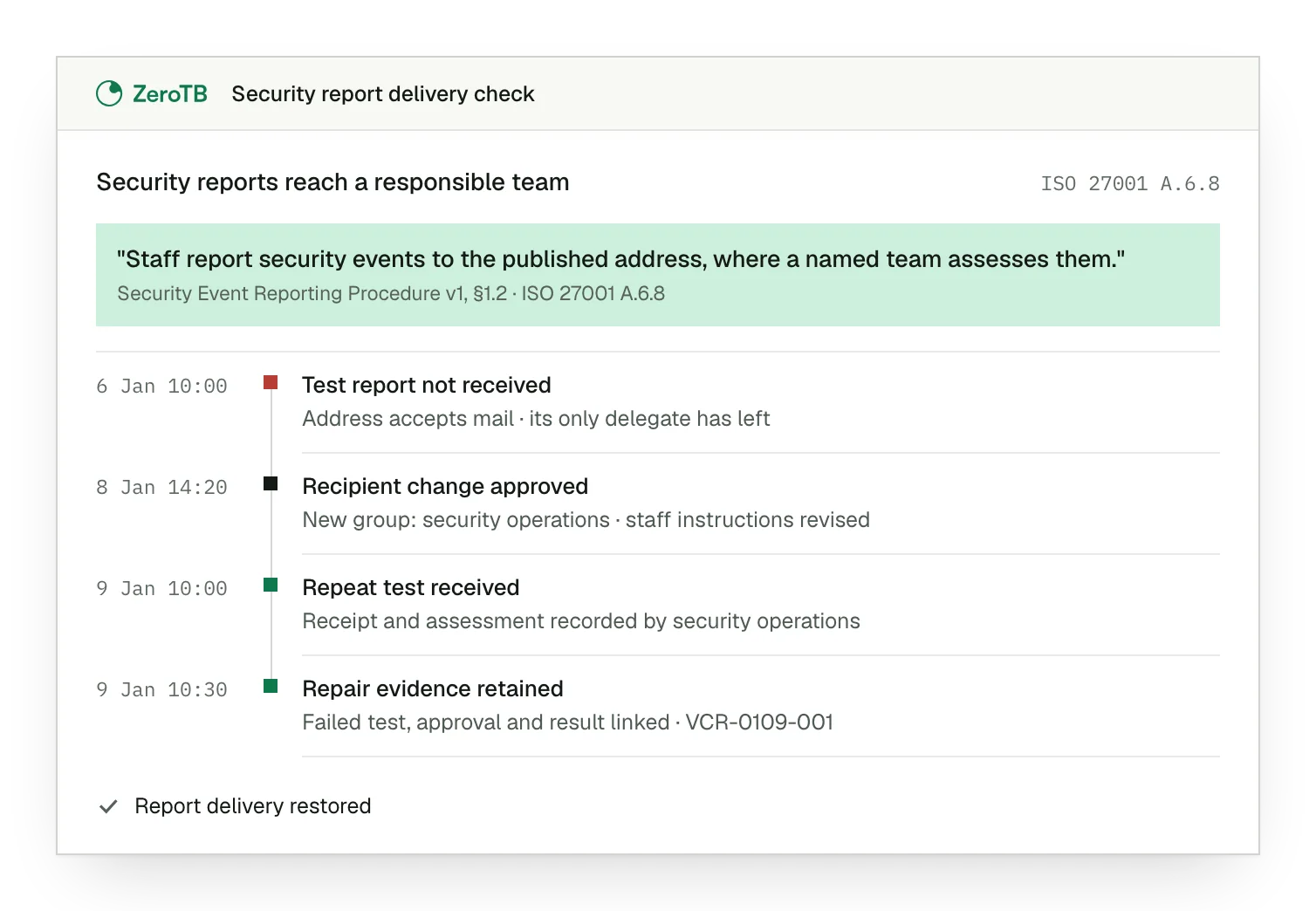
Unreceived test report. The published address accepts the message, but the test finds no active recipient responsible for assessment.
Approved recipient change. The control owner approves the new recipient group and the revised instructions for staff.
Confirmed repeat test. A second controlled report reaches the new group, which records its receipt and assessment.
Retained repair evidence. The Verified Control Record connects the failed test, approved correction and successful result for review.
Reporting control review checklist
Compare the procedure, handbook and induction material to identify every route that staff may use to report concerns.
Check that each route has an active recipient, appropriate access and an arrangement for covering an absence.
Send a controlled test through the published route and confirm the responsible team records receipt and assessment.
Repeat the failed check after the owner approves a correction, and retain the result before closing the gap.
Record who will review the route again, including after changes to recipients, staff instructions or supporting systems.
Sources
- ISO/IEC, ISO/IEC 27002:2022 overview, 2022.
- NIST, SP 800-171A Rev. 3, incident monitoring, reporting, and response assistance, 2024, section 03.06.02.
- HHS, HIPAA audit protocol, 2018 update, security incident procedures.
Start with the Pilot
Talk with our team about reporting failures and other gaps between policy and practice. The eight-week Pilot maps up to 25 commitments and takes two real control gaps through approved fixes and verified restoration, with evidence of the completed work.