What does ISO 27001 A.6.4 require for handling policy breaches?
ISO 27001 A.6.4 covers the disciplinary process used when staff breach information security rules. The organization needs an established procedure, staff who know about it and people authorized to decide the response. After a case, check whether the procedure itself needs repair and follow that work through to completion.
Closing a personnel case does not replace an outdated form or complete missing training. Those tasks can remain open after the organization has decided its response to the breach. Reviewing A.6.4 means examining how the case was handled and what happened to the corrective work it prompted.
Disciplinary procedure
Staff need to know how the organization will handle a suspected security policy breach. The disciplinary procedure explains the route: who receives the report, how an investigation proceeds and who can decide the response. It also explains how the outcome is communicated.
The security rules and the employment process need to work together here. A manager handling a breach should be able to find the applicable rule and the current procedure in the same way as colleagues elsewhere. Keep evidence that staff received those documents, alongside records of their use in cases.
Decision authority
A security investigation supplies facts for a decision that may belong to HR or an authorized manager. The procedure needs to make those responsibilities clear. Otherwise, a case can stall between teams, with each waiting for the other to decide what happens next.
Some decisions also require advice from HR or legal counsel. NIST's personnel sanctions guidance connects the response to applicable rules and consultation with counsel. Keep the decision with the person who has that authority. Software can track a deadline or an agreed action without deciding the consequences for the individual.
Established facts
The investigator needs to establish which rule applied and what happened before the organization decides its response. An alert supplies one observation. It may still take a review of the surrounding events to understand whether the person breached the rule.
Keep the policy version that applied at the time beside the evidence in the restricted case file. Record unresolved questions as well as confirmed facts, so the decision-maker can see where the evidence ends. A later reviewer should be able to reconstruct the basis for the decision from that file.
Consistent responses
The reasons recorded in a case let a reviewer assess whether the organization applied its procedure consistently. Two cases may end differently because their facts differ. The record needs to explain that difference well enough for an authorized reviewer to follow the decision.
For example, one manager might have information that another lacked when responding to a similar event. Another explanation could be that one manager used an obsolete procedure. Reviewing the evidence distinguishes these situations. Where the procedure failed, record the correction required and identify who can approve and complete that work.
Procedure changes
A change of owner can leave a disciplinary procedure pointing to someone who no longer handles cases. An old form can do the same, even after the policy has been updated. Managers following those instructions may have no clear route for the next decision.
Check the documents people use when responsibility changes. The current procedure, saved templates and contact details should lead to the same owner. Replace obsolete instructions and tell the managers affected by the change. A review of the policy alone can miss copies still used elsewhere in the organization.
Restricted records
The people correcting a process rarely need every detail of the personnel case that exposed the problem. Investigation material and disciplinary decisions belong in a restricted record. Give access according to each person's role in the case and the work they need to perform.
The compliance task can identify the process gap, owner, due date and evidence needed for closure. Keep its description limited to that work. When an auditor needs to examine the underlying case, its owner can arrange access to the restricted file.
Process corrections
A completed disciplinary case can leave the underlying process weakness unresolved. The review may identify unclear instructions, missing training or a failed handoff between security and HR. Each weakness needs its own corrective action and an owner who can complete it.
Agree what completion will demonstrate before assigning the work. Revised instructions need to reach the people who use them; a missing training activity needs evidence of completion. Record these actions separately from the personnel response so that closing the case does not also close unfinished control work.
Verification and closure
The check before closure should reproduce the step that previously failed. When a procedure sent cases to the wrong owner, use its replacement to send a test referral. The current owner should receive it and be able to identify the next step.
Record the date and result with the approval for the change. A failed test leaves the corrective task open for more work. A Verified Control Record preserves the correction, its approval and the observed result. The reviewer can read those together when deciding whether the control has been restored.
Periods without cases
With no disciplinary cases in the review period, the organization can still examine whether its procedure is ready for use. Start with the document, the assigned roles and records showing that staff received the instructions. Each supplies evidence about the arrangements currently in place.
Then follow a suspected breach through a walkthrough with a manager. Can the manager find the reporting route and reach the next decision-maker? Record the result as a walkthrough. Keep it distinct from actual case records, which show how the organization responded to real events.
Continuing ownership
Someone must follow the corrective work after the personnel case ends. The control owner can use scheduled reviews to check progress and identify changes in responsibility. Overdue tasks need an escalation route to someone who can resolve the delay or obtain a missing decision.
For people-and-process commitments, ZeroTB schedules the work, assigns an owner and checks completion. Its control restoration process supports that follow-up alongside the organization's human decisions. The owner can then review evidence of completed work and see which tasks still need attention before accepting that the procedure is working again.
Audit evidence
A review follows the evidence from the procedure in force to the decisions made and the corrections completed.
| Requirement | What an auditor asks for | Where it comes from |
|---|---|---|
| Defined procedure | The procedure in force when a breach was handled | Approved document versions, with the responsible roles identified |
| Staff communication | Records showing how staff learned the rules and the process | Distribution records, acknowledgments or relevant training records |
| Authorized decisions | Evidence supporting the response and the authority of its decision-maker | Restricted case files containing the findings, decision and approval |
| Protected case information | The people allowed to read personnel evidence | Case-file permissions and arrangements made for the reviewer |
| Completed corrective work | Evidence that a process weakness identified in a case was corrected | Approved corrective tasks and dated results from checking the changed procedure |
Related framework requirements
| Framework | Control | What it covers |
|---|---|---|
| ISO 27001 | A.6.4 | The disciplinary process for handling breaches of information security rules |
| SOC 2 | CC1.5 | Accountability for responsibilities that support internal control |
| HIPAA | 164.308(a)(1)(ii)(C) | Appropriate sanctions for workforce breaches of security policies and procedures within HIPAA's scope |
Example of correcting an outdated procedure
Replacing an obsolete procedure is only part of the correction. In this example, a manager's saved template directs a security case to a former HR owner. The team keeps the corrective task open until a walkthrough confirms that the revised route reaches the current owner.
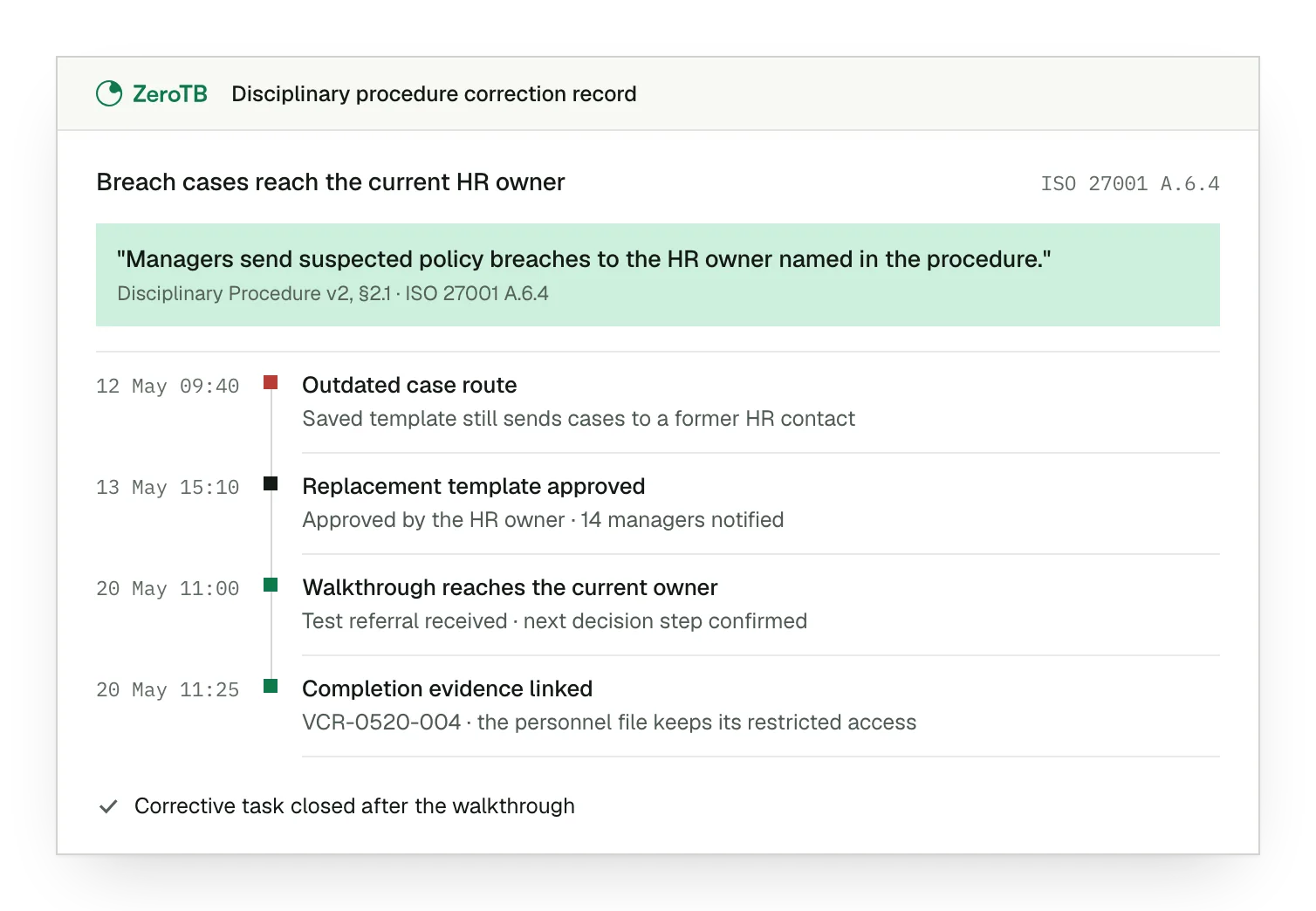
Outdated case route. The saved template directs the manager to an HR contact who no longer owns the procedure.
Approved procedure update. The current HR owner approves replacing the template and informing the managers who use it.
Successful route check. A walkthrough using the replacement template reaches the current owner and confirms the next decision step.
Restricted case details. The control record links to completion evidence while the underlying personnel file keeps its restricted access.
Disciplinary process review checklist
Read the procedure in force and identify which staff it covers and who is responsible for maintaining it.
Check the forms and contact details managers use against the current procedure, including any saved local copies.
Confirm the authority for the proposed process change, keeping the associated personnel decision with its authorized owner.
Follow the revised instructions through the step that failed and record whether they produce the agreed result.
Ask the case owner to arrange access for the reviewer without copying personnel details into general compliance tasks.
Sources
- ISO/IEC, ISO/IEC 27002:2022 overview, 2022.
- NIST, SP 800-53 Rev. 5, PS-8 Personnel sanctions, 2020, updated December 2020.
- HHS, HIPAA audit protocol, sanction policy, July 2018 update.
- ZeroTB, SOC 2 compliance automation with human approval, 2026.
Related pages
People controls
Explore the other ISO 27001 controls that concern staff responsibilities and working practices.
ISO 27001
See how this control contributes to the wider information security management system.
Compliance frameworks
Find related guidance across the frameworks that apply to the organization's controls.
Start with the Pilot
Talk with our team about the controls that need attention. The eight-week Pilot maps up to 25 commitments and takes two real control gaps through approved correction and verified restoration, with evidence of the work completed.