What does ISO 27001 A.6.2 require for security terms in employment contracts?
Under ISO 27001 A.6.2, employment terms set out the security duties of the organization and the people working for it. Those terms need to reflect their work. Review them when responsibilities change, then keep the approved document and the acceptance required by the employment process together.
A person can complete onboarding and later move into a job their signed terms do not cover. The security team sees the new access; HR holds the agreement. Connecting those records makes it possible to decide whether the change needs new terms or another acknowledgement.
Agreed security duties
Security terms explain what each party agrees to do to protect information. The duties should be recognizable in the person's work: handling company files, using work equipment or reporting a security concern. They also need to describe the organization's responsibilities in that arrangement.
Security owners explain the work and the information it involves. HR and legal owners use that explanation to decide how the agreement should express each duty. Keeping those decisions connected helps prevent a contract from describing responsibilities that differ from the job someone actually performs.
Contract and policy evidence
Employment terms and policy acknowledgements provide different kinds of evidence. A contract can establish a duty to protect company information. A policy can explain what that means for everyday tasks, including the route for reporting a lost device or sending a sensitive file.
HR and legal owners decide how the documents work together and what the person must accept. The record should identify that action. A receipt for an email shows delivery; a recorded acknowledgement can show acceptance of the attached policy. Neither record proves more than the action it records.
People in scope
A review can miss people when it starts and ends with the signed documents already on file. Start with the workforce and role records instead. These identify whose agreements belong in the review and make it possible to find someone with no acceptance record.
For external personnel, identify the arrangement that governs their security duties. A supplier may maintain some of the records, while the organization holds others. The control owner needs to know where the evidence resides and who can obtain it for the people included in the review.
Changes in responsibilities
A role change can leave someone working under terms that describe an earlier job. New access, remote administration or responsibility for sensitive information can introduce duties that the existing agreement does not explain. The change in work gives the reviewer a reason to inspect the terms.
Compare the new duties with what the person already accepted before requesting another signature. Some changes fit the existing terms; others require an approved update. Record that decision against the role change, including its reason, so later reviewers can understand why the terms stayed unchanged or were revised.
Review timing
Changes in work provide useful occasions to review security terms. A new hire needs the terms for the role they are joining. A person moving into a different job may need revised duties. A policy revision can also affect what personnel need to accept.
A scheduled review helps catch missed changes between those events. NIST PS-6 uses organization-defined intervals for access-agreement reviews and requires renewed signing when agreements change. Use that as a practical reference when setting the organization's own commitments, with the document owner deciding the applicable timing.
Approved changes
HR and legal owners approve how revised security duties enter the employment arrangement. They need to know which duty is missing, whose work it affects and what has changed. The security owner provides that explanation so the wording and acceptance process address the gap found.
An updated template reaches future hires. Existing personnel need a separate decision about whether to accept the revision. Keep both actions visible in the correction record: approval of the template can be complete while acceptance by the people already doing the work remains outstanding.
Outstanding signatures
An outstanding signature needs investigation before anyone decides what to do about it. The person may have a question about the terms, or may already have accepted them in a record that is missing. Assign the case to someone who can establish which situation applies.
HR resolves questions about employment terms. Any change to system access needs the appropriate owner's decision. Keep the case open while the required acceptance or evidence is missing, unless an authorized decision changes the requirement. The task's overdue status does not itself authorize either kind of change.
Verification before closure
Before closing a gap, check that the acceptance belongs to the right person and the approved document version. An old signature attached to a completed task can otherwise appear to resolve a new duty. The check needs to use the completion condition agreed for this correction.
ZeroTB's control operations process assigns work from approved commitments and verifies completion of human tasks. The employment decision and acceptance remain with people. Connecting their completed action to the requirement gives the control owner evidence for closure and a way to explain the decision later.
Evidence across versions
The accepted document version is part of the evidence. A shared link can point to new terms after someone signed an earlier version. Retaining the relevant document and its acceptance record lets a reviewer establish what the person agreed to at the time.
Apply the organization's records policy to those versions. For corrected gaps, the Verified Control Record connects the original condition, approved action and checked result. That history explains the change even after a later revision, when the current document alone would tell only part of the story.
Access to personnel records
Control evidence should expose only the personnel information needed for the review. Employment files can contain details unrelated to security duties. A controlled reference to the relevant agreement and acceptance record can keep the control history useful without copying the entire file into each task.
An authorized reviewer must still be able to retrieve the referenced evidence. Agree who can retrieve the record and which version the reference identifies. If the reviewer cannot locate the document, the acceptance remains unchecked, even when a task reports completion.
Evidence for employment terms
The evidence should let a reviewer follow one person from the role record to the accepted terms and any correction.
| Requirement | What an auditor asks for | Where it comes from |
|---|---|---|
| Defined coverage | Which people the control covers | The current workforce list and the scope decision |
| Approved terms | What the organization and the person agreed to do | The approved terms, including their policy references |
| Recorded acceptance | The accepted version and date for the person under review | The signature or acknowledgement retained for that version |
| Reviewed changes | How a new role affected the agreed duties | The review of the role change and its approved outcome |
| Verified correction | How the missing duty or acceptance was resolved | The approved action, completion evidence and dated check |
Related framework requirements
| Framework | Control | What it covers |
|---|---|---|
| ISO 27001 | A.6.2 | The security duties agreed by the organization and its personnel |
| SOC 2 | CC2.2 | Communication within the organization about responsibilities for its controls |
| HIPAA | 164.308(a)(3) | Workforce access to electronic protected health information; permission checks provide separate evidence |
| NIST SP 800-53 | PS-6 | Access agreements kept under review, with signing and renewed signing when required |
Example of correcting outdated employment terms
This example follows a correction to its acceptance record. An employee starts remote administration under terms written for an earlier role. HR approves revised duties. The final check confirms that the employee accepted the approved version, providing the evidence needed to close the gap.
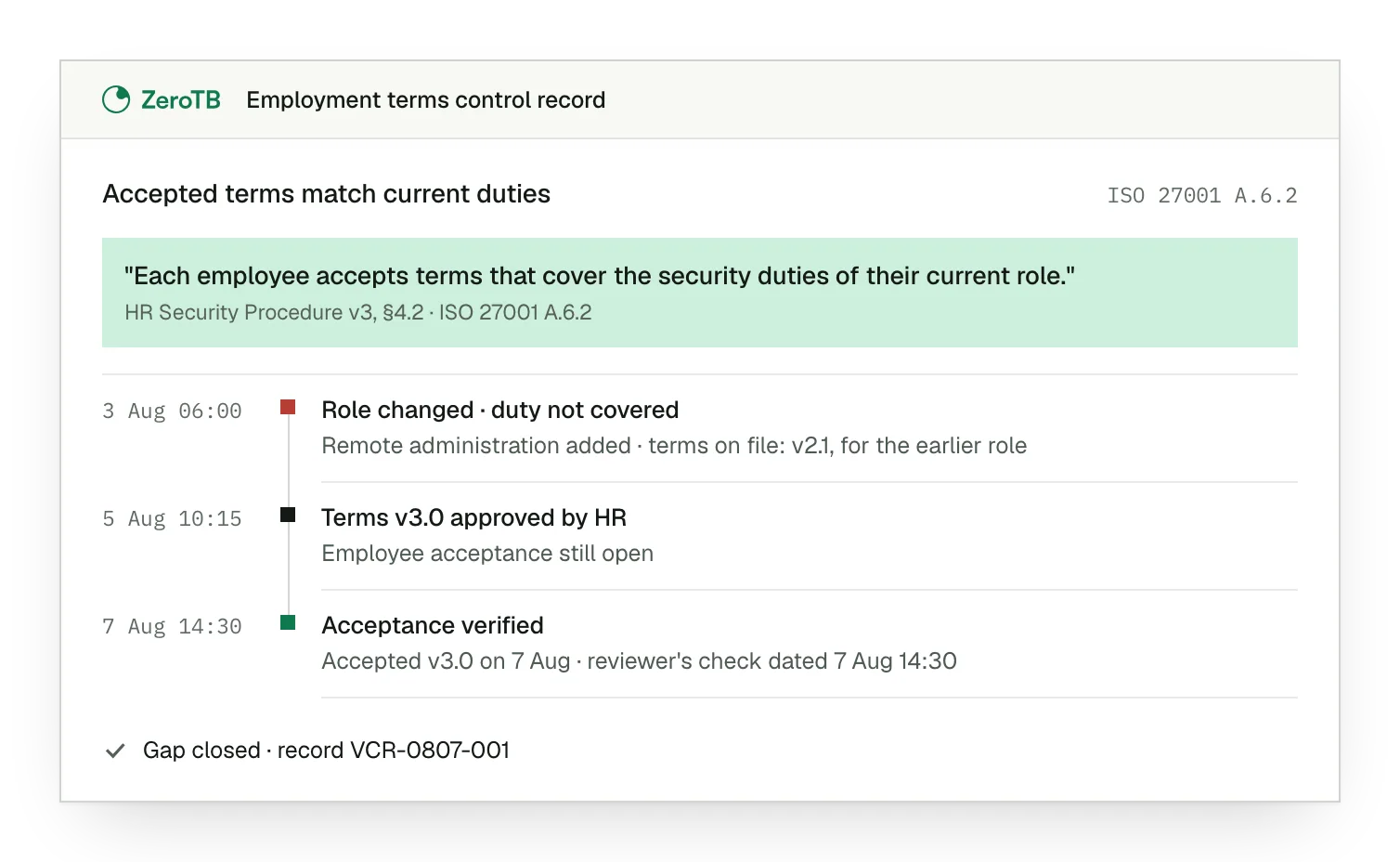
Changed responsibilities. Remote administration appears in the new role, with no corresponding duty in the terms on file.
Approved update. HR has approved the new terms, and the employee’s acceptance remains an open task.
Verified acceptance. The acceptance points to the approved version, with the reviewer’s dated check recorded beside it.
Employment terms review checklist
Choose an agreed security duty and establish which roles, people and employment documents it covers.
Review the agreements for people whose work has changed, using their current roles as the starting point.
Have the authorized owners approve revised terms and decide whose acceptance the change requires.
Check the person and document version against the acceptance record before recording the correction as complete.
Preserve the accepted version and correction history, with an owner assigned to any remaining work.
Sources
- ISO/IEC, ISO/IEC 27002:2022 overview, 2022.
- NIST, SP 800-53 Rev. 5, PS-6 access agreements, 2020, catalog release 5.2.0 issued 2025.
- AICPA & CIMA, Trust Services Criteria with revised points of focus, 2022 revision.
- HHS, HIPAA audit protocol, workforce security, 2018 update.
Related pages
People controls
Read the adjoining controls for security duties as people join, work and leave an organization.
ISO 27001
Place this control in the wider ISO 27001 program, alongside the requirements it helps support.
Compliance frameworks
Browse the framework guides and individual controls for the other commitments your organization has adopted.
Start with the Pilot
Talk with our team about the duties and controls that keep needing attention. In the eight-week Pilot, we map up to 25 commitments and take two real control gaps through approved correction, verified restoration and a record of the work.