What does ISO 27001 A.6.1 require for screening?
ISO 27001 A.6.1 concerns screening people for the responsibilities and information access their work involves. Match checks to role risk and applicable requirements, then connect their completion to the authorized hiring and access decisions. Keep that connection current when assignments change or required checks remain incomplete.
Hiring records and access records can tell different stories. A contractor may already have an account while HR still awaits screening confirmation. The useful question is whether the evidence supports the work that person can do today, including any access granted while checks were pending.
Screening scope
Screening under A.6.1 helps an organization decide whether a person is suitable for the work and information access a role involves. The screening policy sets out which roles it covers. It belongs alongside the other ISO 27001 people controls.
HR needs to know which checks apply before it requests them. Hiring managers need to know who will assess the results. The policy should settle both questions and explain how legal and privacy requirements affect the checks the organization can use.
Role-based checks
Different responsibilities can justify different screening checks. A person with authority to change production systems can affect more than someone who reads a limited set of internal documents. Assess the information involved, the person's authority and the possible consequences of misuse.
Use that assessment to explain why the role needs particular checks. Hiring teams need enough detail to make consistent decisions under applicable requirements. A more extensive check should answer a relevant question about the work the person will be trusted to perform.
Screening responsibilities
Incomplete screening needs a decision-maker who can assess what it means for the role. HR may hold the report and arrange any further checks. The hiring manager and other authorized reviewers decide whether the evidence supports the proposed assignment.
The access owner acts on that decision, including any limits on permissions. They need a clear outcome from the reviewer to do so. If more information is needed, the case should identify who will obtain it and when the reviewer will consider it again.
Contractor screening
Contractor screening needs evidence that covers the assignment and the person doing it. Where a supplier performs the checks, the organization's reviewer needs confirmation against the agreed screening requirements. A general assurance about the supplier leaves the individual assignment unresolved.
The agreement should make clear who performs the checks, what confirmation the organization receives and who handles missing information. When the supplier changes the assigned person, the same handoff needs to work again. The previous contractor's record cannot establish the replacement's screening status.
Hiring and access timing
Access approval needs to take account of the screening status at that time. A start date may be agreed before the checks finish. If account creation follows that date automatically, the person could receive access while the screening decision remains open.
The hiring record, confirmation and access approval should show the order in which those events happened. Compare their dates as well as their status. Where access began before the required decision, the authorized owner needs to assess the gap and decide how to respond.
Changes in responsibility
Screening evidence may need another review when someone changes roles. A person who moves into a position with broader system access may have been screened for quite different work. Their earlier approval gives the reviewer a starting point for that assessment.
Compare the new responsibilities with the ones covered by the existing checks. If the evidence remains adequate, record that decision. If additional checks are needed, record what must happen before the new access can be approved. This also applies to an expanded contractor assignment.
Rescreening conditions
A screening policy needs to explain when the organization will revisit an earlier decision. NIST PS-3 calls for defined rescreening conditions and frequencies. Those choices reflect applicable requirements and the risk of the position. Read PS-3.
In the ISO 27001 program, a role change can prompt that assessment. The reviewer may find that the existing evidence remains sufficient, or decide that another check is needed. The policy should explain the basis for making that choice and recording the outcome.
Missing screening evidence
An absent confirmation calls for investigation: the check may be unfinished, or the record may be missing. HR needs to establish which happened. An account's active status provides no answer to that question, even if the person has already started work.
Record the missing item and assign someone to resolve it, with a date for further review. Keep the case open until the evidence is available. The access owner can use the case record to decide what permissions are appropriate while HR resolves the uncertainty.
Temporary access decisions
The authorized owner must decide what happens to access while a screening gap remains open. The policy and applicable requirements determine the available options. The decision may require access to be delayed or suspended, or allow a restricted arrangement during review.
If limited access is permitted, the approval should describe its boundaries and when it will be reviewed. The system owner implements those conditions. Retain the reason for the decision so a reviewer can understand why that access was allowed at the time.
Verification and closure
The screening review and the resulting access both need to be complete before the gap can close. A report arriving in HR starts the review. The authorized reviewer assesses it and decides what the outcome means for the person's assignment.
The access owner then implements that decision. Verify the permissions against the approved scope, including any restrictions, and keep the dated result with the approval. If a condition remains unresolved, leave it visible so another reviewer can see what still needs attention.
Screening records
A screening record should let an authorized reviewer follow the decision without receiving the person's full background history. Record the role, the checks required and whether they finished. Add the authorized outcome and any conditions that the access owner must implement.
The detailed material can remain with its proper custodians, with a controlled reference from the decision record. That reference lets someone with permission find the evidence when needed. The organization's rules for access and retention apply to the material and the records that refer to it.
Continuing control checks
Checks between audits should look for hiring and role changes without a completed screening decision. Include confirmations still awaited from suppliers. When the same omission appears repeatedly, inspect the handoff: the task may have no owner, or its result may never reach the access team.
ZeroTB assigns people-and-process work from approved commitments and verifies that it is done. Overdue work returns to the responsible person for attention. The control workflow retains the decisions and resulting evidence, while the authorized people continue to make the hiring and screening judgments.
Screening evidence
Use these records to trace a screening case from the applicable policy through the decision and resulting access.
| Requirement | What an auditor asks for | Where it comes from |
|---|---|---|
| Defined screening scope | Which roles require checks, and why those checks differ | Approved screening policy and role descriptions |
| Completed checks | When the checks finished and who accepted their results | Restricted HR records and screening confirmations |
| Contractor coverage | Whether the assigned person's checks cover the agreed requirements | Supplier agreement and person-specific screening confirmation |
| Controlled unresolved cases | What remains unresolved, who decides, and which access is permitted | Open case records and approved access decisions |
| Verified correction | The completed review and verification of the access granted afterward | Review approval and dated access verification linked in the control record |
Related framework requirements
| Framework | Control | What it covers |
|---|---|---|
| ISO 27001 | A.6.1 | Screening matched to role risk, information access and applicable requirements |
| SOC 2 | CC1.4 | Hiring, developing and retaining competent people; screening evidence can support the hiring assessment |
| HIPAA | 164.308(a)(3) | Workforce security, including whether access to electronic protected health information is appropriate; assess evidence within that scope |
Example of resolving a screening gap
In this example, a contractor has production access while the required supplier confirmation is missing. The access owner restricts that access during review. The record follows the missing confirmation through the authorized screening decision and a separate check of the permissions that follow.
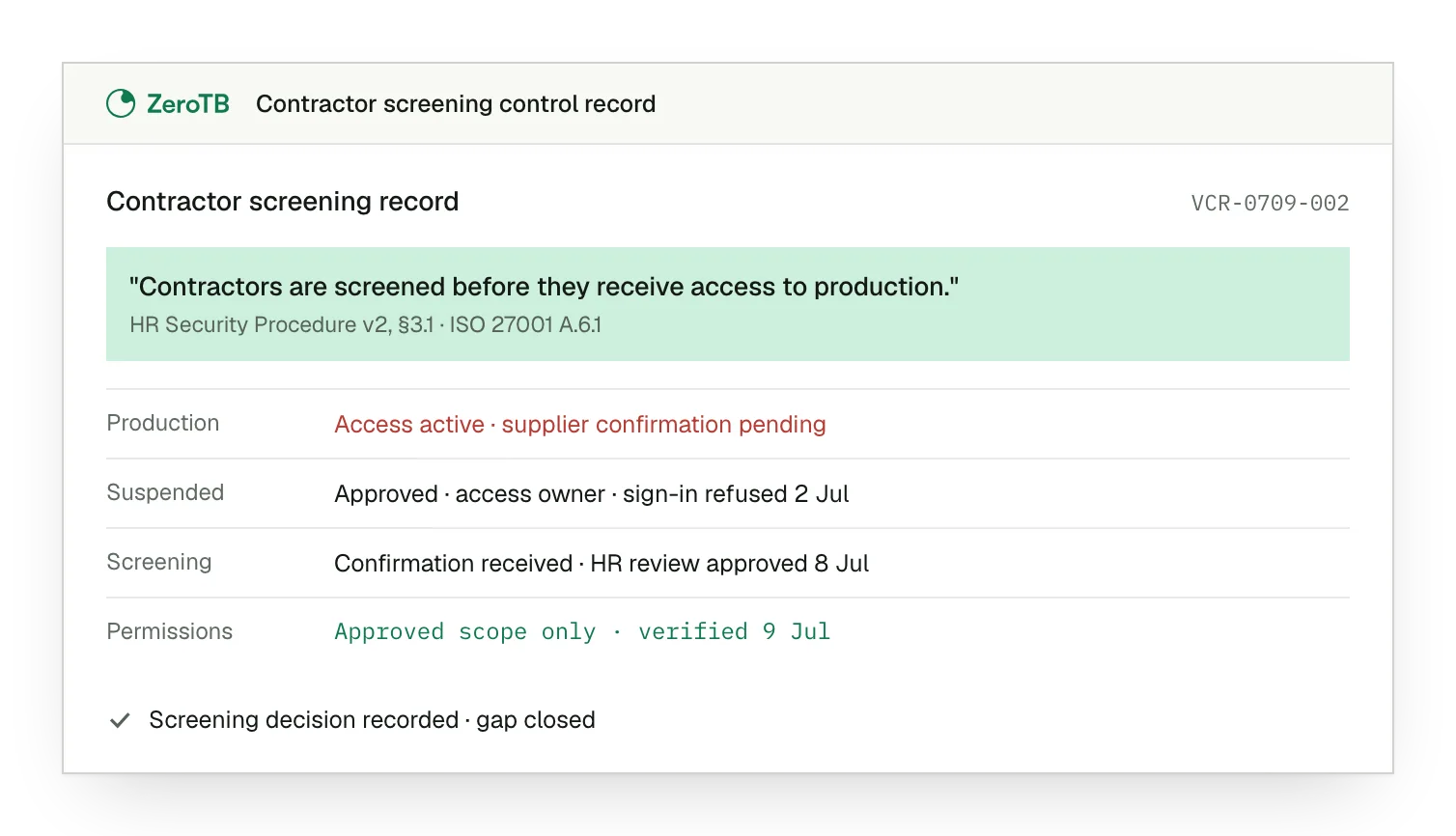
Missing confirmation. The contractor's production account is active, but the required supplier confirmation remains pending.
Restricted access. The authorized owner approves suspending production access while HR obtains and evaluates the missing confirmation.
Completed review. HR receives the evidence, and the authorized reviewer approves the contractor for the agreed assignment.
Verified permissions. The access owner grants only the approved permissions and records the result of verification.
Screening review checklist
Identify the person's responsibilities and information access, then compare them with the screening requirements for that assignment.
Find the completed checks and authorized assessment, including any missing supplier confirmation or unresolved condition affecting access.
Refer gaps to the authorized owner for a decision on further checks and any access restrictions.
Confirm that permissions match the approved outcome, and retain the dated result with the screening decision.
Identify how the gap arose and assign the process correction that will make similar omissions visible.
Sources
- ISO/IEC, ISO/IEC 27002:2022 overview, 2022.
- NIST, SP 800-53 Revision 5, PS-2 and PS-3, 2020, including December updates.
- HHS, HIPAA audit protocol, workforce security, updated 2018.
- AICPA & CIMA, Trust Services Criteria with revised points of focus, 2022 revision.
Start with the Pilot
Talk with our team about the control gaps that keep returning. In the eight-week Pilot, we map up to 25 commitments and take two real gaps through verified restoration. The Verified Control Record retains the action, approval and result of each correction.