Policy as code
Policy as code expresses requirements as rules that software can check. ZeroTB uses those checks to keep compliance controls working after the audit. Our team handles the control work across your systems, so compliance and engineering can resolve gaps without building a separate compliance engineering function.
Works with the stack you already run


Rules without a completed repair
A failed policy check leaves a repair for someone to handle. It might concern missing reviews in a repository or a cloud setting that changed after the audit. The check identifies the failure; someone still needs to investigate it and restore the control.
System settings change
Policy checks find gaps
Control failures remain unresolved
Compliance engineering after the audit
ZeroTB handles this work for teams that cannot justify a dedicated compliance engineering function. We use the commitments in your reports and policies to put compliance as code into daily operation. You retain the decisions about material changes and exceptions; our team handles investigation and repair.
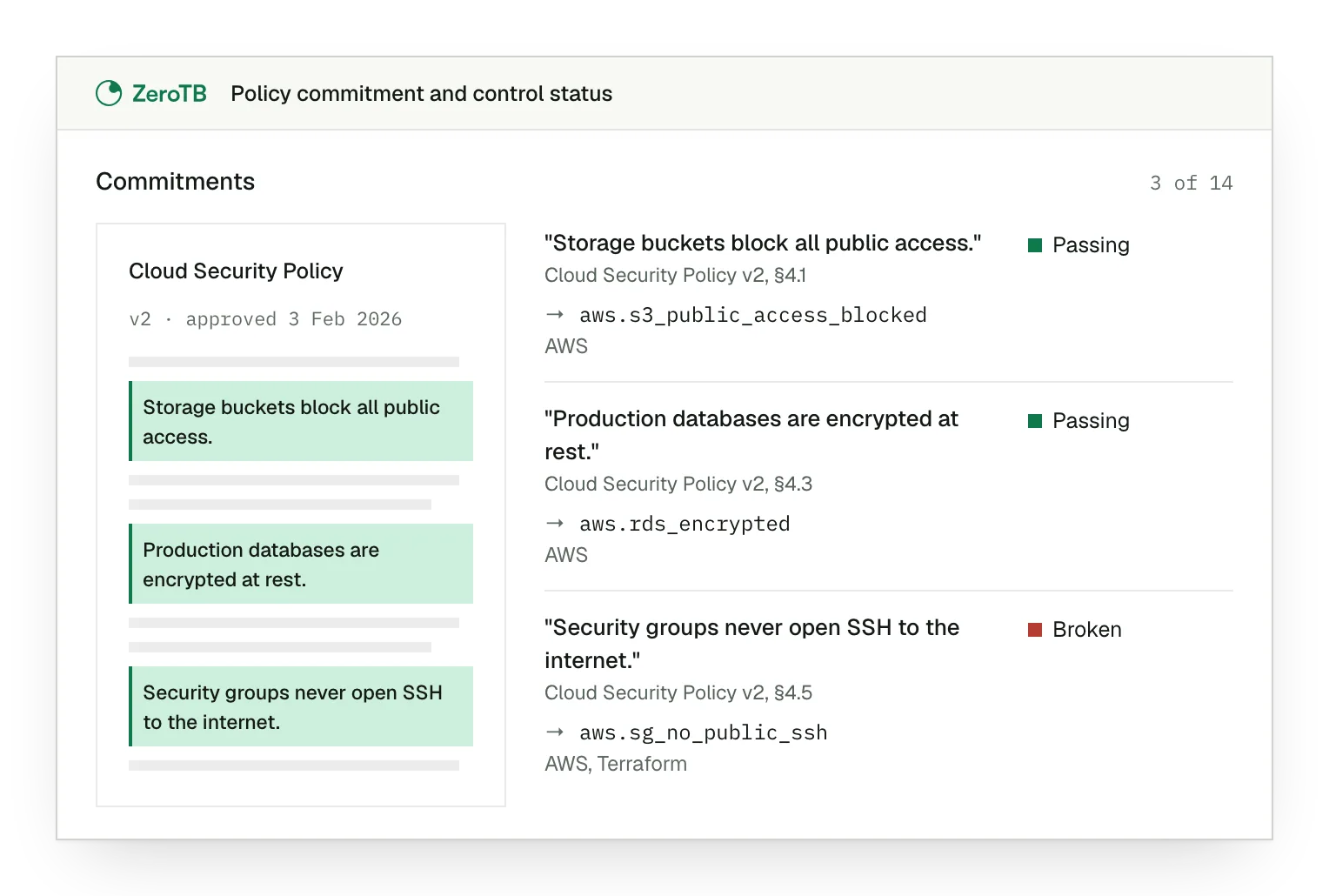
Checks follow the company's approved commitments
Control gaps get an owner and response
People authorize changes that affect their systems
From policy to verified operation
We read your reports and policies, identify commitments for approval, then check the systems those commitments cover.
We draft the response that fits the gap: a runbook, pull request, API action or guardrail. People authorize material actions.
We recheck the system before closing the finding. The signed record keeps that result with the repair and its approval.
Example of repairing a cloud configuration
A cloud repair record lets a reviewer see whether production meets the policy after a configuration change. For example, a repair made through an infrastructure-as-code pull request leaves the requirement and the resulting system state together in a Verified Control Record.
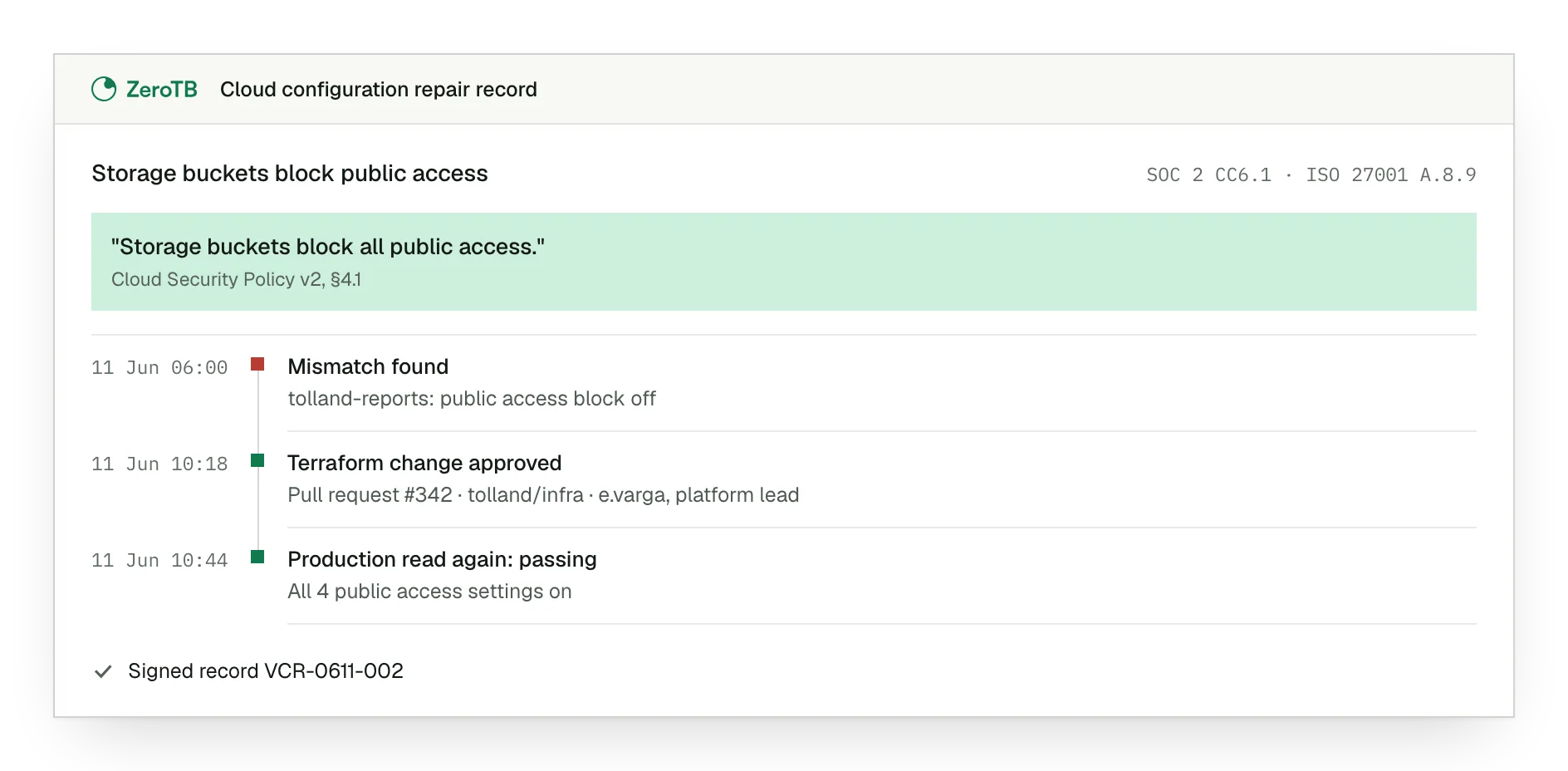
Source requirement. The record identifies the approved commitment that applies to this production configuration.
Earlier mismatch. The earlier observation shows where the cloud setting differed from the approved requirement.
Approved change. The repair entry connects the infrastructure change with the approval that authorized it.
Checked result. The later observation shows whether production meets the requirement after the repair.
Evidence for the compliance program
ZeroTB holds the record of commitments, checks, repairs and evidence for the compliance program. ZeroTB gives you portable evidence for the controls repaired, which auditors can also inspect directly in ZeroTB. Where frameworks share a control, the same repair can support SOC 2, ISO 27001 and HIPAA requirements.
Each record connects the requirement and result
Signed evidence stays available for later review
Shared controls can support several frameworks
Talk to our team
We can talk through the control work your checks uncover and how ZeroTB could help your compliance and engineering teams.
FAQ
How are ambiguous policy requirements handled before they become rules?
Your team approves the meaning and scope of a commitment before it becomes an operating rule. AI helps interpret the policy, but people decide what it requires in the company's circumstances. They also retain responsibility for legitimate exceptions.
Does a passing AI assessment establish that a control works?
No. AI can investigate a gap and propose a conclusion. ZeroTB uses approved logic to operate the control and checks the resulting system state before it closes the finding. The record distinguishes the human approval from the work the software performs.
Can we assess policy gaps before granting permission to change systems?
Yes. ZeroTB starts with read-only access. Your team grants write permissions separately by action class and can revoke them. Material changes use reviewed pull requests by default; direct API actions require opt-in, a way to reverse the change and limits on the systems affected.
How does ZeroTB handle commitments that need someone to do the work?
ZeroTB can schedule work from the commitment, assign an owner, escalate overdue tasks and verify completion. This applies to activities such as training, vendor reviews and incident exercises. The compliance program can therefore cover work beyond configuration rules.
How should we interpret a check with no current system data?
ZeroTB shows unknown, stale and disconnected states when observations cannot establish that a control works. A missing observation remains visible as a gap in evidence. It cannot support a healthy status, even if an earlier check passed.
Can policy enforcement prevent the same control gap from returning?
A preventive guardrail can address some recurring gaps. For example, branch rules can require reviews and delivery gates can require tests. ZeroTB proposes the response for the affected control, and people authorize material changes within the agreed permissions.
Related pages
Start with the Pilot
The eight-week Pilot maps up to 25 commitments from your report and takes two real control gaps through verified restoration. You receive working controls and portable evidence, with results from your own systems to review with our team.