A compliance automation platform should reduce the work of keeping controls in operation, including the repairs that follow a failed check. During an evaluation, follow a failure through investigation, approval and verification. Use the work left with your team to judge whether the platform addresses the capacity you need.
After an audit, a missing repository rule can send the same people back to the same problem. Compliance asks what changed. Engineering investigates, restores the setting and replies to the ticket. Someone then needs evidence that the required protection works again.
Automated evidence collection can help with the last request while leaving much of that work untouched. This is why a platform demonstration needs to follow a failure. Seeing the response makes it easier to judge what the software and service would take off the team's hands.
Compliance automation platforms
A platform may collect evidence and test controls while leaving repairs to the customer. Another may include people who investigate and coordinate corrections. Both can be sold as compliance automation, so the useful comparison is the work each completes after a failure.
NIST's continuous monitoring guidance describes visibility into control effectiveness as information for a timely response to risk. The response still needs an owner. During a demonstration, ask the provider to identify that owner and explain what the service handles before it hands work to the team.
Commitment scope
The requirement behind a check needs to be specific enough to test. A company policy may apply to a particular group of repositories or accounts. The provider needs that scope, the source clause and the expected result to determine whether the control operates.
A generic framework label cannot settle those details. Ask to see how the proposed check represents the approved requirement, including any exception. This is where a buyer can discover that a connection supplies useful data but covers only part of the promised protection.
Detection timing
An alert can arrive only after the software observes a change and evaluates it. Scheduled checks and checks triggered by system events have different delays. A claim of immediate detection needs evidence of the event source, evaluation time and alert delivery.
Compare those times for the controls that matter to the buying decision. Daily checks can support recurring oversight, while a requirement for faster detection needs an appropriate observation method. The evaluation should distinguish the time a control failed from the time the software discovered it.
Missing observations
Missing evidence should leave a visible gap in the control's status. An expired connection or an old observation cannot establish the present state. Automated compliance software should distinguish a failed check from a check it could not complete, with the last observation available for review.
That distinction affects the response. A failed control needs investigation of the system; an unavailable observation needs the connection or collection problem resolved. Treating both as a generic alert makes it harder to assign the right work and understand what remains unknown.
Repair ownership
A repair needs an owner who follows it through the handoffs between compliance, IT and engineering. Sending a ticket to another team can leave the original requester chasing the diagnosis and the completion date. Include that coordination when comparing automated compliance tools.
The service description should say who investigates, proposes the correction and follows the work to completion. These responsibilities determine how much the service takes off the team. The system owner still needs enough information to approve the change and decide whether an exception has a legitimate purpose.
Security automation
Security automation needs permission that matches the action it will perform. Diagnosis can begin with read-only access. Once the proposed repair is understood, the responsible person can authorize a runbook, review a pull request or approve a change through the system's API.
Direct API actions need a defined scope and a way to reverse the change. They also need an explicit decision about when they are allowed. The SOC 2 automation guide develops these approval boundaries, including cases where a person must judge the proposed correction.
Verification after a change
A successful action still needs a separate check of the resulting control. An accepted request or completed ticket records progress, but the pass condition concerns how the system behaves afterward. Verification should inspect that behavior against the approved requirement before the gap closes.
If the check fails, or the resulting state is unavailable, the record should remain open. A reviewer needs to see the observation supporting closure and its date. This makes it possible to distinguish a completed repair from an action that still needs investigation.
Control work and records
An automated compliance platform should keep commitments, checks, repairs and audit evidence together. ZeroTB combines daily checks with a service that handles approved restoration and returns a signed Verified Control Record. ZeroTB keeps that record with the commitment and checks.
The record connects the commitment, before-and-after state, action, approval and verification. That evidence can support several framework requirements where they depend on the same control. The compliance software guide explains how program records, evidence collection and control operations fit together.
Compliance costs
Compliance costs include the work that remains after the software subscription is paid. Implementation, connection maintenance, investigation and repair all consume capacity. A lower evidence-collection workload can coexist with an unchanged repair backlog, so the evaluation needs to account for both.
Compare the same tasks before and during a trial, including time spent waiting for another team. Retain unresolved work in that comparison. Otherwise, a trial can appear efficient because difficult cases stayed open while easier cases supplied the evidence of completion.
Hiring based on the work that remains
Whether automation avoids another hire depends on the work behind the hiring request. A team short of time for recurring investigations has a different need from one without security leadership. Both may be keeping SOC 2 and ISO 27001 current, but the missing capacity differs.
A compliance analyst can handle evidence and program administration. A virtual chief information security officer, or vCISO, provides leadership and risk judgment. An engineering service can investigate and restore controls. Compare those contributions with the remaining workload before treating software as a substitute for the proposed role.
Changes to coverage
A company can add systems after the original checks are configured. The provider needs a way to identify new repositories, services and access routes that fall under existing commitments. Ask how it proposes changes to the approved scope when those additions appear.
Repeated failures create another kind of maintenance work. Repairing a setting addresses the present gap, while an approved guardrail may prevent the same change from breaking it again. If recurrence is consuming staff time, the evaluation should cover who investigates that pattern and develops the guardrail.
Service trials with difficult control failures
Test the service on a few real failures that represent the work the team wants help completing. An easy correction alone tells little about the cases that wait for engineering attention. Include one of those cases and follow its outcome during the evaluation.
The final record should let a reviewer understand what was corrected and why the work closed. Alongside that record, compare the effort staff still spent with the capacity another hire would provide. This gives the buying decision a basis in completed work and remaining responsibility.
Example of restoring a review requirement
This example follows a repository that permits changes without the review required by its policy. The owner approves a correction to the rule. A subsequent check tests whether review is enforced again, giving the person closing the gap evidence of the result.
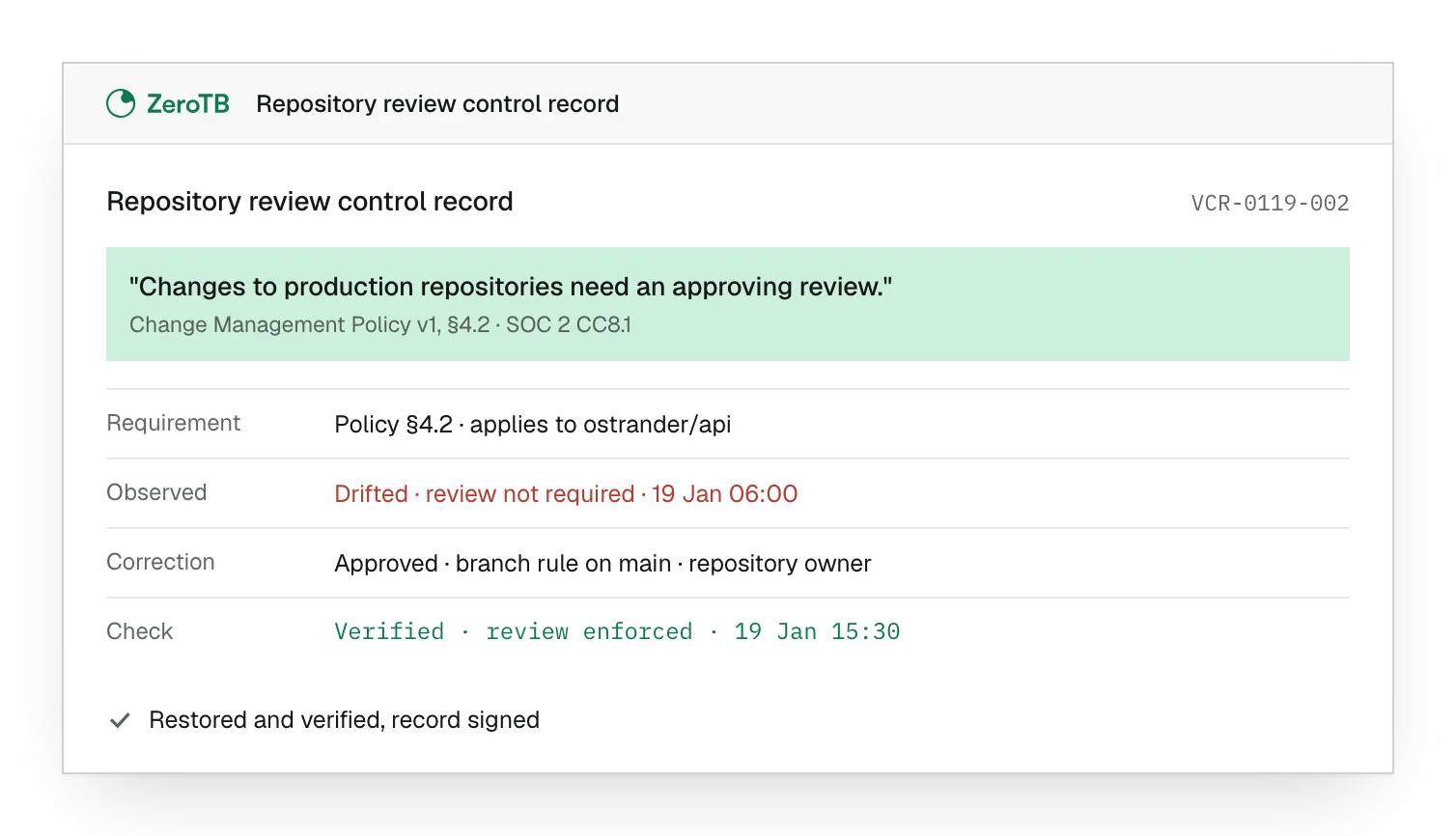
Approved review rule. The source policy requires review, and the record shows which repository falls within its scope.
Observed enforcement gap. The observed repository permits changes without the review that its approved policy says must happen.
Authorized rule restoration. The proposed change identifies the affected repository and rule so its owner can approve the correction.
Verified enforcement result. The check records when review enforcement returned, linking the observed result to the approved correction.
Platform evaluation checklist
Select a check and ask which approved clause it tests, where it applies and what counts as passing.
Ask when the source is checked and how the result changes if its connection stops supplying observations.
Follow the handoffs after a failure and establish who is responsible for completing the work at each one.
Review the actions the provider may take, the approval each requires and the means of reversing direct changes.
Read a completed record with the reviewer who will use it, then compare staff effort before and during the trial.
Sources
Related pages
Coding-agent compliance
See where agent-made changes can affect the engineering controls covered by an existing compliance commitment.
Healthtech compliance
Read about maintaining access and engineering controls in healthtech, including the evidence available after a repair.
Compliance software
Understand how tools for compliance records and evidence relate to the work of keeping controls operating.
Start with the Pilot
In the eight-week Pilot, our team maps up to 25 commitments and takes two real control gaps through approved correction to verified restoration. We can talk through the recurring work and where you need help.