Continuous compliance
ZeroTB helps your team maintain compliance controls throughout the year. We check the requirements in your reports and policies against your systems and handle the repair work when controls fail. Compliance, IT and engineering spend less time coordinating that work, while your people keep authority over material decisions.
Works with the stack you already run


Controls between audit reviews
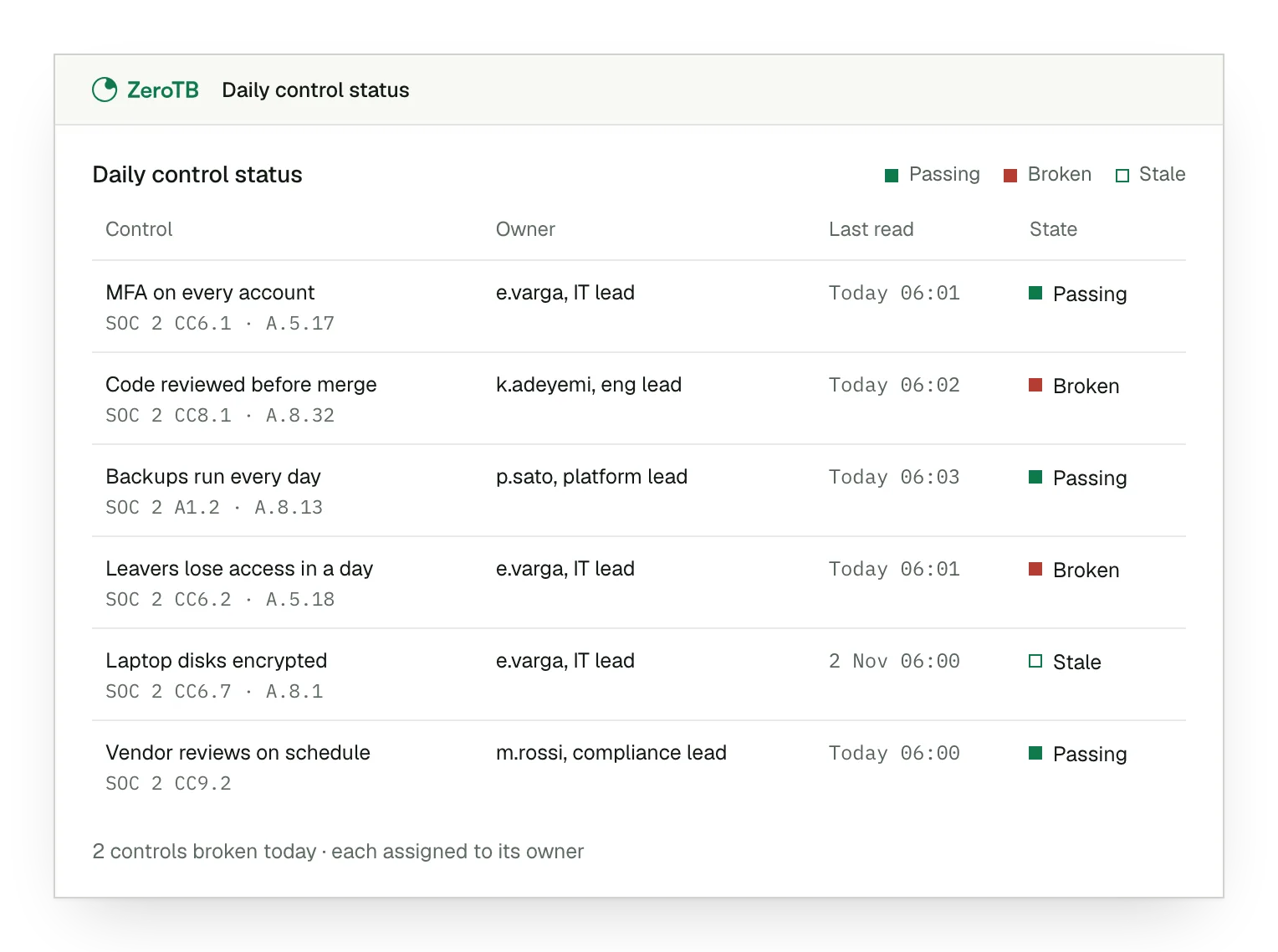
Changes to accounts, devices and development workflows can leave controls failing between audit reviews. An account can retain access after someone leaves, or a repository can lose required protections. These failures can remain unresolved until the next review, even though the written requirements have stayed the same.
Systems and access change
Required safeguards stop working
Failures reach the next review
Ongoing checks and repairs
We read the commitments your team approves and check them against the relevant system settings and activity.
We draft a repair for approval, using a runbook, pull request or action with limited permissions.
We check whether the repair worked, preserve evidence of the result and then close the work.
Evidence for ongoing reviews
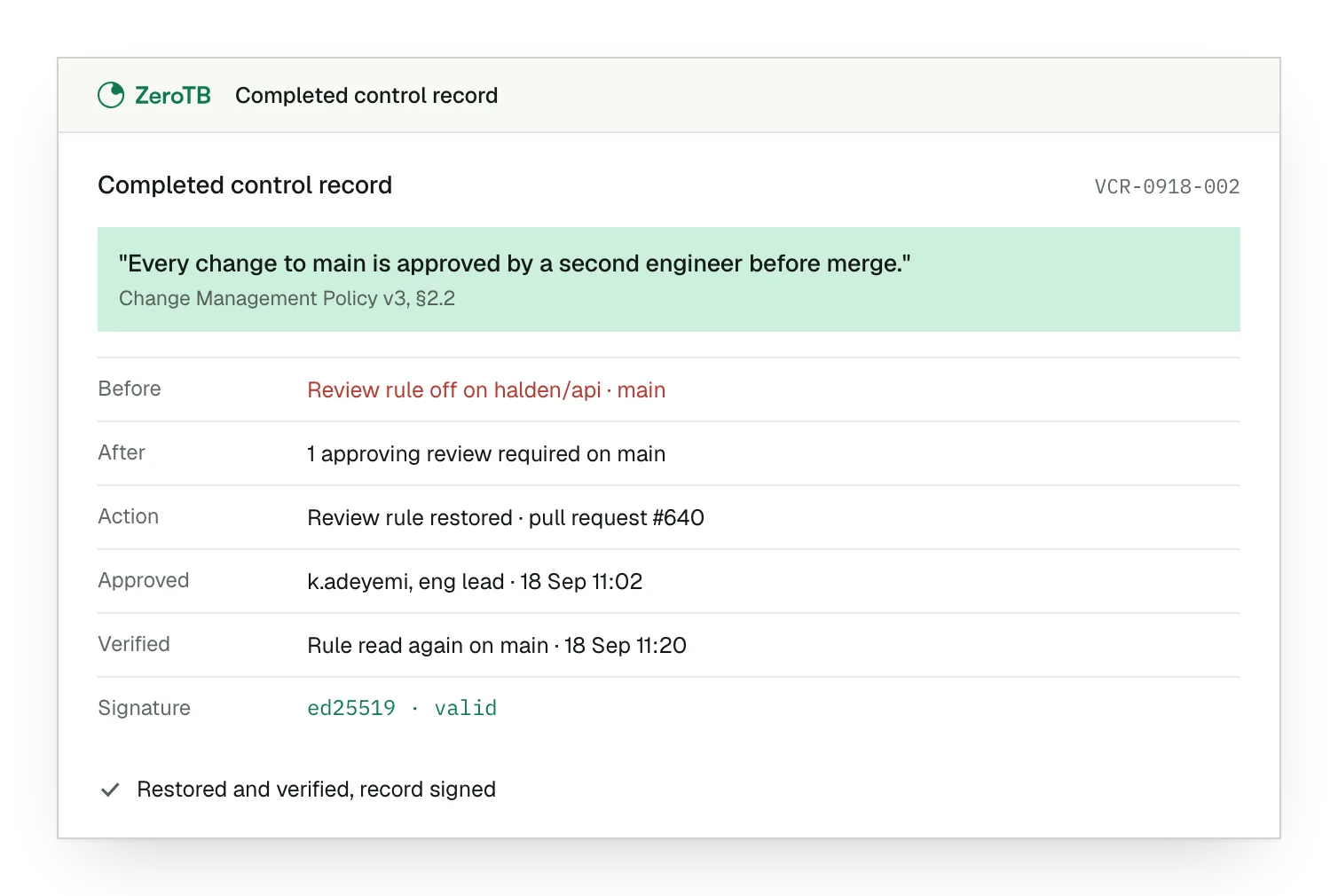
The Verified Control Record lets an auditor examine what happened during a repair. It keeps the requirement, approval and verification together for that review. Compliance can retain a signed copy, while the auditor can also read the record directly in ZeroTB.
Choosing continuous compliance tools
Continuous compliance tools need a clear way to handle the work after a failed check. ZeroTB carries that work through with your team and keeps the commitments, checks and repair evidence together. Our monitoring tools guide explains the response capabilities to assess.
Each failure has a responsible owner
Material changes require human approval
Closure requires evidence that the repair worked
Talk to our team
Talk with our team about recurring control failures, the follow-up they create, and how ongoing support could fit your compliance program.
FAQ
Can ZeroTB help if we have no compliance engineering team?
Yes. Our team works with regulated technology companies that cannot justify a dedicated compliance engineering function. ZeroTB handles checks and repairs with the people responsible for the systems. Your team decides which material actions to approve.
Can the same control support several compliance frameworks?
Yes. A control can meet requirements from SOC 2, ISO 27001 and HIPAA. ZeroTB works on the controls beneath those requirements. When several frameworks depend on the same control, its verified repair can provide evidence for each applicable requirement.
Does ongoing support cover scheduled reviews and training?
Yes. Training, vendor reviews, incident exercises and policy reviews are part of the people and process controls ZeroTB covers. The commitment sets the schedule. ZeroTB assigns the work, escalates it when overdue and checks that it has been completed.
Does every requirement need a daily check?
No. The cadence comes from the commitment and the work it governs. Daily checks can suit a technical setting; a scheduled review has its own due date. ZeroTB retains the cadence with the requirement so those different obligations stay explicit.
How does a lost system connection affect the reported control status?
A lost connection leaves ZeroTB without the observation it needs to assess the control. Unknown, stale and disconnected states remain visible. A control can only receive a healthy status when a check supports that conclusion.
Can we limit which changes ZeroTB can make?
Yes. Access begins read-only, and write permissions apply to specific action classes. Those permissions can be revoked. Pull requests are the default for material changes. Direct API actions require opt-in, must be reversible and have limits on what they can affect.
Who decides whether a control exception is acceptable?
Your team decides. AI can help interpret a requirement and investigate why a control failed, but people own legitimate exceptions. The decision to accept an exception remains separate from the check that establishes whether the control is working.
Can ZeroTB support the program after the Pilot?
Yes. Control operations continues the checks and repairs between audits. As accounts, devices and software change, ZeroTB helps maintain the controls that apply to them. The service supports the continuing work of your compliance program after the initial engagement.
Start with the Pilot
The Pilot gives your team working controls and portable evidence from two real repairs. Over eight weeks, ZeroTB maps up to 25 commitments from your report and takes two control gaps through verified restoration in your systems.