The choice between SOC 2 and ISO 27001 starts with the document your customer needs: an independent controls report or management system certification. Pursue the assurance they accept for the service they buy. When both are required, one platform can hold shared controls and evidence, with separate scopes and assessment requirements.
One sales conversation ends with a request for a SOC 2 report. The next customer asks for an ISO 27001 certificate. Meanwhile, the security team already reviews access and approves changes. That work gives the company a starting point for either assessment.
Assurance documents
SOC 2 results in a report issued by a CPA firm. It describes the service organization's controls and the auditor's conclusions. With a Type 2 report, the customer can also read the tests and results for the period examined, including any exceptions identified.
ISO 27001 certification applies to a defined information security management system. A certification body assesses that system, and the certificate identifies its scope. These are the two forms of assurance covered by the AICPA overview and ISO overview.
| Area | SOC 2 | ISO 27001 |
|---|---|---|
| Result | Independent attestation report | Certificate for a defined management system scope |
| Basis | Applicable Trust Services Criteria | ISO/IEC 27001 requirements |
| Assessment provider | CPA firm | Certification body |
| Main subject | Controls within the described service organization system | Information security management system and how it operates |
Customer requirements
The first assessment should produce a document the customer can use to approve the purchase. Ask which service needs coverage and when they need the document. Their answer determines whether a proposed assessment will satisfy the request behind the deadline.
For a SOC 2 Type 2 request, that conversation should settle the categories and examination period. For ISO 27001, it should settle the certification scope. If another document is available sooner, the customer needs to agree that it meets their requirements before the team changes direction.
Scope boundaries
Both programs need a clear boundary around the services, systems and activities being assessed. Compare the SOC 2 system description with the ISO 27001 management system scope. Identify which applications, teams and supporting services sit within each boundary before deciding what can be shared.
An access review covering one product may leave another product's accounts unexamined. If the second product falls within the other program's scope, the review needs additional coverage. A shared policy can guide both reviews, while their account lists and evidence reflect the systems assessed.
Shared controls
Access reviews, account removal and change approvals can support both programs when their requirements cover the same work. Start with the activity already performed, its owner and the systems it covers. Then connect that activity to the relevant requirements in each program.
Keep the reason for each mapping alongside the control. A similar control title is insufficient to establish equivalent coverage. Where one requirement calls for additional systems, approvals or records, include that work in the operating process and retain evidence that shows it happened.
Evidence for both assessments
Evidence can serve both assessments when it shows the required activity, systems and period for each. Retain its source, date and coverage with the applicable requirement. These details let an assessor judge whether an existing record answers the question under review.
A current account export shows who has access now. An access-removal record also needs to explain when removal was due and what happened. For historical testing, retain the observations and decisions from that period. A later successful check cannot establish how the control operated earlier.
One platform for both programs
One compliance platform can support SOC 2 and ISO 27001 if it preserves each program's scope, requirements and evidence. Test it with one shared control: follow both requirements to the operating activity, its evidence and any unresolved exception. A reviewer should see what each record establishes.
A separate tool can be useful when it observes another system or performs work the main platform cannot handle. Agree where the authoritative record lives and how results reach it. Two framework subscriptions provide little value if teams still reconcile conflicting control states by hand.
Separate assessment work
A second assessment brings questions the first program may not have answered. SOC 2 examines a described system against applicable Trust Services Criteria. ISO 27001 assesses the management system's approach to information security risks. Evidence reuse has to account for those different purposes.
For a team adding ISO 27001, existing technical controls provide part of the work; management-system and risk decisions also need attention. For a team adding SOC 2, the system description and selected categories determine the examination's coverage. Review the gaps before assuming the existing evidence is sufficient.
Preparation and timing
An assessment date is useful only when the work leading to it is clear. Identify controls that need correction and records that are missing. Then separate preparation, evidence collection and assessment in the schedule. Agree the scope early so missing coverage can be addressed before fieldwork.
A SOC 2 Type 2 schedule includes the examination period, followed by reporting. An ISO 27001 schedule includes management-system implementation and certification assessment. Discuss these dependencies with the assessor before promising a delivery date to a customer. Assessor availability and unresolved gaps both affect the plan.
Cost of continuing work
Operating controls takes time from people who also have other jobs. Include that time in the budget, alongside tools, preparation, specialist support and independent assessment fees. Compare proposals against the same systems and teams, with responsibility for collecting evidence and correcting failures made explicit.
Evidence reuse reduces duplicate collection only where both assessments accept the coverage. There will still be separate requests to answer and system changes to review. The useful cost comparison includes that continuing work. A lower subscription price may leave more of it with engineering and compliance.
Control ownership
Someone needs to resolve failures wherever a shared control operates. When a new application enters the company, the existing access-removal process may miss it. Its owner needs to establish which checks cover the application and who can remove access when a check finds a gap.
ZeroTB handles continuing checks and verified restoration against approved commitments, keeping the commitments, checks and repair evidence together. The Verified Control Record keeps the action and approval with the commitment and before-and-after evidence. Framework mappings can refer to that record for the systems and accounts the correction covered.
Example of account removal evidence for both programs
Removing one account can produce evidence that serves both programs. Here, a contractor has left but retains repository access. The repository is in both scopes, and both mappings refer to the same departure rule. The record shows the gap, the decision and the checked result.
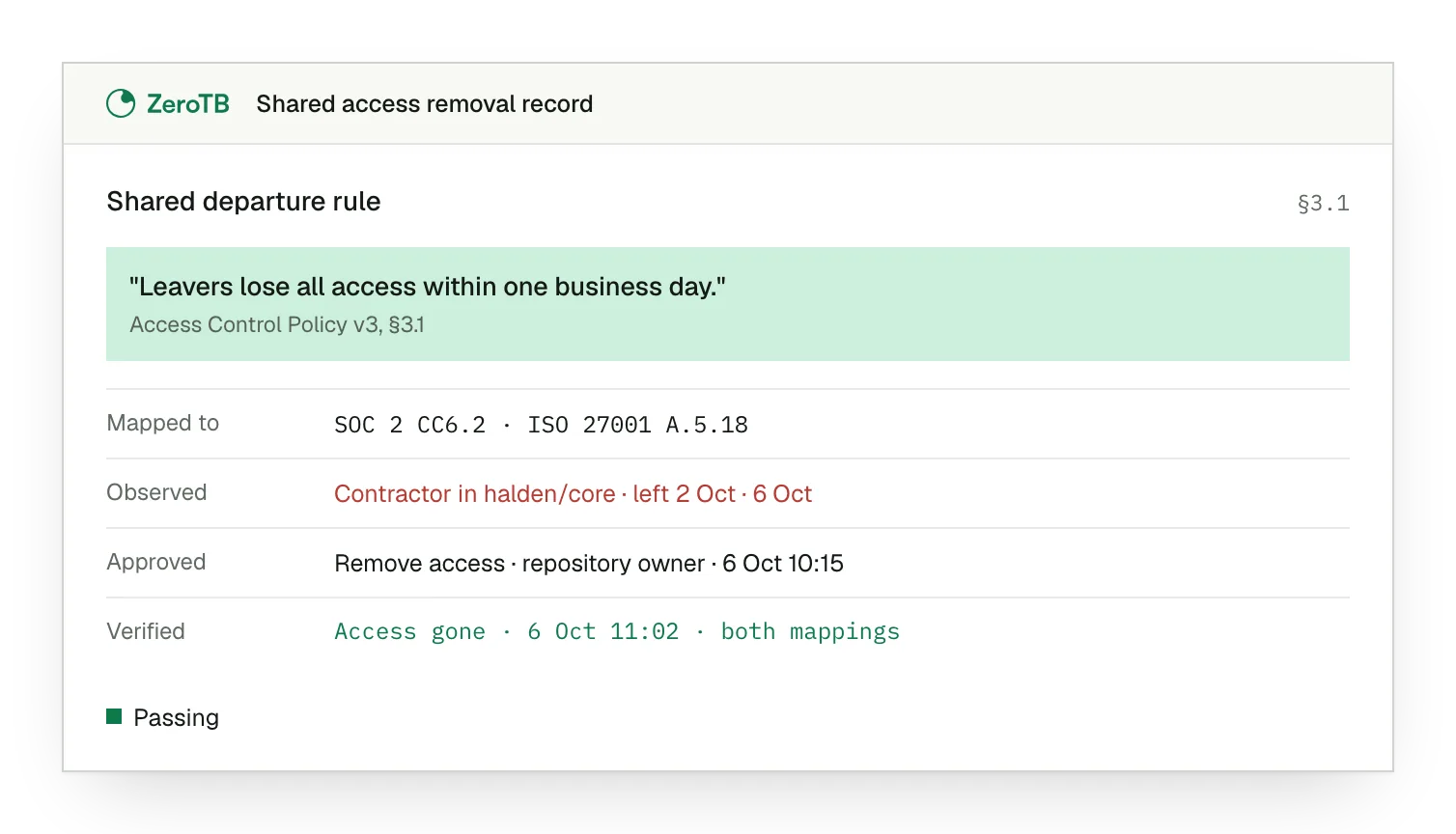
Shared access rule. The departure rule appears beside its mappings, establishing why this account matters to both programs.
Remaining repository access. The departure date has passed, and the account still appears in the repository's current access list.
Approved access removal. The owner checks the contractor's assignment, confirms it has ended and approves removal of repository access.
Verified shared evidence. The next check confirms removal; its timestamp and result remain attached to the correction and both mappings.
Framework planning checklist
Establish the document, service coverage and timing that the customer needs before choosing the first assessment.
Identify which systems and teams both programs cover, including any additional coverage the second program needs.
Trace one control through both requirements and check whether its records establish the activity, coverage and period required.
Identify who investigates failed checks, who approves corrections and how new systems enter the control's coverage.
After an approved correction, retain dated verification with the original gap and connect it to each applicable requirement.
Sources
- AICPA & CIMA, System and Organization Controls: SOC suite of services, accessed 2026.
- AICPA, SOC 2 report review checklist, accessed 2026.
- ISO, ISO/IEC 27001:2022 overview, 2022 edition, accessed 2026.
Related pages
SOC 2
Explore the criteria and operating controls that support the service covered by a SOC 2 report.
ISO 27001
Connect information security management with controls that continue to operate as systems and teams change.
User access reviews
Follow access decisions through the account changes and checks needed to establish that approved permissions remain.
Start with the Pilot
Talk with our team about keeping shared controls working. The eight-week Pilot maps up to 25 commitments and takes two real control gaps through approved correction and verified restoration, with evidence records you can retain in your compliance program.