A SOC 2 readiness assessment identifies gaps in a service's controls and evidence before the independent examination. Review the scope, how each control is designed and how it operates. The findings should make the next decision clear: what needs correction, who can approve the work and which check will show that the gap has closed.
A policy can be approved while the system it describes behaves differently. That discrepancy matters when an audit approaches. The readiness reviewer follows the written rule into the actual work, then records the differences and the evidence needed to explain them.
Assessment outcome
Management needs a usable account of the work left before the examination. For each finding, the reviewer should explain what was examined, what happened and why it needs attention. The person responsible for the correction can then act from that record without repeating the investigation.
The independent examination is where the auditor issues an opinion under the AICPA's SOC reporting framework. The readiness report helps management prepare for that work. It should identify unresolved corrections and evidence needs that could affect the examination plan, giving management specific issues to discuss with the auditor.
Service scope
The assessment covers the service intended for examination, including the people and systems that support its commitments. This includes relevant applications, infrastructure and providers. The reviewer first establishes how they contribute to the service, then selects the controls and records to examine.
The last audit's scope helps with a repeat assessment, provided the reviewer checks what has changed since then. New applications and delivery processes need attention. So do changes in responsibility: the written control may remain the same even after the person who performed it has moved on.
Control design
Each control needs an observable condition or activity that fulfills an approved commitment. The Trust Services Criteria provide the basis for evaluating controls. The company's control description explains how its own systems and processes meet the relevant requirement, with enough detail to test that explanation.
A reviewer should be able to find the pass condition, affected systems, frequency and exception authority in that description. The owner resolves any uncertainty before testing begins. The SOC 2 framework guide explains how the criteria relate to the controls a company operates.
Operating checks
The assessment must examine how a control runs in the systems and processes it covers. Interviews with the people doing the work help explain the sequence and responsibilities. System observations, completed reviews and activity records then show whether that explanation matches actual practice.
Each check also needs a clear limit. A review of selected records supports a conclusion about what was examined; other systems or activities may still need attention. Missing access to a source, an outdated observation or a disconnected integration should remain visible in the findings.
Evidence coverage
Evidence needs to identify the system, activity and period behind the readiness conclusion. A current setting shows the state observed today. Records of earlier reviews or changes answer a different question: whether the required activity occurred when the control said it should.
That distinction affects audit planning. A correction made today cannot establish that a control operated earlier. The assessment should identify missing periods or activities and the records available to investigate them. The team can then discuss the remaining evidence needs with its auditor before settling the examination plan.
Finding types
A missing control, a failed control and missing evidence require different corrective work. A missing control needs an approved design and a way to operate it. A failed control needs a correction to the activity or system condition that departed from the agreed rule.
Missing evidence calls for investigation into what happened and which records can establish it. The activity may have occurred, or the gap may reveal a missed task. Recording that distinction keeps a documentation request from obscuring an operational failure and gives the owner a specific question to resolve.
Remediation priorities
Priority depends on the affected commitment, the risk and the work that other corrections depend on. An incomplete system inventory can delay several checks because their coverage remains uncertain. Resolving that dependency may advance readiness further than completing several isolated documentation tasks with little effect on other controls.
Each finding needs an owner who can arrange the correction and identify the person authorized to approve it. Planned completion dates should reflect those dependencies. Where management accepts an exception, the record should explain its scope, safeguards and review conditions so the readiness conclusion remains understandable.
Closure tests
A finding closes when a check establishes the agreed result and the record explains what changed. Define that result before approving the correction. After the change, verification should establish that the intended control works and that necessary service or access remains available to its users.
Keep the original observation, approved action and dated verification together. A periodic activity may also need evidence from its next scheduled occurrence. The completion of corrective work and the availability of operating evidence can therefore have different dates; the finding should make that difference clear to the reviewer.
Review approach and timing
An internal review works best when the reviewer understands both the criteria and the service being assessed. Outside assistance can help resolve unfamiliar requirements or disputed scope. In either approach, the review needs access to people who understand the controls and can explain their operation.
Begin early enough for findings to change the plan. The time required depends on the controls already operating, the corrections needed and the evidence still to accumulate. A new control may need a longer preparation period than a configuration repair whose resulting state can be checked immediately.
Readiness after the assessment
Readiness can change as soon as the systems behind an assessment change. Controls exposed to frequent changes need continuing checks and someone responsible for investigating failures. Coverage also needs attention when the company adds a system or revises the commitment that a check was built to test.
This is the continuing work ZeroTB carries through approved repairs and verification. Its Verified Control Record keeps the result of that work with the original commitment. The compliance lead can follow findings into verified corrections, with the commitments, checks and repair evidence together in ZeroTB.
Example of restoring production repository review requirements
In this example, a production repository allows changes without the review required by the company's policy. The readiness finding stays open through the approved correction. Verification tests both an unreviewed change and an approved change before the reviewer accepts the restored control.
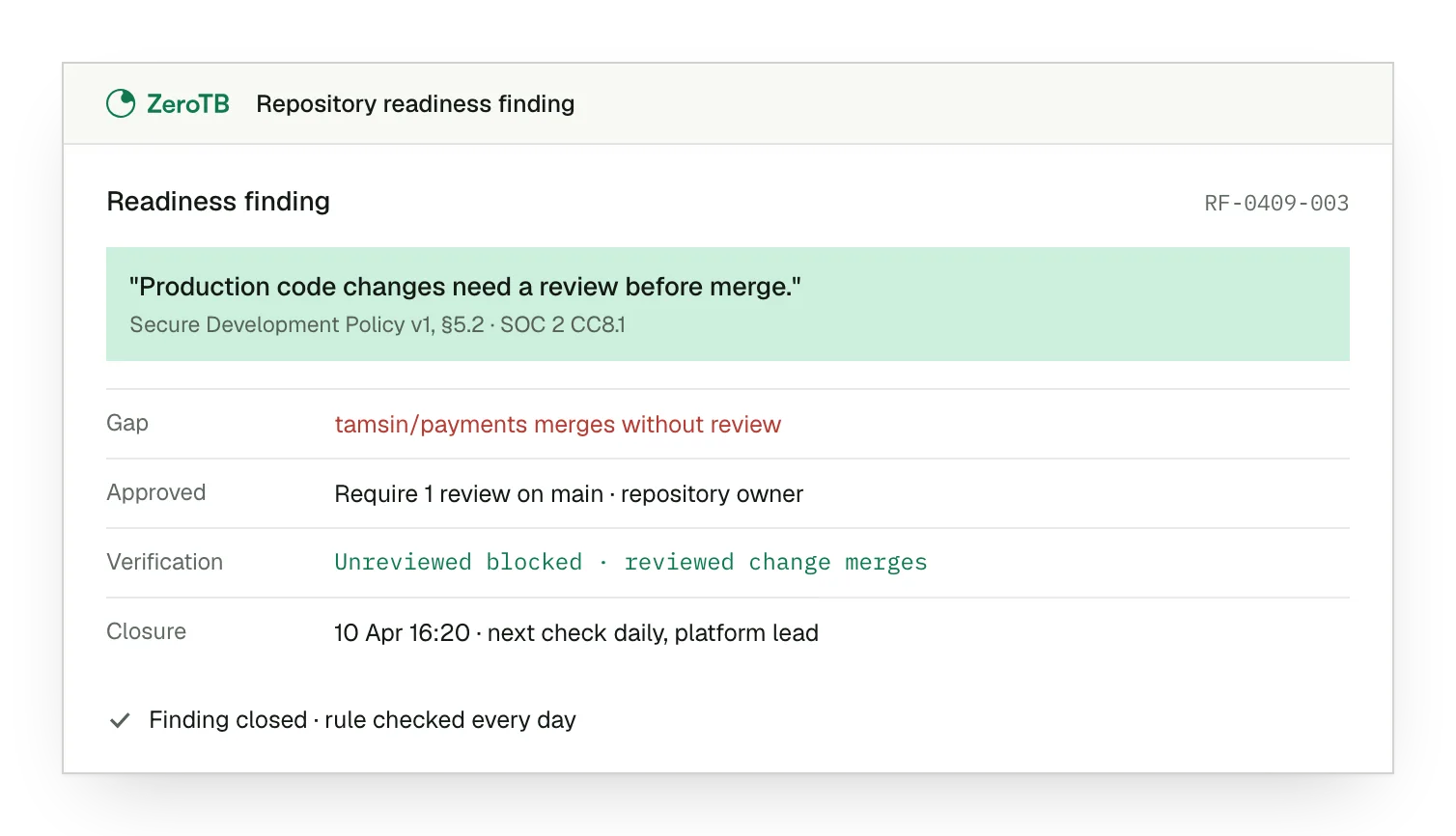
Observed review gap. The policy requires review, but the repository permits a change to merge without it.
Approved rule change. The repository owner approves a correction that requires review before a production change can merge.
Verification results. An unreviewed change is blocked, while a reviewed change can still follow the approved route.
Continuing checks. Dated results remain with the finding, and later checks inspect whether the rule still holds.
SOC 2 readiness checklist
Agree which service, systems and commitments the assessment covers, including changes since the previous review.
Follow each approved control into actual work and identify the observations that support its stated condition or activity.
Distinguish missing controls, failed operation and missing evidence so each finding has an owner and a clear corrective purpose.
Agree the intended result, approve the proposed action and retain the check that establishes the resulting control state.
Keep dated evidence and assign continuing checks so an owner investigates later changes and failed observations.
Sources
- AICPA & CIMA, System and Organization Controls: SOC Suite of Services, accessed 2026.
- AICPA & CIMA, 2017 Trust Services Criteria with revised points of focus, 2022 revision.
- ZeroTB, Recurring SOC 2 findings, 2026.
- ZeroTB, SOC 2 compliance automation, 2026.
Start with the Pilot
In the eight-week Pilot, our team maps up to 25 commitments and takes two real control gaps through verified restoration. Talk with us about the findings that remain open and how to keep the affected controls operating.